

Why These Two Numbers Matter So Much
Tyre pressure and tread depth are the only two points of contact between your vehicle and the road. Every braking, steering, and acceleration input passes through those four contact patches - roughly the size of a hand each. When either measurement falls outside the acceptable range, the consequences ripple through fuel economy, handling precision, braking distance, and long-term tyre wear.
Under-inflated tyres flex excessively, generating heat and wearing the outer edges of the tread faster than the centre. Over-inflated tyres ride on a reduced contact patch, prolonging braking distances and making the ride harsher. Insufficient tread depth - the channels that evacuate water from under the tyre - sharply reduces grip on wet surfaces, raising the risk of hydroplaning (where a layer of water lifts the tyre off the road surface).
Worn Tyres Dramatically Increase Stopping Distance
Independent testing by various automotive safety organisations has consistently shown that vehicles with worn tyres require significantly longer distances to stop in wet conditions compared to vehicles with adequate tread. Do not treat the 2/32-inch legal minimum as the safe threshold - consider replacement at 4/32 inch, particularly if you drive in rain or on wet roads regularly.
The good news: both checks are straightforward, require minimal equipment, and take under 20 minutes for the entire vehicle.
What You'll Need Before You Start
Gather the following before beginning. Having everything on hand avoids interruptions mid-check.
What you will need
Tyre Pressure Gauge
Measures the air pressure inside each tyre in PSI (pounds per square inch).
Portable Air Compressor
Allows you to inflate tyres to the correct pressure at home without visiting a service station.
Tread Depth Gauge
Provides a precise tread depth reading in 32nds of an inch, more accurate than the coin test.
US Penny or Quarter
Used for the coin tread-depth test as a quick visual indicator of remaining tread.
Step-by-Step: How to Check and Adjust Both
Follow these steps in order. Steps 1 through 4 cover tyre pressure; steps 5 and 6 cover tread depth and ongoing maintenance.
Let the tyres cool down
Tyre pressure rises as the rubber heats up during driving. For an accurate reading, park the vehicle and wait at least three hours before measuring. If you must check immediately after driving, note that your reading will be slightly higher than the true cold pressure - typically 4-6 PSI above resting values.
Find your vehicle's recommended pressure
Look for a sticker on the inside edge of the driver-side door jamb. It lists the recommended cold tyre pressure in PSI for both front and rear tyres. You can also find this figure in your owner's manual. Do not use the maximum pressure printed on the tyre sidewall - that is the tyre's structural limit, not the manufacturer's recommendation for your vehicle.
Measure the pressure in each tyre
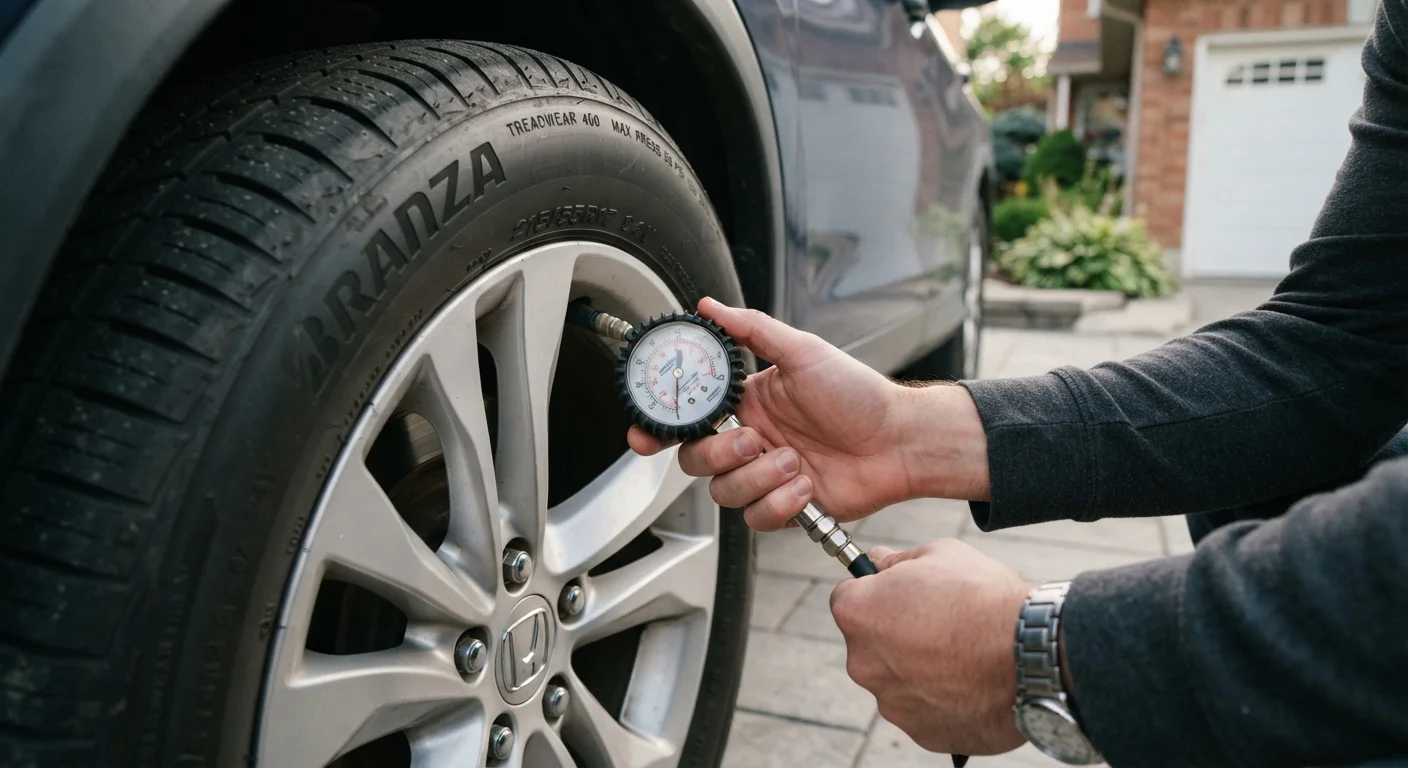
Remove the valve cap from the first tyre and store it somewhere safe. Press the gauge firmly and squarely onto the valve stem - a hissing sound means the seal is not complete, so reposition and try again. Read the displayed PSI value and compare it to your vehicle's recommendation. Repeat for all four tyres and the spare if accessible.
Inflate or deflate to the correct pressure
If a tyre is low, attach an air source and add air in short bursts, rechecking frequently to avoid over-inflation. If a tyre is over-inflated, use the small pin on the back of most pressure gauges - or the valve stem itself - to release air in brief increments, rechecking each time. Replace the valve cap securely when done.
Perform the coin tread-depth test
Insert a US penny into a tread groove with Lincoln's head pointing downward into the tyre. If the top of Lincoln's head is fully visible, the tread is at or below 2/32 inch - the legal minimum in most states and a sign the tyre should be replaced promptly. For an earlier warning, use a quarter: if the top of Washington's head is visible, tread is at or below 4/32 inch, meaning the tyres are approaching the replacement zone. Test several grooves across the tyre's width, as wear is often uneven.
Record your findings and set a reminder
Note the date, each tyre's pressure reading, and any tread observations. Most vehicle manufacturers recommend checking tyre pressure monthly and before long trips. Tread depth should be assessed at least every six months or whenever you notice handling changes, pulling to one side, or longer braking distances.
Monthly Checks Pay Off Year-Round
Tyre pressure drops roughly 1 PSI for every 10°F fall in ambient temperature, making autumn and winter checks especially important. A quick monthly check - taking less than five minutes with a gauge you keep in the glovebox - helps catch gradual pressure loss before it affects safety or fuel economy.
Understanding What Your Readings Tell You
Once you have your numbers, here is how to interpret them:
| Reading | What It Means | Action |
|---|---|---|
| Pressure within 1-2 PSI of recommendation | Normal operating range | No action needed |
| Pressure 5+ PSI below recommendation | Meaningful under-inflation | Inflate immediately; inspect for a slow leak |
| Pressure 5+ PSI above recommendation | Over-inflation | Release air to correct level |
| Tread at 4/32 inch (quarter test fails) | Approaching wear limit | Plan tyre replacement soon |
| Tread at 2/32 inch or below (penny test fails) | At or below legal minimum in most states | Replace tyres before further driving |
Never Rely on Visual Inspection Alone
A tyre can appear fully inflated while being 10 or more PSI below the recommended pressure. Modern run-flat and stiff-sidewall tyres are especially deceptive. Always use a calibrated gauge - visual checks will not reveal under-inflation until it becomes severe.
If one tyre consistently loses pressure faster than the others, have it inspected by a qualified tyre technician - it may have a slow puncture, a faulty valve stem, or a bead-seal issue that a visual check will not reveal.
The content on this site is for informational purposes only and is not a substitute for professional advice. Always consult a qualified professional for guidance specific to your situation.