

Why Tracking Works - and Why Most People Quit
Knowing your bank balance tells you where you stand. Tracking your spending tells you how you got there - and what to expect next. Without that transaction-level detail, most people are flying on instinct, and instinct tends to be overly optimistic about small purchases.
The reason most people abandon spending trackers isn't lack of motivation - it's friction. Systems that require too many steps, too many categories, or too much time get dropped within weeks. The goal is to build a system that's accurate enough to be useful and simple enough to sustain.
Understanding where each dollar fits starts with a solid foundation. If you haven't yet mapped out your household budget, our guide to the anatomy of a household budget is a useful starting point before you begin tracking in detail.
Don't Rely on Memory Alone
Studies consistently show that people underestimate their spending - especially on small, frequent purchases like coffee, snacks, and subscriptions. Without a written or digital record, your perception of where your money goes will almost always be optimistic. Recording transactions as close to real-time as possible dramatically improves accuracy.
Getting Started: Tools and Setup
Before your first transaction, you need two things: a method for recording and a set of categories for sorting. Neither has to be elaborate.
What you will need
Bank or credit card statements
Used to reconstruct past spending and verify current transaction records.
Budgeting app or spreadsheet
Your primary tool for logging, categorizing, and reviewing spending data.
Notebook or index cards
A paper-based alternative for logging transactions throughout the day.
Calendar or phone reminder
Used to schedule a recurring weekly spending check-in.
Start With One Category, Not All of Them
If full-scale tracking feels overwhelming, begin by logging just one category - dining out, groceries, or entertainment - for two weeks. This low-pressure entry point builds the habit without requiring a complete financial overhaul. Once tracking one area feels natural, adding others is much easier.
Discretionary spending - the flexible, non-essential portion of your budget - is usually where tracking reveals the most surprises. If you want a deeper understanding of what discretionary spending includes and why it matters, see our overview of discretionary spending.
Step-by-Step: Building Your Tracking Routine
These five steps take you from a blank page to a functioning, low-maintenance spending tracker. Work through them in order the first time; after that, steps three through five become your ongoing rhythm.
Avoid Over-Engineering Your System
It's tempting to build an elaborate spreadsheet with dozens of subcategories before you've tracked a single dollar. Overly complex systems tend to collapse within weeks. Start with five to seven broad categories and add detail only if you find you genuinely need it.
Choose a tracking method that fits your habits
There is no universally superior tracking format. A paper notebook works for people who carry one everywhere. A spreadsheet suits those who enjoy customizing their own system. A budgeting app appeals to anyone who wants automation and reminders built in. The only criterion that matters is whether you will actually use it. See our comparison of spreadsheets and apps for a practical breakdown of the trade-offs.
Set up five to seven spending categories
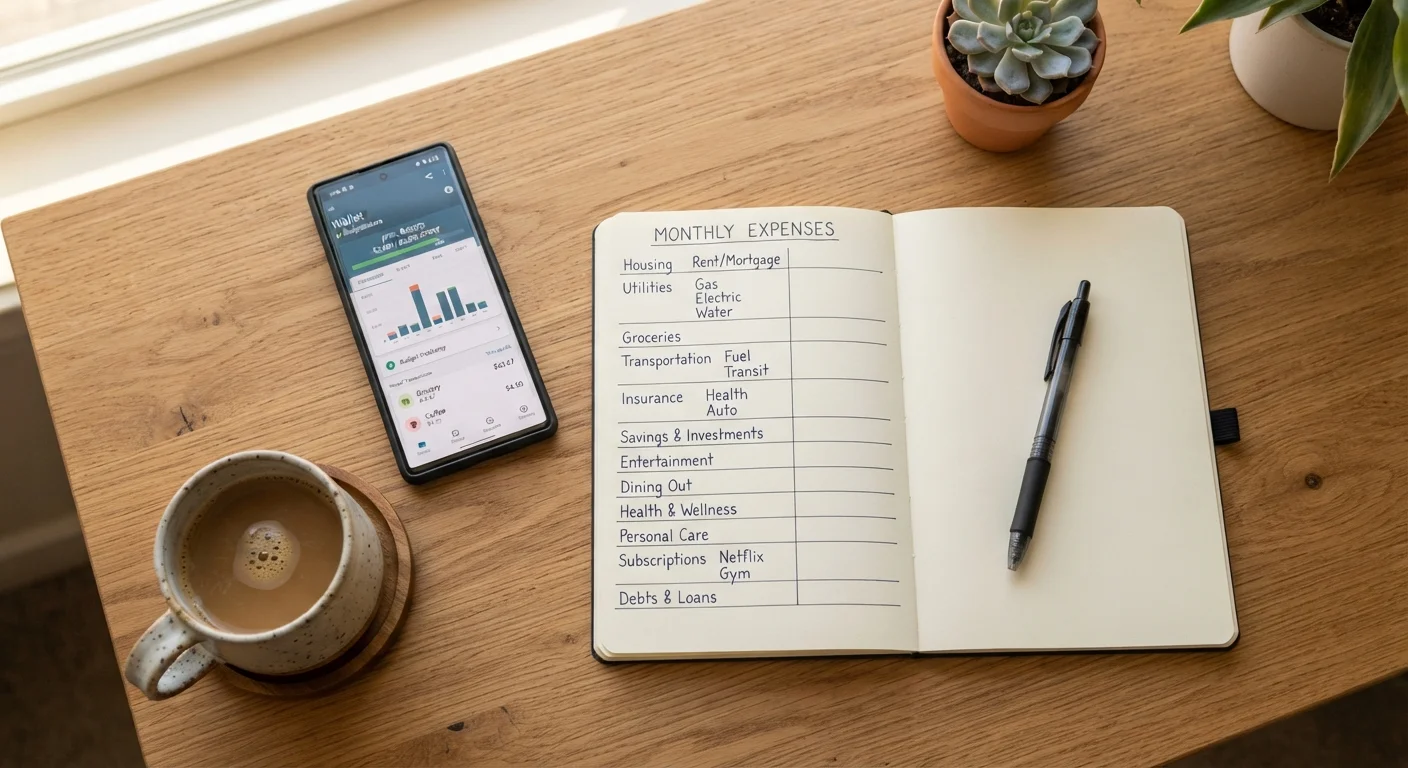
Categories give your raw transaction data meaning. Common starting categories include: Housing (rent or mortgage, utilities), Transportation (fuel, transit, parking), Groceries, Dining & Takeout, Health (copays, prescriptions), Entertainment & Subscriptions, and Miscellaneous. Keep categories broad enough that sorting transactions takes seconds, not minutes. You can always split a category later if patterns emerge that are worth separating - for example, once you notice dining out is its own significant line item.
Log every transaction - ideally in real time
Record each purchase as soon as it happens or within a few hours. Cash purchases are the most commonly forgotten; consider keeping a small notepad or using your phone's notes app to capture them immediately. At the end of each day, take 60 seconds to confirm everything is recorded. If same-day logging isn't realistic, aim to reconcile at least every two to three days using your bank's transaction history.
Conduct a weekly 10-minute check-in
Once a week - the same day each week works best - review what you've spent against your category targets. This doesn't need to be a formal session: scan your totals, note which categories are running high, and adjust the rest of the week accordingly. Catching a budget category that's 80% spent with two weeks left in the month gives you time to course-correct. Waiting until month's end gives you only a postmortem.
Do a monthly review and adjust your targets
At month's end, compare your actual spending in each category against what you planned. Look for patterns: are you consistently over in one area? Consistently under in another? Use this data to set more realistic targets for next month rather than simply repeating the same numbers. Our monthly budget reset guide walks through this review process in detail. Over time, your category targets should become an accurate reflection of how you actually live - not an aspirational fiction.
Making the Habit Stick
Tracking spending is a habit before it's a skill. The mechanical steps are simple; consistency is what requires effort. A few practices make a meaningful difference:
- Keep your tool visible. A budgeting app buried in a folder or a spreadsheet bookmarked under 'Misc' will be forgotten. Pin it, bookmark it prominently, or keep the notebook on your desk.
- Don't aim for perfection. Missing a day or losing a receipt doesn't mean the system has failed. Estimate what you can and keep going. An 85% accurate record is vastly more useful than no record at all.
- Connect spending to goals. Tracking feels more purposeful when each category maps to something you care about - paying down debt, building an emergency fund, or saving for a trip. Our saving and credit hub covers strategies for putting tracked savings to work.
For readers who want to make financial awareness a daily default rather than a deliberate effort, the habits that separate consistent budgeters is worth reading alongside this guide.
This article is for general informational purposes only and does not constitute personalized financial advice. Consult a qualified financial professional for guidance specific to your situation.
The content on this site is for informational purposes only and is not a substitute for professional advice. Always consult a qualified professional for guidance specific to your situation.