

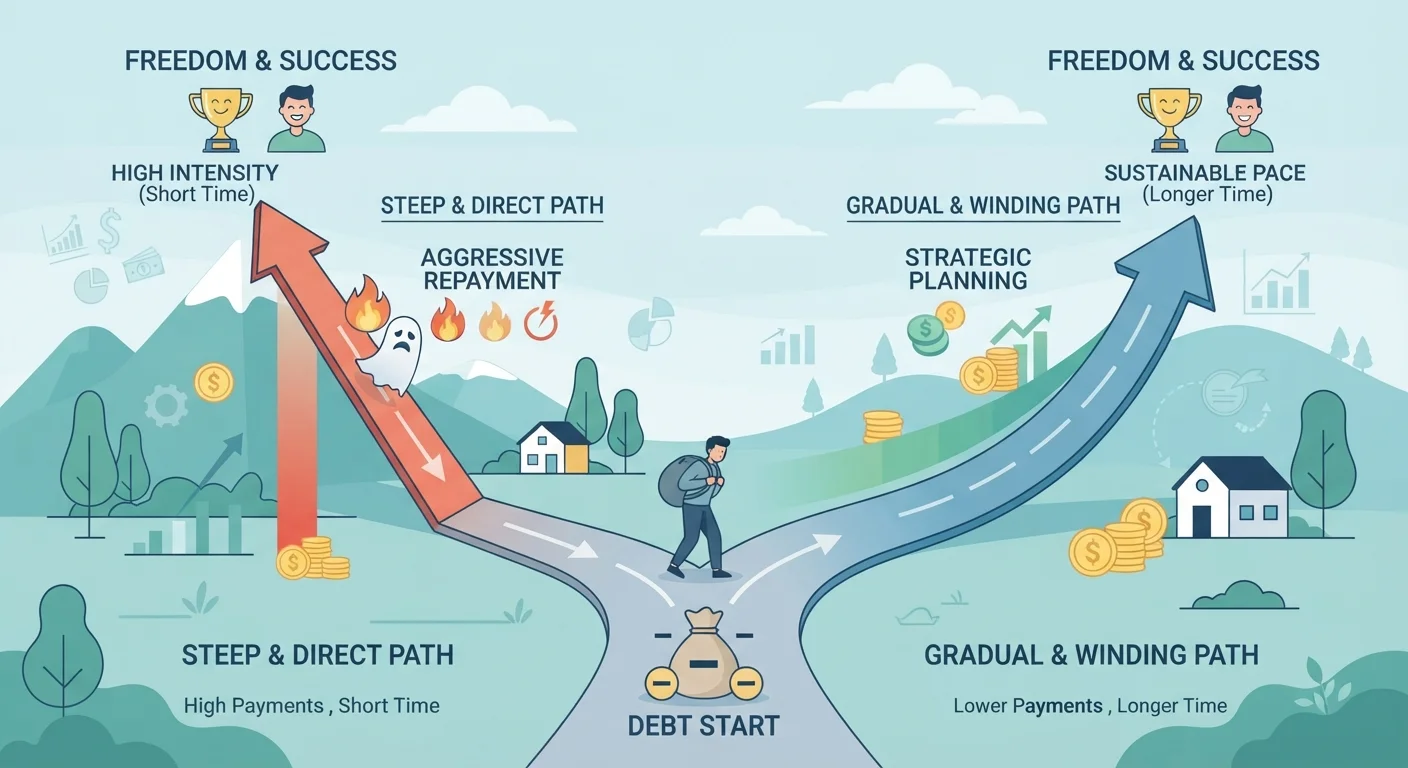
Option A
Debt Avalanche
The mathematically efficient, interest-minimizing approach.
Best for: Borrowers who are comfortable with delayed gratification and want to minimize total interest paid over time.
Option B
Debt Snowball
The momentum-driven, psychologically rewarding approach.
Best for: Borrowers who need early wins to stay motivated and build consistent repayment habits.
How Each Method Structures Your Payments
Both methods share the same foundation: you make minimum payments on every debt except one, then direct any extra money toward that priority debt. The difference lies entirely in how you pick which debt gets that extra attention.
With the Debt Avalanche, you rank your debts from highest interest rate to lowest. The account charging the most interest receives all extra funds first. Once it's paid off, you roll that freed-up payment amount into the next highest-rate account - and so on. This sequence is designed to reduce the total interest you'll pay across all accounts.
With the Debt Snowball, you rank debts from smallest balance to largest, regardless of interest rate. You eliminate the smallest account first, then apply that payment to the next smallest. Each paid-off account adds momentum - like a snowball picking up mass as it rolls downhill.
| Criterion | Debt Avalanche | Debt Snowball |
|---|---|---|
| Priority order | Highest interest rate first | Smallest balance first |
| Total interest paid | Lower over time | Potentially higher |
| Time to first payoff | Longer (if high-rate debt is large) | Shorter (small balances clear fast) |
| Motivational structure | Delayed gratification | Early, frequent wins |
| Best suited for | Disciplined, numbers-focused borrowers | Habit-building, motivation-driven borrowers |
| Complexity | Simple - rank by rate | Simple - rank by balance |
Neither approach requires you to earn more money. Both work by recycling payments: once one debt is gone, its minimum payment becomes extra firepower for the next. This compounding repayment effect is what drives both strategies forward.
The Real-World Trade-Off: Math vs. Motivation
The avalanche is the more efficient strategy on paper. By targeting high-rate debt, you slow down the rate at which interest accumulates across your accounts. Over months or years, that difference can add up to meaningful savings - sometimes hundreds of dollars depending on balances and rates.
But efficiency only matters if you stay the course. The snowball's strength is behavioral: early payoffs deliver a concrete sense of progress. Research in consumer behavior consistently suggests that visible milestones help people maintain long-term commitments. For borrowers who have previously abandoned repayment plans, that psychological structure can be genuinely valuable.
~$1,000+
Potential interest savings with the avalanche
Estimates vary widely by balance and rate mix, but choosing high-rate debt first can meaningfully reduce total interest on balances in the thousands.
40%
Adults carrying credit card debt month-to-month
According to Federal Reserve survey data, a significant share of US cardholders do not pay their full balance each month, making interest-rate strategy consequential.
It's worth noting that certain debt habits can quietly undermine either strategy. Patterns like paying only minimums or missing months can extend repayment timelines significantly, regardless of which method you're following. Staying consistent with your chosen approach is the non-negotiable element.
For borrowers juggling many accounts, it may also be worth understanding what debt consolidation does - and doesn't - fix before deciding whether to use an avalanche or snowball at all. Consolidation changes the structure of your debt; these two methods work within the structure you already have.
Choosing the Right Approach for Your Situation
There's no universal answer, but a few honest questions can help point you in the right direction:
- Do you have high-rate debt like credit cards? If one account carries a significantly higher rate than the others, the avalanche often makes sense - the interest savings are concrete and sizable.
- Do you have several small balances? The snowball can clear those accounts quickly, simplifying your monthly obligations and reducing the number of creditors you're managing.
- Have you tried and quit a repayment plan before? That's a signal worth taking seriously. The snowball's early wins may help you build the habit before the numbers catch up.
Some borrowers use a hybrid: they start with the snowball to eliminate one or two small accounts, then switch to the avalanche once they feel confident. There's nothing wrong with that approach as long as you're still making minimums on everything and directing extra funds deliberately.
For a broader framework on staying consistent, see principles for managing debt without losing ground - which covers practices that support steady progress regardless of which payoff method you use. And if you're still building the savings habits that help you maintain a repayment buffer, the Saving & Credit hub is a useful starting point.
This article is for general informational purposes only and does not constitute personalized financial advice. For guidance tailored to your specific situation, consider consulting a qualified financial professional.
The content on this site is for informational purposes only and is not a substitute for professional advice. Always consult a qualified professional for guidance specific to your situation.