

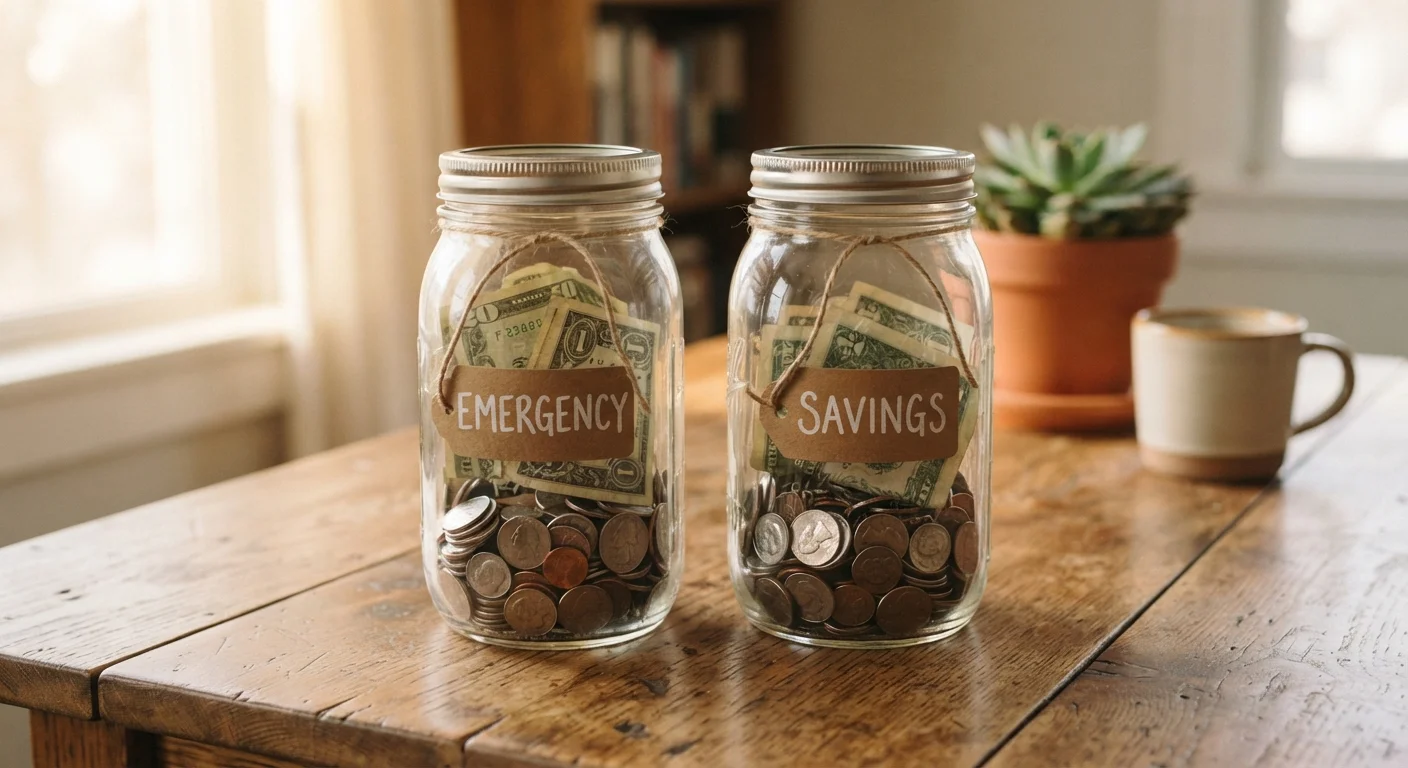
Option A
Emergency Fund
The financial safety net for life's unexpected moments.
Best for: Covering sudden, unavoidable expenses like job loss, medical bills, or urgent car repairs without going into debt.
Option B
General Savings Account
The flexible tool for planned financial goals.
Best for: Accumulating money toward defined goals such as a vacation, home down payment, or new appliance.
What Sets These Two Goals Apart
At first glance, an emergency fund and a general savings account look nearly identical - both hold cash, both may sit in a bank, and both are separate from your daily checking account. But their purpose is fundamentally different, and that difference shapes how you build them, how large they should be, and when you are allowed to touch them.
An emergency fund is a dedicated reserve for genuine financial emergencies: sudden job loss, an unexpected medical cost, a critical home repair, or a car breakdown that prevents you from getting to work. It is not a source of funds for planned expenses, no matter how important those expenses feel. Its defining feature is liquidity - the money must be accessible within one to two business days - and its defining rule is that it exists only for true emergencies.
A general savings account, by contrast, is a goal-oriented pool of money. You build it with a specific target in mind - a vacation, a down payment, new furniture, or a semester of tuition. Unlike an emergency fund, spending it down is the plan. When you reach your goal, you use the money as intended and start again.
| Criterion | Emergency Fund | General Savings Account |
|---|---|---|
| Primary purpose | Cover unexpected financial shocks | Fund a specific planned goal |
| Typical target size | 3-6 months of essential expenses | Defined by the goal amount |
| When to withdraw | True emergencies only | When the goal milestone is reached |
| Liquidity requirement | High - accessible within 1-2 days | Moderate - timeline depends on goal |
| Spending it down | Unplanned - replenish after use | Planned - spending it is the goal |
| Mindset | Protection and stability | Progress toward a defined outcome |
How Much You Need in Each
Sizing your emergency fund is fairly straightforward in principle. Most financial educators suggest covering three to six months of essential living expenses - rent or mortgage, utilities, groceries, insurance, and minimum debt payments. If your income is variable, you work in a seasonal industry, or you are the sole earner in your household, erring toward the six-month end is generally prudent.
~57%
Americans unable to cover a $1,000 emergency from savings
A Bankrate survey found that a majority of U.S. adults would need to borrow money or use credit to handle an unexpected $1,000 expense.
3-6 months
Recommended emergency fund coverage
Financial educators and consumer protection agencies broadly recommend this range as the baseline for a meaningful emergency cushion.
General savings targets are entirely personal and vary by goal. A vacation fund might need $2,000; a home down payment fund might need $40,000. The key is to define a concrete number and timeline so you can calculate how much to set aside each month. Goals without specific targets tend to drift.
If you are starting from zero, building your first emergency fund step by step is a practical place to begin, especially when your budget feels stretched. Even saving $500 to $1,000 as an initial milestone meaningfully reduces the chance you will reach for a credit card when something goes wrong.
Managing Both at the Same Time
The most common question people face is whether to build the emergency fund first or split contributions between both goals simultaneously. There is no universal answer, but a reasonable starting framework is this: prioritize your emergency fund until it holds at least one month of essential expenses, then begin splitting contributions.
Keeping the two funds in separate accounts - even at the same bank - is one of the most effective structural choices you can make. When emergency savings and goal savings share the same balance, the boundaries blur. A compelling sale or a minor inconvenience can start to feel like an emergency when the money is right there. Separation creates a psychological barrier that supports better decisions.
Automation helps both goals progress without relying on willpower. Setting up two automatic transfers on payday - one to your emergency fund and one to your goal savings - removes the friction of deciding each month. For a closer look at how to structure that, see automating your savings and the trade-offs worth understanding before you set it up.
Does the Account Type Matter?
Both your emergency fund and your goal savings can live in the same type of account - typically a high-yield savings account for the interest advantage. What matters is the label and the rule you attach to each balance, not the account structure itself. Some people use two separate accounts at the same institution; others use sub-account or 'bucket' features offered by their bank. Either approach works as long as the separation is clear to you. See how high-yield and traditional savings accounts compare to decide which account type suits both goals.
For broader context on where each fund fits within your monthly budget, the budgeting basics hub covers how to allocate income across competing priorities in a way that is sustainable long term.
This article is for general informational and educational purposes only and does not constitute personalized financial advice. Consult a qualified financial professional regarding decisions specific to your situation.
The content on this site is for informational purposes only and is not a substitute for professional advice. Always consult a qualified professional for guidance specific to your situation.