

Start here
What Home Audio Actually Means
Next
Core Components: Speakers, Receivers, and Sources
Then
Understanding Speaker Wiring Basics
Almost there
Placing Your Speakers for Better Sound
Put it together
Getting Started: A Simple First Setup
What Home Audio Actually Means
Home audio refers to any system designed to reproduce sound - music, movies, podcasts, games - inside a home environment. Unlike the tiny speakers built into a TV or laptop, a dedicated audio system gives you control over volume, tone, and spatial sound that simply isn't possible from factory-built drivers.
The term covers a wide range: a pair of powered bookshelf speakers on a desk qualifies, and so does a multi-room surround system with a dozen components. This guide focuses on the fundamentals that apply across all of them. For a broader look at home electronics - including TVs and smart devices - see our comprehensive home electronics overview.
Receiver
A device that combines an amplifier, radio tuner, and input switcher in one box, used to power speakers and route audio from multiple sources.
Passive speaker
A speaker with no built-in amplifier; it must be connected to a separate amplifier or receiver to produce sound.
Active (powered) speaker
A speaker with an amplifier already built into its cabinet, so it only needs a direct audio signal - no separate receiver required.
Impedance
A measurement in ohms that describes how much electrical resistance a speaker presents to an amplifier; matching compatible impedance ratings helps prevent distortion or hardware damage.
Polarity
The correct alignment of positive (+) and negative (−) terminals between a receiver and speakers; reversing polarity degrades audio quality.
Two-channel stereo
An audio setup using exactly two speakers - left and right - representing the most common and straightforward home listening configuration.
Core Components: Speakers, Receivers, and Sources
Every home audio system, regardless of complexity, connects three basic building blocks.
- Source: The device that produces the audio signal - a phone, streaming player, turntable, or TV.
- Amplifier or receiver: A receiver is an amplifier with a built-in radio tuner and often an HDMI switcher. The amplifier stage takes a low-level audio signal and boosts it to a level that can drive speakers. A stereo receiver handles two channels (left and right); an AV (audio/video) receiver handles five, seven, or more channels for surround sound.
- Speakers: The physical drivers that convert electrical signals into sound waves. Passive speakers need external amplification; active or powered speakers have an amplifier built into the cabinet.
When shopping or researching, you may encounter terminology like "watts per channel," "THD" (total harmonic distortion), and "sensitivity." Our plain-English home theater glossary is a useful reference if any spec label leaves you puzzled.
Start With Two Channels
If you're new to home audio, a two-channel stereo system is the most forgiving place to begin. It's easier to wire, simpler to calibrate, and still delivers excellent sound quality for music and everyday listening. You can always expand to surround sound later once you understand the basics.
Understanding Speaker Wiring Basics
Passive speakers connect to a receiver through speaker wire - typically two conductors (positive and negative) bundled together. The single most important wiring rule is polarity: the positive terminal on the receiver must connect to the positive terminal on each speaker, and the same for negative. Reversing polarity on one speaker causes the drivers to move out of phase with each other, which audibly hollows out the bass and stereo image.
Speaker wire is labeled in a few ways: one conductor may have a stripe, ridge, or printed text to distinguish positive from negative. Always check both ends before securing cables.
Always Check Polarity Before Powering On
Connecting speaker wire with reversed polarity won't necessarily damage equipment, but it will noticeably degrade your sound - particularly bass response and stereo imaging. Double-check that positive-to-positive and negative-to-negative connections are correct at both the receiver and the speaker terminals before turning on the system.
For most living-room runs under 50 feet, 16-gauge wire is adequate. Longer runs or high-power setups may benefit from 14- or 12-gauge wire. The gauge number works inversely - lower numbers mean thicker wire with less resistance.
Placing Your Speakers for Better Sound
Placement influences how a system sounds more than most beginners expect. A few principles apply broadly regardless of speaker type.
- Ear level: Ideally, the tweeters (high-frequency drivers, usually a small dome at the top of the cabinet) should be roughly at ear height when you are seated in your primary listening position.
- Toe-in: Angling speakers slightly inward toward the listening seat - a practice called toe-in - can improve stereo imaging and focus the sound.
- Distance from walls: Placing speakers very close to a rear wall can artificially boost bass and create muddiness. Pulling them a foot or more away often clarifies the sound, though this depends on the speaker design.
- Symmetry: Keep left and right speakers equidistant from the listening position and from side walls where possible.
Experimentation costs nothing. Move speakers by small increments and listen to familiar material to develop your ear for the changes.
Getting Started: A Simple First Setup
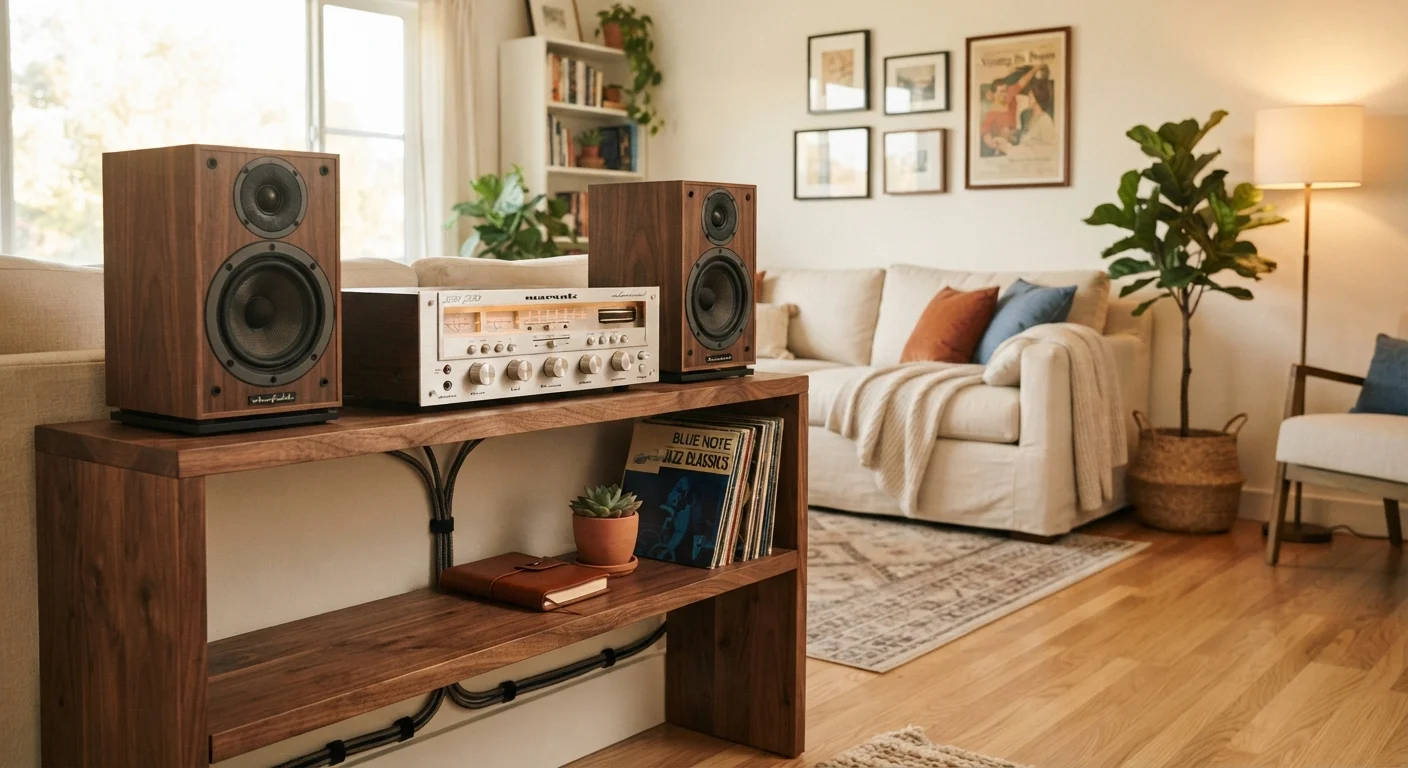
The most practical entry point for new listeners is a two-channel stereo system: a stereo receiver paired with two passive bookshelf speakers, or simply a pair of powered bookshelf speakers connected to any audio source. Two-channel audio is well-suited to music and smaller rooms, and it avoids the complexity of surround calibration.
A straightforward starting checklist looks like this:
- Choose your source - phone via Bluetooth, a streaming device via optical or RCA, or a TV audio output.
- Determine whether you want powered speakers (simpler, fewer cables) or a receiver-and-passive-speaker combination (more expandable).
- Run speaker wire carefully, noting polarity at every termination point.
- Set receiver volume low before powering on, then gradually raise it.
- Listen, reposition speakers as needed, and adjust tone controls (bass and treble) if available on your receiver.
There is no single "correct" system - the right setup is the one that fits your room, habits, and listening preferences. Start simple, learn what you enjoy, and expand from there.
Home Theater Jargon Decoded
A plain-English glossary covering common home audio and home theater terms - useful when researching receivers, speakers, and specs.
Everything Home Electronics
A broad reference covering TVs, audio systems, streaming devices, and smart home basics for consumers building out their home setup.
Frequently Asked Questions
Most TVs don't output enough power to drive passive speakers on their own. You generally need a receiver or amplifier between your TV and passive speakers. Active (powered) speakers, however, can connect directly to a TV's audio output without an amplifier.
Passive speakers have no built-in amplifier and require a separate receiver or amp to power them. Active (or powered) speakers have an amplifier built into the cabinet and only need an audio signal input, such as from a phone, computer, or TV.
For most home listening setups with runs under 50 feet, 16-gauge wire is a practical and widely recommended choice. Thicker wire (lower gauge number, like 14 or 12) is generally used for longer cable runs or high-power systems.
Impedance, measured in ohms, describes how much electrical resistance a speaker presents to an amplifier. Most home speakers are rated at 4, 6, or 8 ohms. Matching your receiver's supported impedance range to your speakers helps avoid distortion or damage to the amplifier.
A subwoofer is not required to enjoy music or movies at home - a good pair of bookshelf or floor-standing speakers can reproduce a satisfying range of sound. A subwoofer primarily extends the low bass frequencies and tends to add more value in home theater contexts than in basic stereo music listening.
Yes, Bluetooth speakers function as self-contained active systems and are easy to integrate into any room. They are convenient but typically offer less audio fidelity than wired setups at a comparable price point, and they require periodic charging or a power outlet.
The content on this site is for informational purposes only and is not a substitute for professional advice. Always consult a qualified professional for guidance specific to your situation.