

What Tire Rotation Actually Does
Every tire on your vehicle wears differently depending on its position. Front tires carry the weight of the engine and handle steering forces, so they typically wear faster - especially on the outer edges. Rear tires, in contrast, wear more evenly but at their own rate.
Tire rotation solves this by physically relocating each tire to a different position - moving front tires to the rear, switching sides, or following a pattern specified by the manufacturer. The goal is to distribute wear more evenly across all four tires, extending their overall lifespan and keeping the vehicle's handling consistent.
Rotation is a straightforward procedure that most shops complete quickly. It does not involve any adjustment to how the wheels are angled or how the suspension is set up - it simply moves the tires around. For questions about which tasks you can handle yourself versus what belongs in a shop, see our guide to DIY car maintenance.
Check Your Owner's Manual First
Rotation patterns vary by vehicle - front-wheel drive, rear-wheel drive, and all-wheel drive vehicles often require different patterns. Your owner's manual specifies the correct rotation pattern and interval for your car. Following the manufacturer's guidance helps ensure you get the full benefit of each rotation.
What Wheel Alignment Actually Does
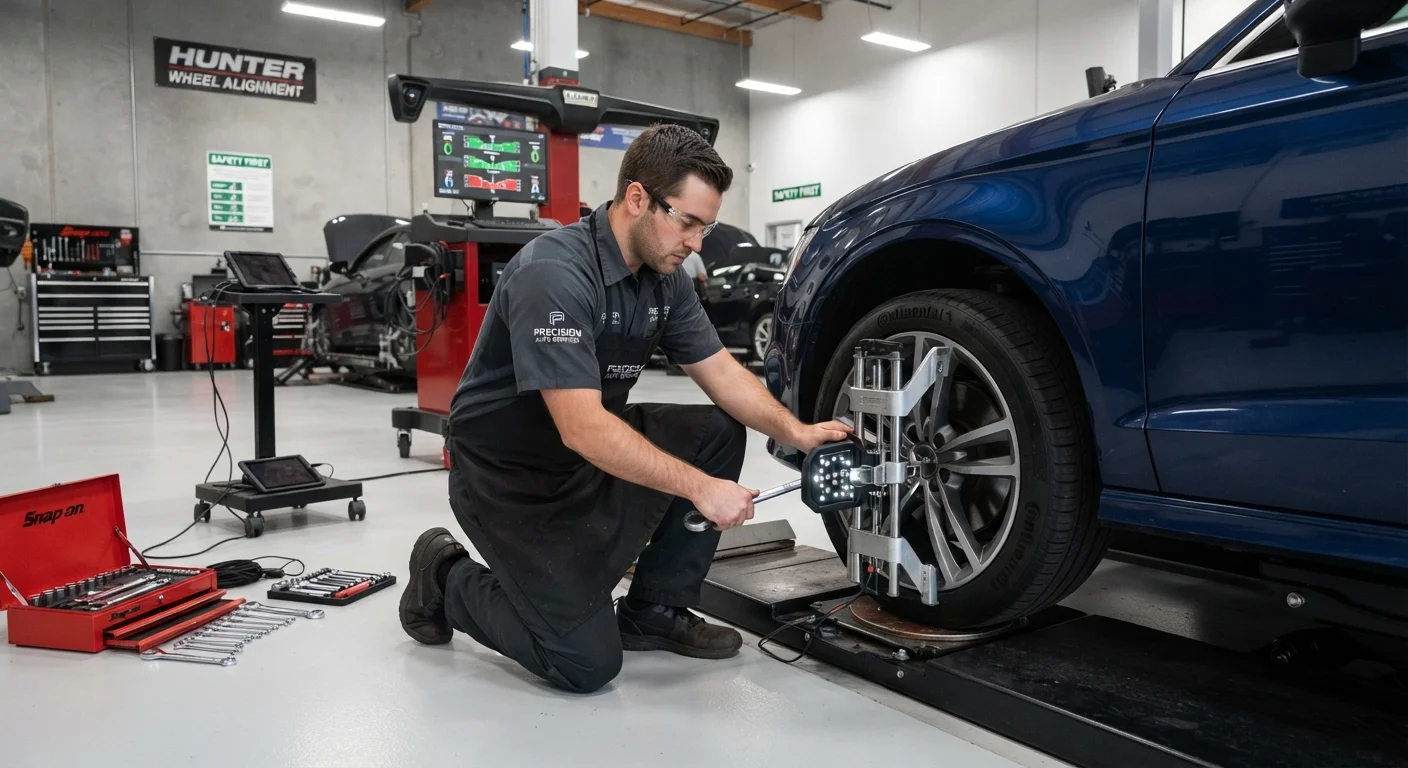
Wheel alignment is a completely different type of service. It involves measuring and adjusting the angles at which your tires meet the road. These angles - known as toe (whether tires point inward or outward), camber (the vertical tilt of the tire), and caster (the steering axis angle) - are set by the manufacturer to precise specifications.
Over time, normal driving gradually shifts these angles. Hitting potholes, striking curbs, or simply accumulating mileage on worn suspension components can accelerate the process. When wheels fall out of alignment, the vehicle may pull to one side, the steering wheel may sit crooked on a straight road, and tires can begin wearing unevenly in patterns that rotation cannot correct.
Alignment work is performed on specialized equipment that measures each wheel's angles precisely and makes mechanical adjustments to bring them back into specification. This is not something that can be done in a driveway - it requires a professional alignment rack.
~$75-$100
Typical cost of a wheel alignment
Industry estimates from auto service providers suggest a standard two-axle alignment generally falls in this range, though prices vary by region and vehicle type.
5,000-7,500 mi
Recommended tire rotation interval
This range reflects common manufacturer guidance; always confirm the interval in your vehicle's owner's manual, as it can vary by drivetrain and tire type.
Why Confusing the Two Can Cost You
The mix-up is understandable - both services involve your tires and both are typically offered at the same types of shops. But treating them as the same service, or skipping one in favor of the other, has real consequences.
If your wheels are misaligned and you only rotate tires, the misalignment continues causing uneven wear. You'll burn through tires faster, and the vehicle may continue to handle poorly. Conversely, if you keep your alignment in check but never rotate, the front tires will wear out significantly sooner than the rears, forcing premature replacement.
Neither service replaces the other. Think of rotation as keeping all four tires aging at the same rate, and alignment as making sure every tire is doing its job correctly in the first place.
How to Keep Both on Your Maintenance Schedule
Most vehicle manufacturers recommend tire rotation every 5,000 to 7,500 miles - roughly every other oil change for many drivers. Wheel alignment is typically recommended once a year, or any time you notice pulling, a crooked steering wheel, or after a significant impact.
Your owner's manual is the most reliable guide for your specific vehicle. When scheduling either service, ask the shop to inspect the tires for unusual wear patterns - this can signal alignment problems even before other symptoms appear.
Staying current on both services protects your investment in tires, keeps the vehicle handling safely, and can prevent more expensive suspension repairs down the road.
This article is for general informational purposes only. For guidance specific to your vehicle, consult your owner's manual or a qualified mechanic.
Frequently Asked Questions
Yes - these are separate services and can be done independently. Rotation is recommended more frequently, while alignment is typically checked annually or after a hard impact like hitting a pothole. A shop may inspect alignment during a rotation, but one does not automatically include the other.
Common signs include the vehicle pulling to one side while driving straight, a steering wheel that sits off-center when the car is going straight, or uneven tire wear - particularly wear on one edge only. If you notice any of these, have alignment checked by a qualified mechanic.
It can. A significant impact from a pothole, curb strike, or minor collision can shift suspension components enough to throw your alignment off. It's a good idea to have alignment checked after any major road impact.
Most vehicle manufacturers recommend rotation every 5,000 to 7,500 miles, though your owner's manual is the most reliable guide for your specific vehicle. Many drivers rotate tires at every other oil change as a convenient reminder.
Rotation helps prevent uneven wear by equalizing how much work each tire does. However, if misalignment is the cause of the uneven wear, rotation alone won't solve the problem - the alignment issue must be corrected first.
The content on this site is for informational purposes only and is not a substitute for professional advice. Always consult a qualified professional for guidance specific to your situation.