

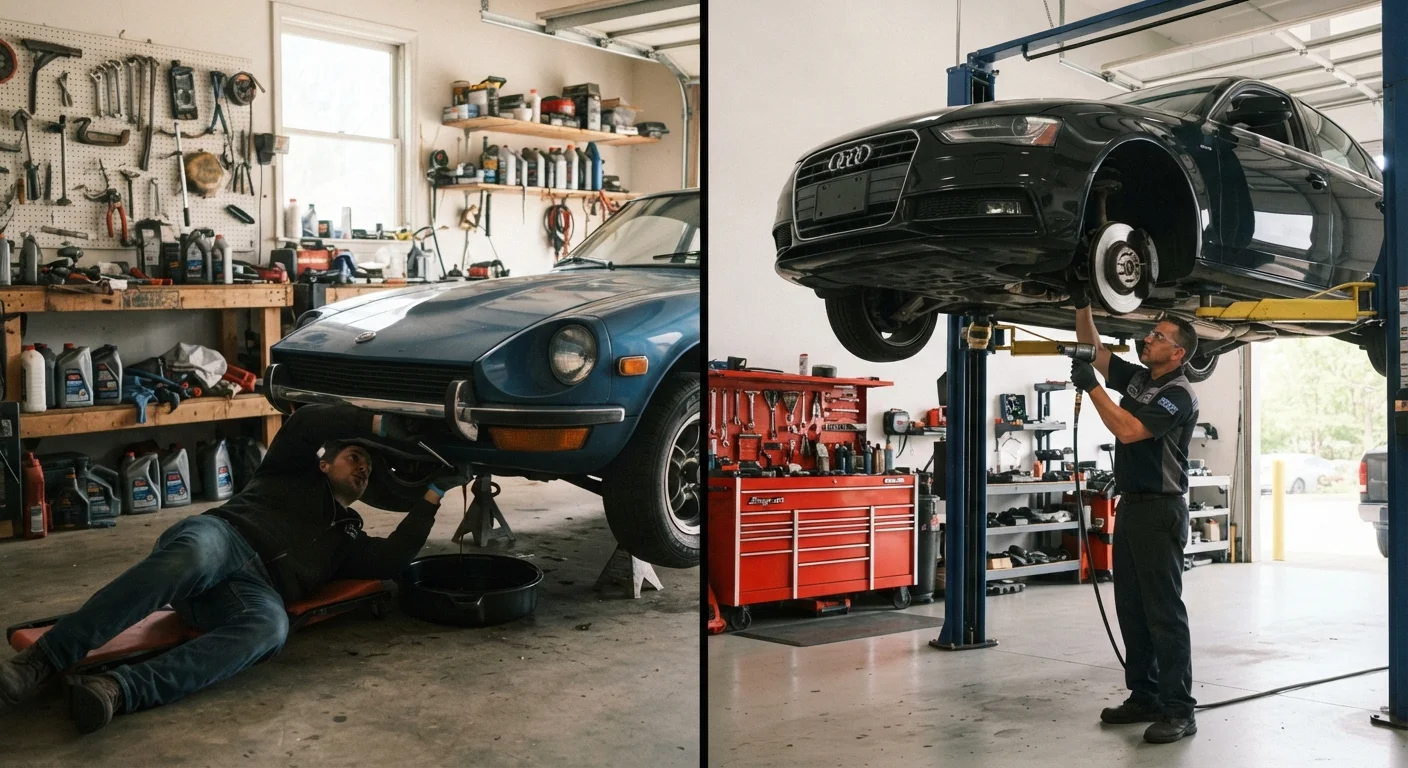
Our Verdict
DIY maintenance makes practical sense for routine, low-risk tasks where the tools are affordable and the margin for error is forgiving. For anything involving brakes, steering, fuel, or advanced electronics, the safety stakes and diagnostic complexity make a qualified shop the smarter call. Most car owners benefit from doing both - handling the simple stuff themselves while building a relationship with a trusted mechanic for the rest.
| Best for | Recommended |
|---|---|
| Routine, low-risk upkeep like fluid checks and filter swaps | DIY |
| Safety-critical systems including brakes, suspension, and steering | Professional Shop |
| Owners with limited tools or time who want reliable results | Professional Shop |
| Experienced home mechanics comfortable with diagnosis and proper torque specs | DIY |
Why the DIY vs. Shop Question Matters
Car ownership involves a steady stream of maintenance decisions, and each one carries the same underlying question: can I do this myself, or do I need a professional? Getting that call right saves money, protects your safety, and keeps your vehicle running longer.
The honest answer is that both approaches have a legitimate place in a smart maintenance routine. The key is understanding where the line sits. Tackle the wrong job without proper training or tools, and you risk turning a minor service into an expensive repair - or worse, a safety hazard on the road. For a broader look at building a routine that works, see our car maintenance schedule guide.
| DIY at Home | Professional Shop | |
|---|---|---|
| Cost | Lower parts cost; tool investment required | Higher labor cost; no tool investment needed |
| Suitable task types | Filters, fluids, wipers, battery terminals | Brakes, suspension, timing belt, diagnostics |
| Safety risk on complex jobs | High if skills or tools are lacking | Low - trained technicians and proper equipment |
| Time required | Varies; includes research and learning curve | Faster for complex work; wait time possible |
| Warranty and liability | May affect warranty on newer vehicles | Typically maintains warranty compliance |
| Diagnostic capability | Limited without professional scan tools | Full system diagnostics available |
Tasks Most Owners Can Safely Handle at Home
A number of routine maintenance jobs require basic tools, minimal mechanical experience, and carry a low risk of serious error. These are generally good candidates for DIY:
- Engine air filter replacement: Typically involves opening a clip-secured housing and swapping the filter. No special tools required.
- Windshield wiper blades: Most wiper arms use a simple tab-release mechanism. The replacement blades come with instructions.
- Checking and topping off fluids: Engine oil, coolant, brake fluid, and washer fluid all have clearly marked reservoirs under the hood. Checking levels is straightforward; adding fluid requires using the correct type specified in your owner's manual.
- Cabin air filter: Usually accessible behind the glove box, this filter keeps dust and pollen out of the interior. Replacement takes about ten minutes in most vehicles.
- Battery terminal cleaning: Corrosion on battery terminals can cause starting problems. Disconnecting and cleaning them with a wire brush is manageable for most owners - just disconnect the negative terminal first.
These tasks share a common trait: a mistake is usually obvious immediately and rarely creates a secondary safety problem. If you're new to car ownership, our guide for new drivers walks through the essential habits to build early.
Always Start With Your Owner's Manual
Before attempting any maintenance task, check your vehicle's owner's manual for the correct fluid types, filter specifications, and service intervals. Using the wrong oil grade or filter can do more harm than skipping the service entirely. The manual also flags tasks that require dealer-specific procedures - a useful signal that a job may be beyond straightforward DIY scope.
Jobs That Belong at a Professional Shop
Other maintenance and repair tasks involve systems where an error can have serious consequences - either for your safety or for downstream components that become far more expensive to fix. These generally require a qualified mechanic:
- Brake pad and rotor service: Brakes are the most safety-critical system on your vehicle. Improper installation, incorrect torque, or leaving air in brake lines can cause brake failure. This work should be done by a professional unless you have verified, hands-on experience.
- Suspension and steering components: Worn ball joints, tie rods, or shocks affect how your car handles in emergency situations. Diagnosing which part has failed requires lifting the vehicle safely and knowing what to look for.
- Timing belt or chain replacement: This is precision work with zero margin for error. A timing belt installed incorrectly can cause catastrophic engine damage within minutes of starting.
- Fuel system repairs: Working on fuel lines or injectors involves flammable materials under pressure. This is not a job for improvisation.
- Advanced diagnostics: Modern vehicles rely heavily on electronic control systems. Diagnosing fault codes properly often requires professional scan tools and training that goes beyond a basic OBD-II reader.
Don't Rely on YouTube Alone for Safety-Critical Repairs
Video tutorials can be a helpful supplement, but they vary significantly in accuracy and may not reflect your specific vehicle's requirements. For brake, suspension, or fuel system work, a video walkthrough is not a substitute for proper training and calibrated tools. If you're uncertain about any step in a safety-critical repair, stop and take the vehicle to a qualified mechanic.
It's also worth noting that some repairs - if done incorrectly - can void warranty coverage or affect your insurance claim in the event of an accident. When in doubt, a diagnostic visit to a shop is almost always worthwhile. Skipping maintenance entirely carries its own serious risks; learn how deferred maintenance shortens engine life.
Honest Cost and Time Tradeoffs
DIY maintenance is often framed purely as a money-saver, but the real calculation is more nuanced. You'll need to factor in the cost of tools (a quality floor jack and jack stands alone can run $150-$300), the time investment in learning the job, and the risk of a mistake that requires professional correction anyway.
For truly simple tasks - wiper blades, air filters, top-offs - DIY almost always makes financial sense. For moderately complex jobs like an oil change, it depends on how often you do it and whether you already have the equipment. For anything involving safety systems, the liability of getting it wrong typically outweighs the labor cost savings.
A useful parallel exists in home improvement: the same logic that governs when to hire a licensed electrician for wiring work applies here. Our guide on DIY electrical work risks explores that line in detail. Also, don't overlook tire-related services - tire rotation and wheel alignment are distinct services that are easy to confuse but both important to keep current.
~35%
US car owners who perform some DIY maintenance
Consumer surveys consistently show a significant share of US drivers handle at least some routine maintenance themselves, most commonly oil changes and filter replacements.
2-4x
Potential cost multiplier when DIY repairs go wrong
Industry repair data suggests that amateur errors on moderate-complexity jobs can double or quadruple the total repair cost compared to professional service from the outset.
The content on this site is for informational purposes only and is not a substitute for professional advice. Always consult a qualified professional for guidance specific to your situation.