

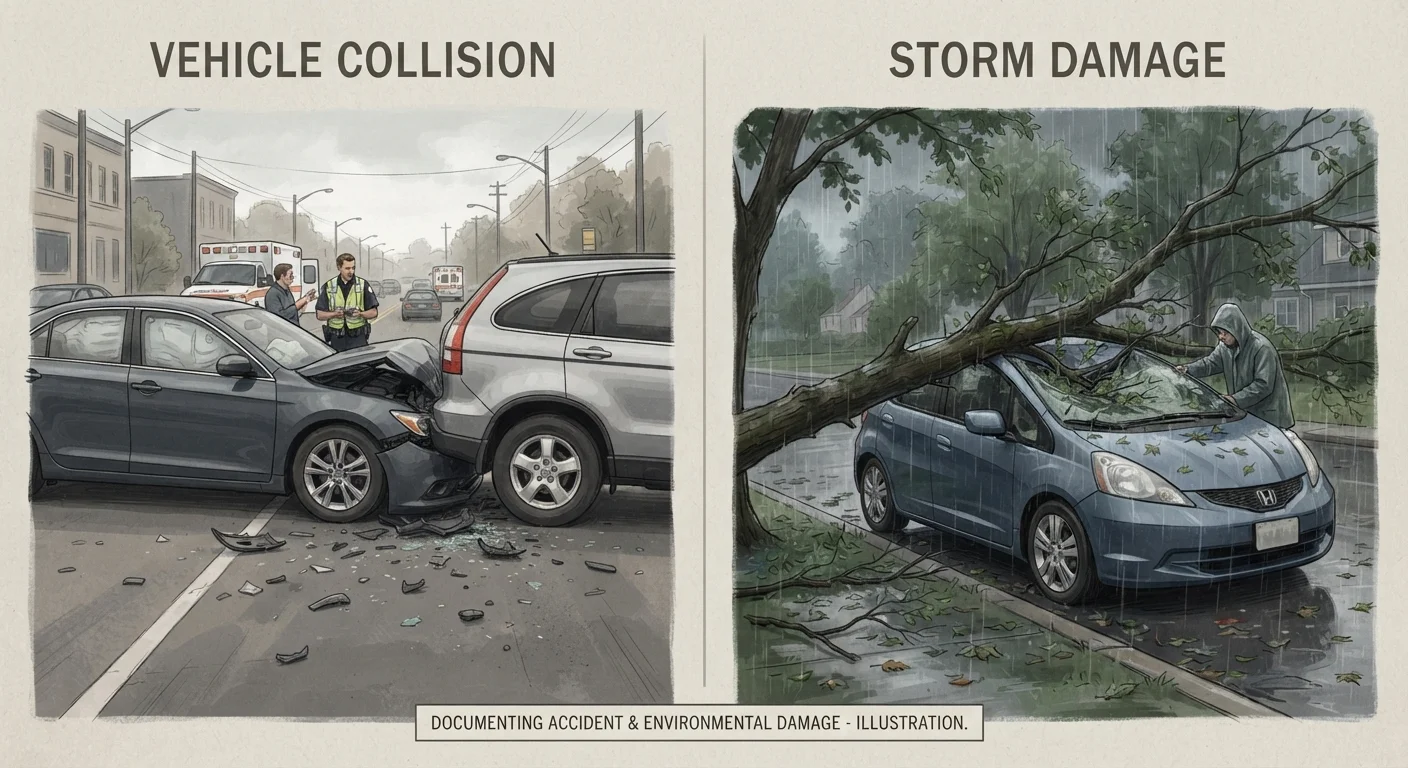
Option A
Collision Coverage
Protection for damage caused by driving incidents.
Best for: Drivers who want financial protection when their vehicle is damaged in an accident involving another car or object.
Option B
Comprehensive Coverage
Protection for damage caused by events outside your control.
Best for: Drivers in areas prone to severe weather, wildlife, or vehicle theft who want coverage beyond road accidents.
What Collision Coverage Actually Covers
Collision coverage pays for repairs to your vehicle - or its actual cash value if totaled - when your car is damaged in a driving incident. This includes hitting another vehicle, striking a guardrail, running into a fence, or rolling your car. The key factor is that the vehicle was in motion and made contact with something.
What collision coverage does not include: damage from weather events, theft, hitting an animal, or vandalism. Those fall under a completely different policy type. It also doesn't cover injuries to you or other parties - that's handled by medical payments or liability coverage.
After a collision claim, you pay your chosen deductible (a predetermined out-of-pocket amount, commonly ranging from $250 to $1,000), and your insurer covers the remaining eligible costs. A higher deductible generally lowers your monthly premium but increases what you owe if you file a claim.
For a deeper look at how insurers define damage eligibility and coverage limits, see our guide to auto insurance fine print.
| Criterion | Collision Coverage | Comprehensive Coverage |
|---|---|---|
| Trigger event | Vehicle hits another car or object | Non-collision event (weather, theft, animal) |
| Legally required | No (lenders may require it) | No (lenders may require it) |
| Covers theft | No | Yes |
| Covers weather damage | No | Yes |
| Covers animal strikes | No | Yes |
| Separate deductible | Yes | Yes |
| Pays out up to | Actual cash value of vehicle | Actual cash value of vehicle |
What Comprehensive Coverage Actually Covers
Despite its broad-sounding name, comprehensive coverage has a specific definition: it covers vehicle damage caused by events that are not a collision while driving. Insurers sometimes call this "other than collision" coverage, which is actually more descriptive.
Covered events typically include:
- Theft or attempted theft
- Vandalism
- Fire or explosion
- Falling objects (such as a tree limb or hail)
- Flooding or water damage
- Striking an animal (such as a deer)
- Civil disturbances or riots
Like collision, comprehensive comes with its own separate deductible. You can often choose different deductible amounts for each coverage type, giving you some flexibility in how you balance premiums against potential out-of-pocket costs.
One common misconception is that "full coverage" means everything is covered. In practice, "full coverage" is an informal term - not a policy type - and even carrying both collision and comprehensive leaves gaps. Common auto insurance myths like this one can lead to costly surprises at claim time.
Actual Cash Value: What It Means for Payouts
Both collision and comprehensive coverage pay out based on your vehicle's actual cash value (ACV) at the time of the loss - not its original purchase price or replacement cost. ACV accounts for depreciation, so an older vehicle may receive a significantly lower payout than expected. If your car is declared a total loss, your insurer's ACV calculation determines your settlement, not what you paid years ago.
How to Decide Whether You Need One, Both, or Neither
Neither collision nor comprehensive coverage is legally required by state law in the US - minimum state requirements typically address liability only. However, if you're financing or leasing your car, your lender will almost certainly require both until the loan is paid off.
For drivers who own their vehicle outright, the decision comes down to risk and value. A useful starting point: compare your annual premium for each coverage type against your vehicle's current market value. If the combined cost of premiums and your deductible approaches what the car is worth, carrying that coverage may not be financially advantageous.
~$290
Average annual cost of collision coverage
According to the National Association of Insurance Commissioners (NAIC), the average expenditure for collision coverage in the US has been approximately $290-$380 annually in recent data cycles, varying by state and driver profile.
~$168
Average annual cost of comprehensive coverage
NAIC data indicates comprehensive coverage tends to cost less than collision on average, though rates vary considerably based on location, vehicle type, and deductible chosen.
Your personal risk environment also matters. Drivers in regions prone to hailstorms, flooding, or high vehicle theft rates may find comprehensive coverage particularly valuable. Drivers with long daily commutes in congested areas may lean toward prioritizing collision.
For a parallel look at how different insurance types interact to protect an asset, the breakdown of homeowners insurance vs. home warranty coverage illustrates a similar "which type covers what" dynamic worth understanding.
The content on this site is for informational purposes only and is not a substitute for professional advice. Always consult a qualified professional for guidance specific to your situation.