

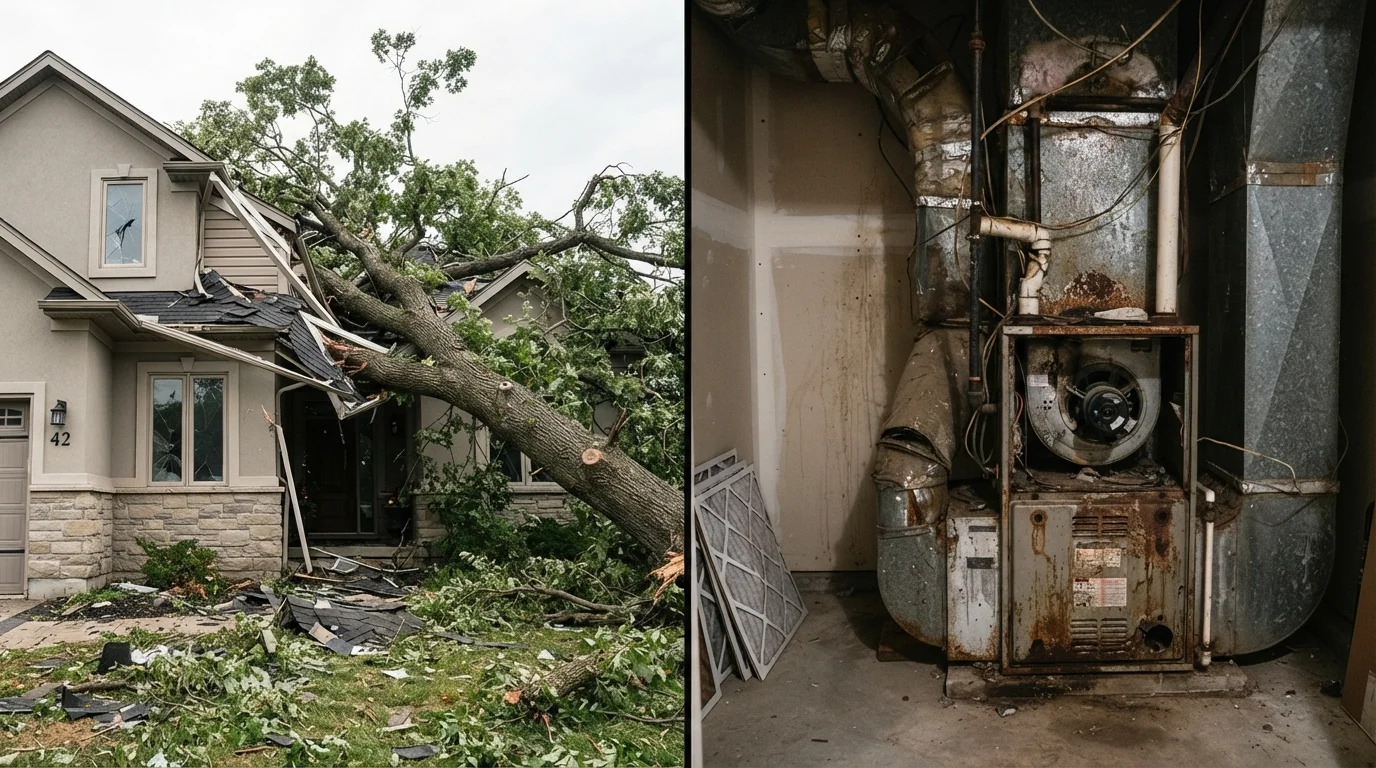
Option A
Homeowner's Insurance
Protection against sudden, unexpected damage or liability.
Best for: Homeowners who need coverage for catastrophic events like fires, storms, theft, and personal liability claims.
Option B
Home Warranty
A service contract covering mechanical wear and breakdown.
Best for: Homeowners who want predictable repair costs for aging appliances and home systems like HVAC, plumbing, and electrical.
The Core Distinction: Events vs. Wear
Homeowner's insurance and a home warranty are frequently lumped together in conversations about protecting your home. They are, in fact, completely different financial products designed to address completely different risks.
Homeowner's insurance is a true insurance policy. It protects against sudden, accidental losses - a fire that destroys your kitchen, a windstorm that tears off your roof, a burglar who steals valuables, or a guest who is injured on your property and sues. The trigger is always an unexpected event.
A home warranty is a service contract - not insurance. It steps in when covered systems or appliances break down through normal use and aging. When your 12-year-old furnace quits in January or your dishwasher stops mid-cycle, a home warranty typically arranges and subsidizes the repair or replacement through a network of contractors.
The simplest rule: if something broke because of an outside force, that is an insurance claim. If it broke because it is old and worn out, that is a warranty claim. Understanding this boundary prevents the frustrating mistake of filing a claim with the wrong provider - and being denied.
| Criterion | Homeowner's Insurance | Home Warranty |
|---|---|---|
| Product type | Insurance policy | Service contract |
| What triggers coverage | Sudden, unexpected events | Mechanical failure from normal use |
| What it covers | Structure, liability, personal property | Home systems and appliances |
| Required by lender | Yes, for mortgaged homes | No, always optional |
| Cost structure | Annual premium + deductible per claim | Annual fee + service call fee per visit |
| Covers flood damage | No (separate policy required) | No |
| Covers appliance breakdown | No | Yes, per plan terms |
| Covers liability injuries | Yes | No |
| Pre-existing conditions | Generally covered if properly disclosed | Typically excluded |
What Homeowner's Insurance Actually Covers
A standard homeowner's insurance policy - typically called an HO-3 policy in the US - bundles several types of protection into one contract.
- Dwelling coverage: Pays to repair or rebuild the physical structure of your home if it is damaged by a covered peril such as fire, lightning, windstorm, hail, or vandalism.
- Personal property coverage: Reimburses you for stolen or damaged belongings - furniture, electronics, clothing - up to your policy limits.
- Liability coverage: Covers legal costs and damages if someone is injured on your property or if you accidentally damage someone else's property.
- Additional living expenses (ALE): Pays for temporary housing and meals if a covered loss makes your home uninhabitable during repairs.
What it does not cover is equally important. Floods and earthquakes are standard exclusions requiring separate policies. Gradual damage - a slow roof leak over years, mold from poor ventilation - is also excluded. And critically, mechanical or appliance breakdown is never covered under a homeowner's policy.
Note that mortgage lenders in the US require homeowner's insurance as a condition of your loan. The coverage minimums they set typically protect the lender's interest, which is not always the same as full replacement cost for you. It is worth reviewing your dwelling coverage limit against current local construction costs, which can shift substantially over time.
Flood and Earthquake Coverage: Read the Fine Print
Standard homeowner's insurance policies in the US do not cover flood damage or earthquake damage. These require separate, standalone policies. Flood insurance is available through the National Flood Insurance Program (NFIP) and some private insurers. If your property is in a designated flood zone, your lender may require this coverage independently. Earthquake coverage is particularly important in seismically active states such as California, Oregon, and Washington.
What a Home Warranty Actually Covers
A home warranty contract - sometimes called a home service agreement - is purchased separately and renewed annually. Coverage varies significantly by plan and provider, but most contracts fall into predictable categories.
- Major systems: HVAC (heating and cooling), plumbing, electrical, and water heater are the most commonly covered systems.
- Appliances: Higher-tier plans often cover kitchen appliances (refrigerator, range, dishwasher), washer, dryer, and garbage disposal.
When a covered item fails, you contact the warranty company, pay a service call fee (typically $75-$125 per visit), and the company dispatches a contractor. If the item cannot be repaired, the warranty may pay toward replacement - though the replacement allowance may not cover the full cost of a modern equivalent.
Exclusions are the most important thing to read in any warranty contract. Common exclusions include pre-existing conditions at the time of purchase, improper installation, cosmetic defects, items not properly maintained, and anything located outside the main dwelling (detached garages, outdoor fixtures). Coverage caps per system or appliance are also standard - meaning a $2,000 HVAC replacement might only be partially subsidized.
Before signing, compare what each plan explicitly covers and excludes in writing. Warranty contracts are not standardized the way insurance policies are, so the variation between providers can be significant. Homeowners purchasing a previously owned home should be especially thorough, as pre-existing wear may immediately disqualify coverage on aging systems. For a related look at how inspections can reveal system conditions before purchase, see our guide on home inspections vs. appraisals.
How the Two Work Together
Because the two products cover non-overlapping risks, many homeowners carry both simultaneously - and for good reason. Consider a common scenario: a severe hailstorm cracks your roof, and the water intrusion damages your attic insulation. That is a homeowner's insurance claim. Two months later, your aging water heater finally fails. That is a home warranty claim. Neither product would have helped you with the other's situation.
When evaluating whether both make sense for your household, consider the age and condition of your home's major systems and appliances. A newly constructed home with builder warranties still active may not benefit immediately from a home warranty. An older home with original systems approaching end-of-life is a much stronger candidate.
It is also worth understanding that homeowner's insurance is general financial education and not a substitute for advice tailored to your specific property and risk profile. For decisions about coverage levels and policy types, consulting a licensed insurance professional is advisable.
Similarly, just as insurance concepts apply across contexts, understanding how structured protections work can help in other ownership scenarios. Our overview of renters insurance illustrates how analogous principles apply to tenants rather than owners.
This article is for general informational purposes only and does not constitute insurance, legal, or financial advice. Coverage terms vary by policy and provider. Consult a licensed insurance professional for guidance specific to your situation.
The content on this site is for informational purposes only and is not a substitute for professional advice. Always consult a qualified professional for guidance specific to your situation.