

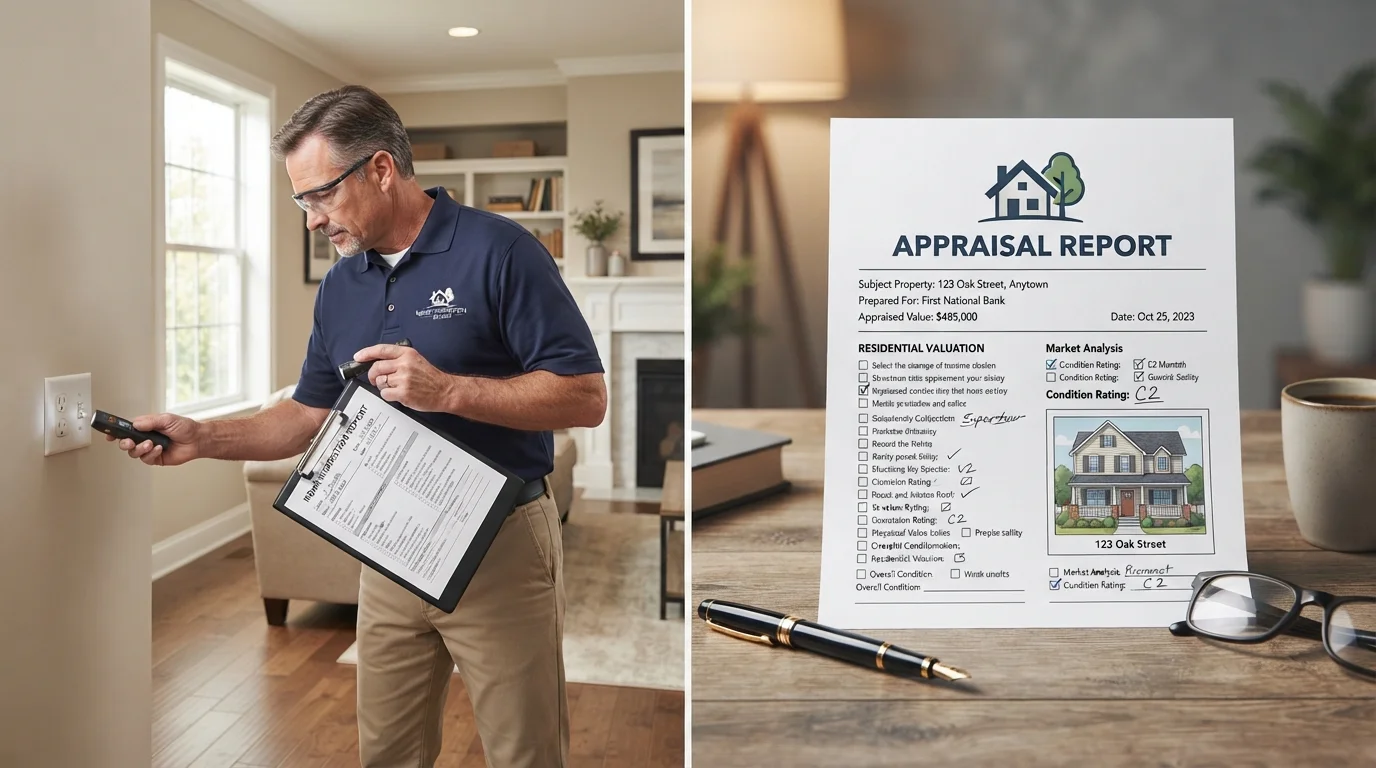
Option A
Home Inspection
The buyer-focused physical condition check.
Best for: Buyers who want to understand the true physical condition of a property before committing to purchase.
Option B
Home Appraisal
The lender-required market value assessment.
Best for: Lenders - and buyers - who need an independent confirmation that a property's price reflects its fair market value.
What Each Evaluation Actually Does
It's easy to see why buyers confuse these two - both involve a professional visiting the home and producing a report. But they answer completely different questions.
A home inspection asks: What is the physical condition of this property? A licensed home inspector walks through the home methodically, examining the roof, foundation, electrical systems, plumbing, HVAC, insulation, windows, and more. The goal is to surface defects, safety hazards, and deferred maintenance that may not be visible during a standard showing. The resulting report is detailed and technical - our guide on reading your inspection report without feeling overwhelmed can help you interpret findings with confidence.
A home appraisal asks: What is this property worth in the current market? A state-licensed appraiser evaluates the home's size, condition, location, and features, then compares it to recently sold similar properties - called comparables or comps - to arrive at a fair market value estimate. This figure is what the lender uses to determine how much it will finance.
| Criterion | Home Inspection | Home Appraisal |
|---|---|---|
| Primary question answered | What condition is the property in? | What is the property worth? |
| Who orders it | The buyer | The lender |
| Who pays | The buyer (directly) | The buyer (via closing costs) |
| Who conducts it | Licensed home inspector | State-licensed appraiser |
| Typical focus | Physical systems, structure, safety | Market value using comparable sales |
| Required by lender? | No (but strongly advisable) | Yes, for most mortgage types |
| Can affect negotiation? | Yes - repair requests or credits | Yes - if value is below purchase price |
Who Orders It and Who Pays
The ordering and payment structure for each evaluation differs - and understanding this matters when you're managing closing costs.
The home inspection is ordered by the buyer, typically right after an offer is accepted and before the inspection contingency deadline. Buyers select their own licensed inspector and pay directly, with fees varying by region and property size. Because you're the client, you receive the full report and can share it with your agent or attorney.
The home appraisal is ordered by the lender, not the buyer - though buyers almost always pay the fee as part of closing costs. The lender selects an appraiser from an approved panel to preserve independence, so buyers generally cannot choose their own. The appraisal protects the lender's financial interest, but buyers benefit from the findings too, particularly if the appraised value comes in lower than the purchase price.
~$300-$500
Typical home inspection cost (US average)
Costs vary significantly by region, property size, and inspector; larger or older homes may cost more.
~$300-$450
Typical home appraisal fee (US average)
The Consumer Financial Protection Bureau notes appraisal fees vary by location, home complexity, and lender requirements.
It's also worth noting that neither process is a substitute for the other. A strong appraisal doesn't mean the roof is in good condition. And a clean inspection report doesn't mean the seller's asking price reflects what the market will support. For a fuller picture of costs and process steps, see our overview of details buyers often overlook before closing.
How Each Can Affect Your Purchase
Both evaluations carry real financial stakes, though they affect the transaction in different ways.
An inspection that surfaces major issues - a cracked foundation, outdated electrical panels, a failing HVAC system - gives buyers documented leverage. You can request the seller make repairs, reduce the price, or offer a credit at closing. In some cases, serious findings may lead a buyer to walk away and recover their earnest money under an inspection contingency clause. Understanding this protection is part of being a prepared buyer; our article on what mortgage pre-approval actually means covers other key contingencies worth knowing.
An appraisal that comes in below the agreed purchase price - known as a low appraisal - can stall or derail a deal. Lenders will not finance more than the appraised value, so the buyer would need to make up the difference in cash, renegotiate the price with the seller, or, in some cases, walk away. Neither outcome is ideal, which is why understanding market conditions before making an offer is valuable preparation.
Inspection Contingencies Protect Buyers
Most purchase contracts include an inspection contingency, giving buyers a set window - commonly 7 to 14 days - to complete an inspection and decide how to proceed. If significant problems surface and the seller won't negotiate, this contingency typically allows the buyer to exit the deal and recover their earnest money. Always review contingency timelines carefully with your real estate agent or attorney.
If you're also thinking about protecting the home after you've purchased it, the distinctions explored here carry over into post-closing decisions - like understanding the difference between homeowner's insurance and a home warranty, two protections that are just as commonly confused. See our breakdown of what each actually covers.
This article is for general informational purposes only and does not constitute legal, financial, or real estate advice. Consult a licensed real estate professional for guidance specific to your situation and local market.
The content on this site is for informational purposes only and is not a substitute for professional advice. Always consult a qualified professional for guidance specific to your situation.