

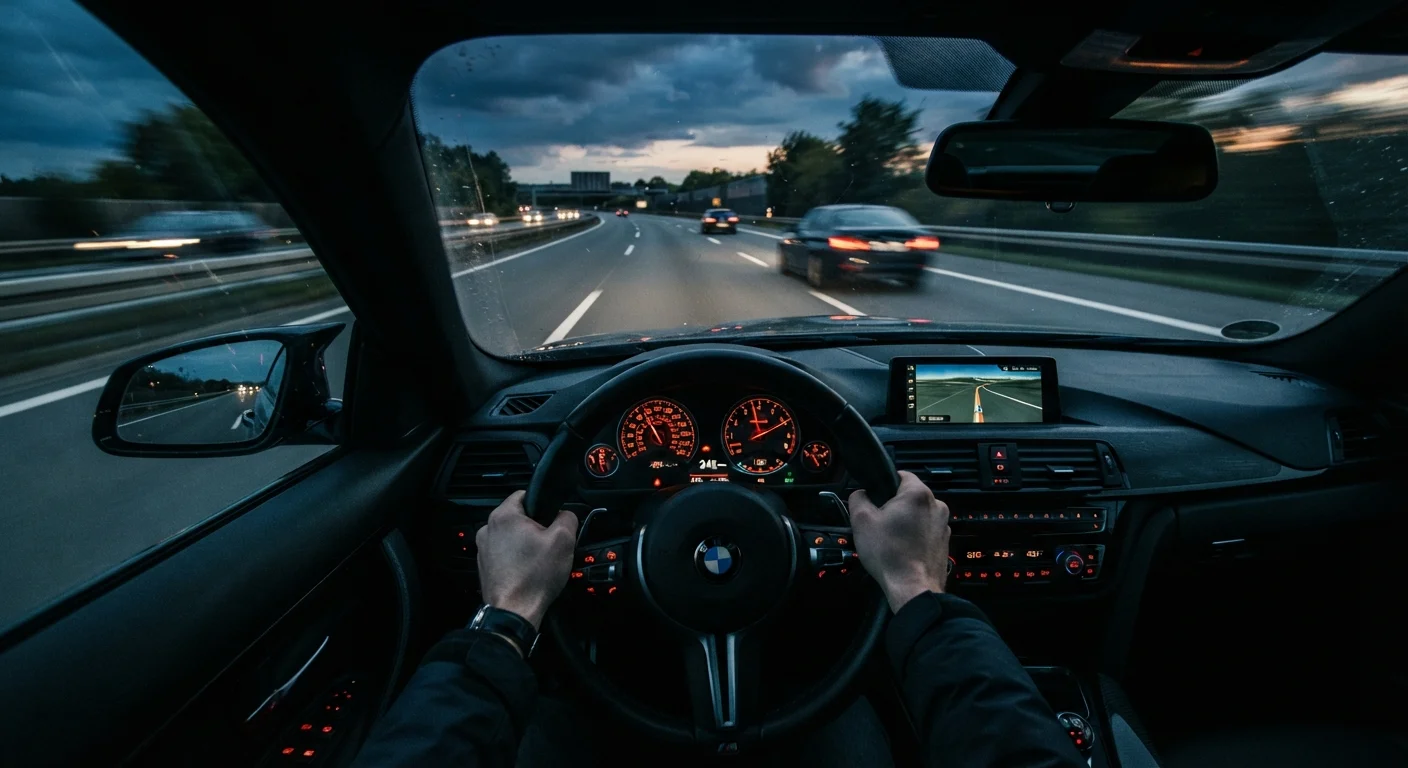
The Gap Between Seeing and Stopping
Most drivers understand that higher speeds mean longer stopping distances - but fewer appreciate exactly when stopping actually begins. There are two distinct phases: reaction distance (how far you travel before your foot hits the brake) and braking distance (how far you travel once the brakes are applied). Speed compounds both.
A driver first must perceive a threat, then mentally process it, then physically move their foot. That chain takes time - typically between 1.5 and 2.5 seconds for an alert, unimpaired driver. During every one of those seconds, the vehicle moves unimpeded at its current speed.
88 ft/sec
Distance traveled per second at 60 mph
A standard conversion used in traffic engineering to calculate reaction and stopping distances.
1.5-2.5 sec
Typical driver perception-reaction time
Range cited in traffic safety research for alert, unimpaired drivers under normal conditions.
4×
Braking distance increase when speed doubles
Because kinetic energy scales with the square of velocity, doubling speed roughly quadruples braking distance needed to stop.
How Reaction Distance Scales with Speed
The math is straightforward but striking. To convert mph to feet per second, multiply by 1.467. Here's what that means in practice:
- 25 mph: ~37 feet per second. A 1.5-second reaction covers roughly 55 feet before braking - more than half the length of a typical city intersection.
- 45 mph: ~66 feet per second. The same reaction time equals about 99 feet of uncontrolled travel.
- 60 mph: ~88 feet per second. Reaction distance alone approaches 132 feet - nearly half a football field.
- 75 mph: ~110 feet per second. With a 2-second reaction, you've covered 220 feet before the brakes engage.
Braking distance then adds further. Because braking force must overcome kinetic energy - which increases with the square of speed - doubling your speed roughly quadruples the braking distance needed. The combined total stopping distance grows faster than most drivers intuitively expect.
What Degrades Your Reaction Time
Reaction time isn't fixed. It varies based on driver state and environment, often in ways that aren't obvious in the moment.
Check Your Own Alertness Before Driving
If you've slept fewer than six hours or feel mentally foggy, your reaction time may already be meaningfully slower than normal - even if you feel functional. When possible, delay driving or reduce speed and following distance to create a larger margin of safety. No deadline justifies the risk created by severely impaired reaction time.
Fatigue is one of the most underestimated factors. Research consistently shows that driving after 20 or more hours without sleep produces impairments comparable to a blood-alcohol level above the legal limit in most U.S. states. Critically, fatigued drivers often underestimate how impaired they are.
Distraction - including hands-free phone use - diverts cognitive resources away from the driving task. Visual distractions remove your eyes from the road; cognitive distractions slow your recognition of what you're looking at. Either adds precious fractions of a second to your reaction chain.
Alcohol and certain medications slow neural processing and physical coordination simultaneously. Even a mild impairment can push reaction time past 3 seconds - during which, at 60 mph, a vehicle travels over 260 feet.
Understanding these compounding risks is central to defensive driving principles - which emphasize anticipating hazards early precisely because reaction time cannot be eliminated.
Following Distance as a Practical Buffer
The primary tool drivers have to compensate for reaction time is following distance. The widely taught three-second rule - maintaining at least three seconds of gap between you and the vehicle ahead - is a minimum under good conditions. At highway speeds or in poor weather, safety experts recommend extending that to four or five seconds.
A three-second gap at 60 mph translates to roughly 264 feet of space. That's enough to absorb a 1.5-second reaction time and still leave meaningful braking room. Reduce that gap, and the buffer disappears faster than most drivers can respond.
Adjusting following distance based on speed, visibility, and your own alertness level is one of the most practical and immediate ways to reduce stopping-distance risk on any road.
This article is for general informational purposes. Always comply with local traffic laws and consult official driver resources for guidance specific to your state.
Frequently Asked Questions
Most drivers have a perception-reaction time between 1.5 and 2.5 seconds under normal conditions. This window covers noticing a hazard, interpreting it, deciding to brake, and moving your foot to the pedal. Impairment, distraction, or fatigue can push this well beyond 3 seconds.
At 60 mph, a vehicle covers roughly 88 feet per second. With a 1.5-second reaction time, that's about 132 feet traveled before braking even starts. Add braking distance on top of that, and total stopping distance can exceed 300 feet.
Speed doesn't change how quickly your brain and body respond, but it dramatically increases how far you travel during that fixed response window. Higher speeds turn the same reaction time into a much longer and more dangerous reaction distance.
Following too closely leaves little or no buffer to absorb reaction time and braking distance. At 70 mph, if you're only two car lengths back, a sudden stop ahead gives you essentially no margin - a collision becomes nearly unavoidable before braking is complete.
Drowsiness, alcohol, certain medications, mobile phone use, and general cognitive distraction all degrade reaction time. Even hands-free phone conversations have been shown in research studies to slow driver response compared to focused driving.
The content on this site is for informational purposes only and is not a substitute for professional advice. Always consult a qualified professional for guidance specific to your situation.