

What Defensive Driving Actually Means
Most drivers assume defensive driving means being cautious - keeping below the speed limit and leaving a little extra space. That understanding is incomplete. Defensive driving is a structured, proactive approach to managing risk on the road. It requires anticipating hazards before they materialize, maintaining vehicle control under unexpected conditions, and recognizing that other road users may behave unpredictably.
The National Safety Council and traffic safety researchers describe defensive driving as making safe decisions regardless of the conditions around you - including the mistakes of other drivers. This positions the defensive driver as an active participant in preventing crashes, not merely a passive follower of traffic rules.
Defensive driving also intersects with vehicle condition. A well-maintained car responds better in emergency situations - see our car maintenance basics guide for an overview of what to keep up with. Driving defensively starts before you even turn the key.
Treat Every Green Light as a Question
Before accelerating through a green light, briefly confirm that cross-traffic has cleared. This habit - sometimes called 'covering the brake' as you approach - takes less than a second and addresses one of the most common intersection crash scenarios. Green means you have the legal right of way; it does not guarantee the intersection is clear.
Scanning Far Ahead: The Foundation of Anticipation
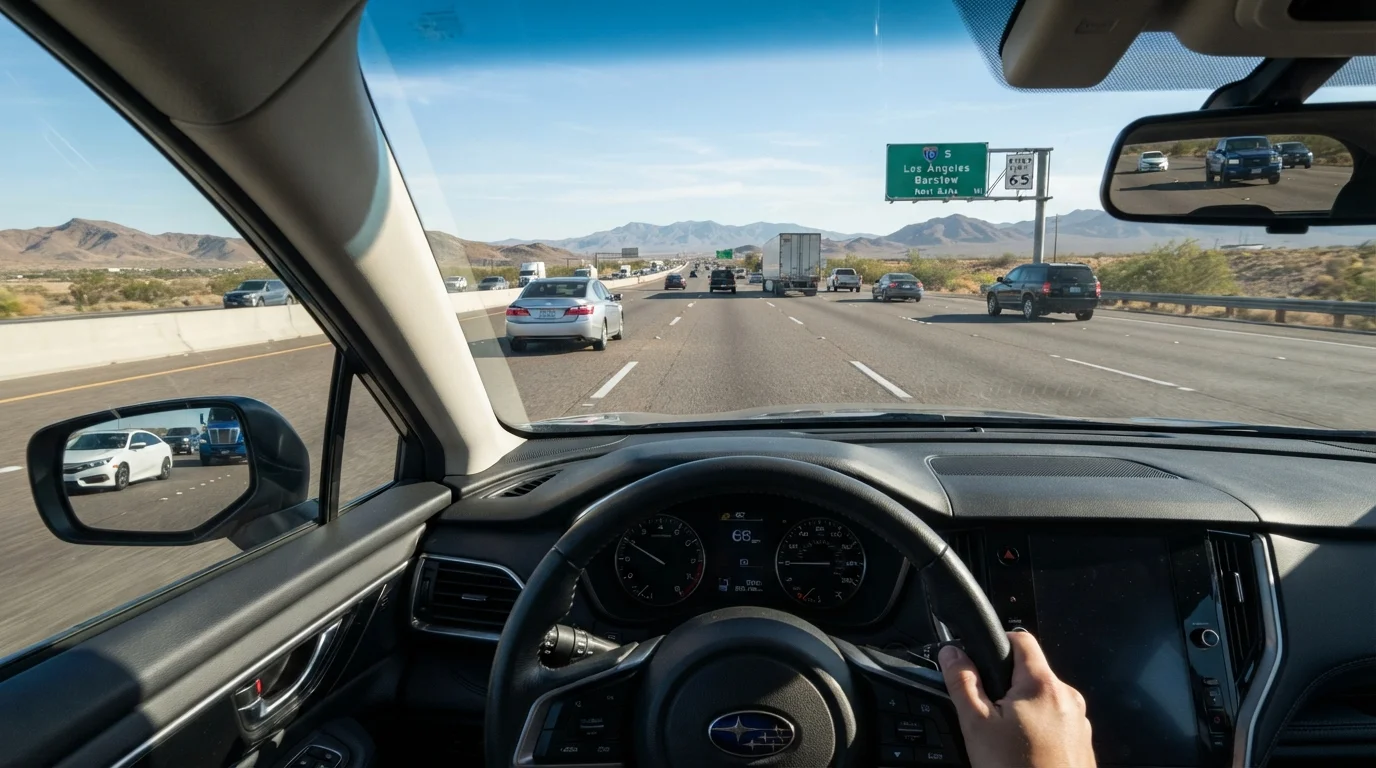
Where your eyes go determines what you can react to. Traffic safety professionals consistently recommend scanning 12 to 15 seconds ahead of your vehicle - at highway speeds, that translates to roughly a quarter mile. At city speeds, it means looking through the next two or three intersections.
Scanning that far ahead shifts you from reacting to hazards to anticipating them. You notice a light that has been green long enough to turn, a driver who appears to be merging without signaling, or a pedestrian stepping toward the curb. These early reads give your brain and your vehicle time to respond rather than lurch.
Coupled with forward scanning, consistent mirror checks - roughly every five to eight seconds - keep you aware of what is closing in from behind and to the sides. The goal is a complete, continuously updated mental picture of your surroundings. For a deeper look at the visual habits associated with safer drivers, see Scanning the Road Ahead.
94%
Of crashes attributed to human error
According to the National Highway Traffic Safety Administration (NHTSA), driver-related factors are cited in approximately 94% of serious crashes.
3-5 sec
Minimum following distance recommended
Traffic safety organizations recommend at least a 3-second gap in dry conditions, extending to 4-5 seconds on wet roads.
12-15 sec
How far ahead to scan the road
Professional driver training programs recommend scanning this distance ahead to allow adequate hazard response time.
Managing Space Around Your Vehicle
Space is your most valuable safety resource. The more room you maintain between your vehicle and others, the more time and distance you have to respond when something goes wrong. The commonly cited three-second following distance - measured by picking a fixed point and counting seconds after the car ahead passes it - is a minimum under ideal conditions. Rain, low visibility, or high speeds all call for extending that buffer.
Lateral space matters equally. Avoid lingering in another driver's blind spot. Position yourself so you are visible in their mirrors and have an escape path available if the lane beside you collapses. When stopped at a light, leave enough room to see the rear tires of the car ahead - this gives you maneuvering space if you need to pull around a stalled vehicle.
Tailgating Is One of the Most Dangerous Habits
Following too closely is a leading cause of rear-end crashes, which account for a significant proportion of all US traffic collisions. At 60 mph, a car travels roughly 88 feet per second - a following distance of less than two seconds leaves almost no margin for reaction. This is especially dangerous on roads where sudden braking is common, such as urban arterials and highway on-ramps.
Reading Other Drivers Before They Act
Defensive drivers develop a kind of situational fluency - the ability to read behavioral cues and predict what another driver is likely to do before they do it. Wheels that begin turning before a turn signal activates, a driver checking mirrors repeatedly before a merge, or a vehicle drifting toward the shoulder are all observable signals.
This is not about suspicion; it is about building an accurate mental model of your environment. When you notice a driver whose attention appears divided - weaving subtly, inconsistent speed, or delayed reactions to traffic changes - you create extra space and avoid positioning yourself where their potential error puts you at risk. The article Distracted vs. Drowsy Driving explains the behavioral signs of each impairment in useful detail.
When entering a new traffic environment - a highway, a downtown grid, an unfamiliar neighborhood - spend the first 30 seconds doing nothing but building your situational picture before you attempt any complex maneuver.
Cognitive load peaks at environmental transitions; giving yourself a brief 'orientation window' reduces the chance of missing a critical cue just as conditions become more complex.
Identify at least one escape route before you need it. On a highway, know which shoulder or lane you could move into safely if the vehicle ahead stops suddenly.
Pre-planning an exit option means your brain does not have to generate one under panic - a process that costs precious milliseconds in a real emergency.
Attention Management and Cognitive Load
Driving is a cognitively demanding task, and the brain has finite processing capacity. Every secondary activity - adjusting the radio, glancing at a notification, or engaging in a complex conversation - borrows from the attentional budget your brain needs to drive safely. Even hands-free phone calls have been shown in research to significantly reduce situational awareness.
Defensive driving requires protecting that attention actively. This means settling navigation before departure, keeping conversations with passengers brief during complex maneuvers, and recognizing when fatigue is eroding your reaction time and judgment. Tiredness impairs driving in ways that closely resemble alcohol impairment, and the effects can arrive gradually - making them easy to dismiss until it is too late.
Hands-Free Does Not Mean Risk-Free
Many drivers assume that using a hands-free device eliminates the cognitive risk of phone use while driving. Research from the AAA Foundation for Traffic Safety and others indicates that the mental distraction of a phone conversation persists even when both hands remain on the wheel. The primary risk is not physical - it is the reduction in situational awareness caused by divided attention.
Conditions That Demand a Higher Level of Defense
Certain environments and scenarios require deliberately escalating your defensive posture. Wet roads lengthen stopping distances significantly - on wet pavement, the three-second rule should extend to at least four to five seconds. Night driving reduces visibility and the ability to read road cues, while also increasing the likelihood of encountering impaired drivers.
Intersections - particularly multi-lane and complex ones - are among the highest-risk locations on any road. Even when you have a green light, briefly confirming that cross-traffic has stopped before accelerating is a low-cost habit that can prevent a serious crash. For intersections with unusual layouts, roundabout navigation principles offer a useful framework for applying the same anticipatory logic in unfamiliar configurations.
High-traffic on-ramps, construction zones, and school zones also call for increased following distance, reduced speed, and heightened mirror awareness. The more compressed and unpredictable the environment, the more actively you must manage it.
Building Defensive Habits Into Every Trip
Defensive driving is not a mode you switch on for difficult conditions - it is a set of consistent habits applied every time you drive. That consistency is what builds the automatic responses that matter most when a hazard appears without warning.
Starting each trip with a brief vehicle check reinforces the link between preparation and safety. A pre-trip vehicle check helps you catch issues - low tires, compromised visibility, non-functioning lights - before they become emergencies at speed. For newer drivers building these habits from the start, what new teen drivers should know before their first solo trip addresses the foundational awareness and preparation that carry into long-term safe driving.
Every experienced safe driver was once a learner who made deliberate choices about how to develop their skills. The habits you build now - scanning far ahead, protecting your space, managing your attention - compound over time into a meaningfully lower risk profile behind the wheel.
NHTSA Traffic Safety Resources
The National Highway Traffic Safety Administration publishes driver safety data, distracted driving research, and consumer guidance relevant to defensive driving principles.
NSC Defensive Driving Courses
The National Safety Council offers defensive driving course information that covers anticipatory driving techniques and hazard recognition strategies.
AAA Foundation for Traffic Safety
The AAA Foundation conducts and publishes independent research on driver behavior, crash causes, and road safety - useful for readers who want data behind the principles.
The content on this site is for informational purposes only and is not a substitute for professional advice. Always consult a qualified professional for guidance specific to your situation.