

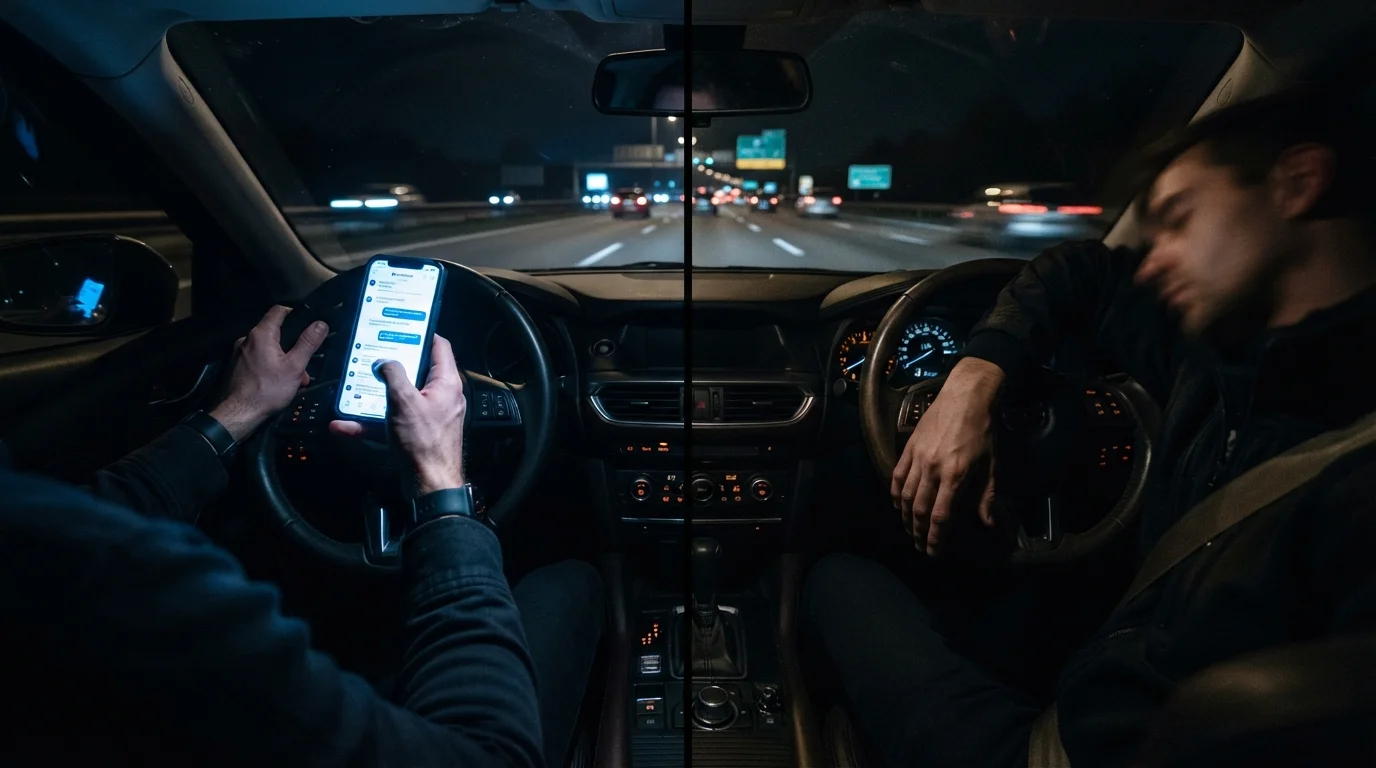
Option A
Distracted Driving
The conscious attention thief - awareness is present, but misdirected.
Best for: Understanding how deliberate or habitual behavior pulls mental focus away from the road.
Option B
Drowsy Driving
The silent impairment - the driver may not realize how compromised they are.
Best for: Understanding how sleep deprivation quietly degrades reaction time, judgment, and alertness.
How Each Type of Impairment Works in the Brain
Distracted driving and drowsy driving are both associated with slower reactions and increased crash risk, but they originate from fundamentally different mechanisms. Understanding that distinction matters for recognizing - and preventing - each one.
Distracted driving occurs when a driver's attention is redirected away from the driving task. Traffic safety researchers commonly categorize distractions into three types: visual (looking away from the road), manual (removing hands from the wheel), and cognitive (thinking about something other than driving). Texting, for example, combines all three simultaneously. The driver's brain is still broadly functional - it is simply occupied with a competing task.
Drowsy driving operates differently. Sleep deprivation degrades the brain's baseline capacity to process information, sustain attention, and respond to stimuli - even when the driver is trying to focus. According to the National Highway Traffic Safety Administration (NHTSA), drowsy driving is associated with thousands of crashes each year, many of them severe. A particularly dangerous phenomenon is microsleep: brief, involuntary sleep episodes lasting two to thirty seconds during which the driver is effectively unconscious. At 60 mph, two seconds of microsleep means traveling roughly 176 feet with no driver input at all.
For a fuller picture of how attention and visual scanning interact with safe driving, see our guide to road-scanning habits used by safer drivers.
| Criterion | Distracted Driving | Drowsy Driving |
|---|---|---|
| Primary cause | Competing task or stimulus | Insufficient sleep or fatigue |
| Brain state | Alert but misdirected | Degraded baseline processing |
| Self-detection | Usually triggered by an identifiable event | Often underestimated by the driver |
| Unique danger | Simultaneous visual, manual, and cognitive gaps | Microsleep: seconds of total unconsciousness |
| In-moment remedy | Remove or ignore the distraction source | Pull over; no quick fix fully restores alertness |
| Crash type association | Rear-end and intersection collisions | High-speed lane-departure and run-off-road crashes |
| Risk peaks when | Phone use, heavy traffic, complex navigation | Late night, early morning, long monotonous roads |
Warning Signs and Self-Detection
One of the most important practical differences between these two risks is how easy - or difficult - they are to notice in yourself.
Distracted driving is often triggered by a clear, external stimulus: a phone notification, a conversation, a GPS rerouting alert. Because the trigger is identifiable, there is at least a theoretical moment of choice. A driver may still choose to engage with the distraction, but awareness that one exists is generally not the problem.
Drowsy driving is more insidious. Research consistently shows that fatigued individuals are poor judges of their own impairment level. Common warning signs include: repeated yawning, difficulty keeping eyes focused, drifting between lanes, missing exits or road signs, and the head nodding forward. However, by the time many of these signs appear, impairment is already significant. Notably, rolling down a window or turning up the radio does not meaningfully restore alertness - these are short-lived coping strategies that can create a false sense of recovery.
~100,000
Annual drowsy driving crashes reported to police (US)
NHTSA estimates this figure is likely an undercount, as fatigue is difficult to determine after a crash.
~3,000
Distraction-affected fatal crashes per year (US)
According to NHTSA data, distracted driving accounts for a significant share of traffic fatalities annually.
176 ft
Distance traveled during 2-second microsleep at 60 mph
This illustrates why even brief unconscious episodes can be catastrophic at highway speeds.
Drowsy driving risk is also compounded at night, when circadian rhythms naturally push the body toward sleep. Our article on night driving hazards explores how reduced visibility and fatigue interact after dark.
Practical Prevention for Each Risk
Prevention strategies differ because the root causes differ.
For distracted driving, behavioral change is central. Placing a phone on do-not-disturb before starting the engine, using hands-free audio only for navigation, and establishing clear boundaries around in-car conversations all reduce the likelihood of attention being pulled away. Passengers can play a role too - minimizing demands on the driver in complex traffic situations is a simple but meaningful contribution.
For drowsy driving, the only genuinely effective remedy is sleep. If you are traveling a long distance and feeling drowsy, the recommended approach is to pull over safely, take a short nap (even 20 minutes can help), or switch drivers. Caffeine can provide a modest, temporary boost but does not substitute for rest and should not be relied on as a primary safety strategy on long trips.
Both risks respond well to the broader principles of defensive driving - maintaining awareness of your own condition, managing space around your vehicle, and anticipating situations before they become emergencies.
When to Pull Over - No Exceptions
If you are experiencing repeated yawning, difficulty focusing your eyes, or any microsleep episodes while driving, the appropriate response is to exit the road as soon as it is safe to do so. There is no driving technique or stimulant that reliably compensates for significant sleep deprivation. Alerting a passenger, using a rest area, or calling someone to assist are all safer options than continuing to drive impaired.
The content on this site is for informational purposes only and is not a substitute for professional advice. Always consult a qualified professional for guidance specific to your situation.