

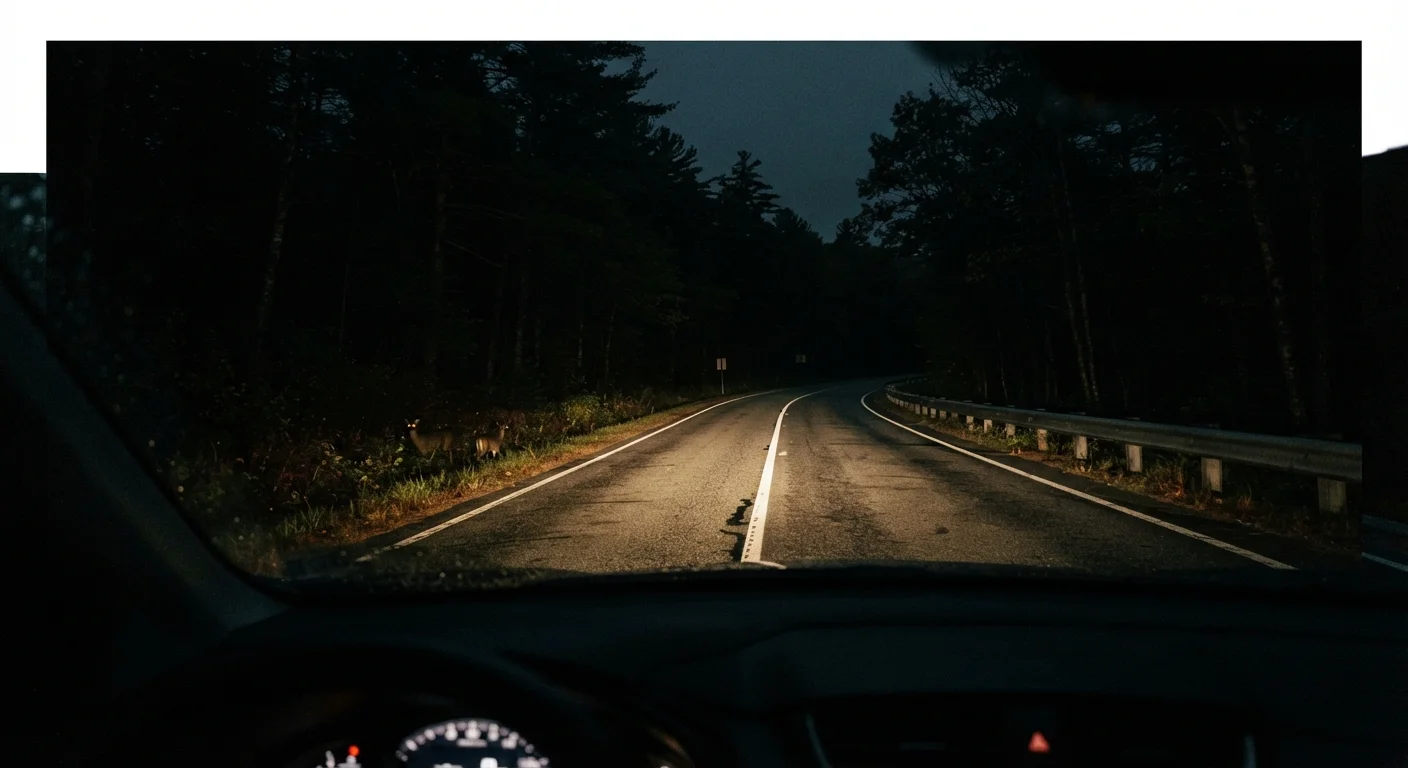
Why Night Driving Is a Different Challenge Entirely
It's the same road. Same car, same route. But after the sun goes down, driving changes in ways that aren't always obvious until something goes wrong. Fatal crash rates per mile driven are notably higher at night than during daylight hours - not because more people are driving, but because the conditions are fundamentally more demanding.
The core problem is visibility. Human eyes rely heavily on contrast and color to identify hazards, and both degrade significantly in low light. Your headlights illuminate only a fraction of the road your eyes can scan in daytime, and the cone of useful light is narrower than most drivers assume. On top of that, oncoming headlights can cause temporary glare blindness - a moment where your vision is essentially useless.
The hazards below don't disappear when the sun sets; they simply become far harder to detect in time to respond safely. Understanding what changes after dark is the first step toward adapting your driving habits accordingly. For a broader framework on reading and responding to road conditions, see our guide to defensive driving principles.
Reduced Depth Perception and Peripheral Vision
In daylight, your peripheral vision picks up movement across a wide field - a child stepping off a curb, a cyclist pulling onto the road. At night, your usable visual field narrows considerably. Low light shifts your vision toward the center of your gaze, meaning objects at the edges of the road become harder to detect until they're much closer.
This narrowing also affects depth perception - judging the distance and speed of oncoming vehicles or intersecting traffic becomes less reliable. Drivers who understand this often increase following distances at night precisely because their ability to judge gaps accurately is reduced.
At night, your usable visual field narrows, making edge-of-road hazards far harder to detect in time.
Glare from Oncoming Headlights
Modern vehicles often have brighter headlights than older models, and not all of them are correctly aimed. When an oncoming vehicle's headlights hit your eyes directly, your pupils - which have dilated to adapt to darkness - can take several seconds to readjust. During that recovery window, your effective vision drops substantially.
A practical strategy: rather than looking directly at oncoming lights, shift your gaze to the right edge of your lane. This keeps your lane position visible while reducing direct glare exposure. If another driver has their high beams on, avoid flashing yours in retaliation - it creates a mutual visibility problem and can escalate tension unnecessarily.
After glare hits your dilated pupils, your vision may take several seconds to recover - plan accordingly.
Wildlife Crossing the Road
Deer, raccoons, foxes, and other animals are more active at dawn and dusk - but encounters happen throughout the night. Animals often freeze when headlights approach, and they can appear with very little warning, particularly on rural roads with dense vegetation on either side.
Deer, in particular, are dangerous because they rarely travel alone. If you see one crossing, slow down and scan the shoulders carefully - others are often close behind. Keeping speed reasonable on wooded or rural roads at night dramatically increases your odds of stopping in time.
If one deer crosses ahead of you, assume more are nearby - reduce speed and scan the shoulders.
Pedestrians and Cyclists in Low-Visibility Clothing
Pedestrians wearing dark clothing can be nearly invisible to a driver until they are well within the stopping distance of a vehicle traveling at typical speeds. Studies examining pedestrian visibility suggest that a person in dark clothing may not be detectable by headlights until they are dangerously close.
Urban intersections, neighborhood streets, and areas near bars or transit stops see higher foot traffic after dark. Slowing down in these zones and scanning the edges of crosswalks - not just the center - can help. Structured visual scanning habits are particularly valuable at night when contrast is low.
A pedestrian in dark clothing may not be visible until they are already within your stopping distance.
Road Debris and Surface Hazards
Potholes, blown tire remnants, fallen branches, and spilled cargo are common on roadways - but at night, they're far harder to spot. Headlights cast light in a relatively flat angle, which can cause low-profile debris to cast almost no visible shadow until you're directly upon it.
Maintaining greater following distance at night gives you more time to react when the vehicle ahead swerves or brakes suddenly - often the first sign that something is in the road. Avoid the temptation to tailgate at night just because traffic seems light.
Flat debris and potholes cast almost no shadow under headlights - following distance is your best buffer.
Driver Fatigue and Circadian Pressure
The body's circadian rhythm - its internal 24-hour clock - naturally promotes drowsiness after midnight and again in the early afternoon. Driving during these windows without adequate sleep creates a fatigue risk that compounds every other hazard on this list. Fatigued drivers show slower reaction times, reduced hazard detection, and impaired decision-making, sometimes without feeling meaningfully tired.
Microsleeps - involuntary sleep episodes lasting just a few seconds - can occur without any warning and without the driver being aware afterward. At highway speeds, even a two-second microsleep covers significant distance. If you're driving late at night, plan your route to include rest opportunities, and take them before fatigue becomes severe rather than after.
Microsleeps can occur without warning - and a fatigued driver may never realize one happened.
Adjusting Your Habits Before and During Night Drives
Awareness of these hazards is only useful if it translates into changed behavior. Slowing down - even modestly - is one of the most effective adjustments, because it gives your headlights time to reveal obstacles before you reach them. A common principle in driving safety is matching your speed to your sight distance: if your headlights reach 200 feet ahead, you should be traveling at a speed that allows you to stop within those 200 feet.
Check Your Headlights Before Night Trips
Yellowed or cloudy headlight lenses can reduce light output by more than half compared to clear ones. Before a nighttime drive, confirm both headlights are working, the lenses are clean, and the beams are aimed correctly - not pointing into oncoming traffic or too low to be useful. This simple check takes under two minutes and can meaningfully extend how far ahead you can see.
Before any nighttime trip, a quick vehicle check pays dividends. Dirty or yellowed headlight lenses can cut light output dramatically. Ensuring your headlights are clean, functioning, and correctly aimed is one of the easiest ways to extend your visual range. Our pre-trip vehicle checklist covers lights, mirrors, and other visibility factors worth confirming before you pull out.
Fatigue deserves special attention - it tends to worsen gradually and is easy to underestimate. If you notice yourself blinking more frequently, missing signs, or struggling to recall the last mile of road, those are meaningful warning signals. Our article on drowsy versus distracted driving explores how each impairs your reaction time in distinct ways. When in doubt, stopping to rest is always the right call. No destination is worth the risk of driving impaired by fatigue.
The content on this site is for informational purposes only and is not a substitute for professional advice. Always consult a qualified professional for guidance specific to your situation.