

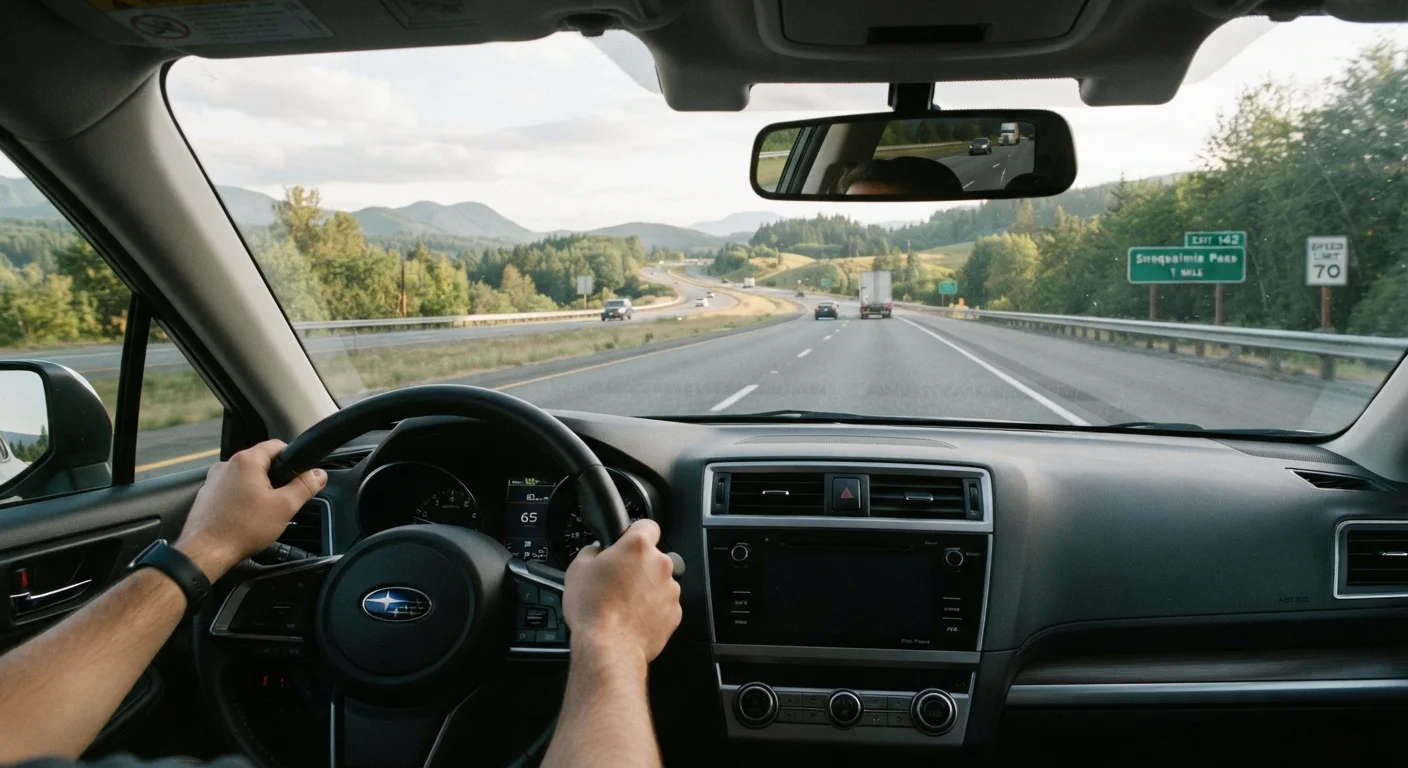
Why Your Eyes Are Your First Line of Defense
Every decision you make behind the wheel starts with what your eyes deliver to your brain. Steering, braking, and merging are all reactions to visual information - which means the quality of that information determines how much margin you have to act safely.
Traffic safety research consistently links crash involvement to a narrow set of eye-movement patterns: drivers who gaze too low, fixate too long on single points, and neglect their peripheral environment tend to have less reaction time than those who scan broadly and systematically. The good news is that these habits are learned - and they can be re-learned.
This isn't about having perfect vision. It's about developing the visual strategy that experienced drivers use without thinking about it. Understanding that strategy is the first step toward applying it consciously.
“The driver who sees the problem first almost always has more choices about what to do. Everything in advanced driving comes back to vision - how far ahead you look and how systematically you use it.”
— Traffic Safety Educator, Advanced driver training instructor and road safety curriculum developer
The Core Visual Habits Safer Drivers Use
The following practices reflect the scanning techniques taught in advanced driver training programs and supported by traffic safety research. Incorporating them takes deliberate effort at first, but they become automatic with repetition.
Look 12-15 seconds ahead of your current position
Scanning well ahead of your vehicle gives you the maximum available time to identify and respond to developing hazards before they become emergencies. Most untrained drivers look only 4-6 seconds ahead, which compresses decision-making time significantly.
Check your mirrors every 5-8 seconds
Your rearview and side mirrors cover the space your eyes cannot naturally reach. Regular checks keep your mental picture of surrounding traffic current, which matters especially when you need to brake, change lanes, or pull over.
Scan intersections actively, not just at the last moment
A large share of US traffic crashes occur at intersections, many involving drivers who technically had a green light but failed to check cross-traffic before entering. The signal tells you it's your turn - it doesn't guarantee the intersection is clear.
Keep your eyes moving rather than fixating
A stationary gaze narrows your effective field of view and causes peripheral hazards to fade from conscious awareness - a well-documented perceptual effect. Continuous, small eye movements maintain broader situational coverage.
Identify escape routes as you travel
Knowing where you could steer if the path ahead closes suddenly is a hallmark of advanced scanning. Drivers who plan only for the expected path have fewer options when something unexpected happens.
Adjust your visual range for speed and conditions
At low urban speeds, near-range detail matters more; at highway speeds, far-range scanning becomes critical. Matching your visual focus distance to your speed ensures you're spending attention where it has the most impact.
Speed, Distance, and What You Can Actually See
Visual scanning doesn't exist in isolation from speed. As your vehicle travels faster, the distance at which new hazards enter your usable field of vision shrinks relative to your stopping distance. At highway speeds, a hazard that appears 400 feet away gives you only about four seconds to perceive it, decide, and brake - assuming ideal conditions.
~94%
Crashes involving human error as a factor
According to the National Highway Traffic Safety Administration (NHTSA), human factors - including recognition failures - are cited in the critical reason for the vast majority of US traffic crashes.
4 sec
Average perception-reaction time at highway speed
At 65 mph, a driver needs roughly 300-400 feet of clear road just to perceive a hazard and begin braking, before factoring in actual stopping distance.
This is why looking far ahead matters more at higher speeds, not less. Drivers who habitually scan only the car directly in front of them are effectively flying blind on the margins, especially in heavy traffic. For a practical framework on managing the space around your vehicle, see our article on the two-second following distance rule.
Weather compounds this challenge significantly. Rain, fog, and snow all reduce the effective range of useful vision - which means your scanning range must expand mentally even as conditions physically shrink it. Our guide on adjusting for rain, snow, and fog covers how to adapt your approach when conditions deteriorate.
Common Visual Mistakes and How to Correct Them
Even experienced drivers fall into habits that compromise their visual coverage. Recognizing these patterns is the first step toward correcting them.
- Staring at the car ahead: Following a single vehicle with your gaze anchors your attention and delays perception of anything beyond it. Deliberately shift your gaze past the lead vehicle.
- Not checking mirrors regularly: Mirrors require active use - they don't work passively. Many drivers go 30 seconds or more without a mirror check, leaving their rearward picture entirely stale.
- Under-scanning intersections: Intersections are where a large proportion of crashes occur. Glancing left-right-left before and during an intersection crossing is a habit worth building deliberately. For more on navigating complex intersections, see our piece on roundabouts versus traditional intersections.
- Visual fixation during stress: When something alarming appears, many drivers lock their gaze on it - a phenomenon sometimes called target fixation. Training yourself to look where you want to go rather than where the hazard is can reduce this reflex.
Practice Scanning on Low-Stress Routes First
If you want to build new visual habits, start on roads you know well - your regular commute or a quiet neighborhood. Familiar surroundings reduce cognitive load, which frees up mental capacity to consciously practice new scanning patterns. Once the habits feel natural on easy routes, they transfer more reliably to challenging or unfamiliar roads.
Distraction is a major driver of poor visual scanning. When attention is divided - by a phone, conversation, or fatigue - the brain narrows its visual intake even if the eyes remain open. Our article comparing distracted and drowsy driving explores how each disrupts your road awareness in different ways.
Building Better Scanning Into Every Drive
Improved visual habits don't require a course or specialized equipment. They require intention and repetition during ordinary driving.
These practices fit naturally into the broader framework of defensive driving, which treats anticipation - not reaction - as the goal. Visual scanning is how anticipation is fed. Before long drives, pairing these habits with a quick pre-trip vehicle safety check ensures both you and your vehicle are prepared for what the road demands.
The content on this site is for informational purposes only and is not a substitute for professional advice. Always consult a qualified professional for guidance specific to your situation.