

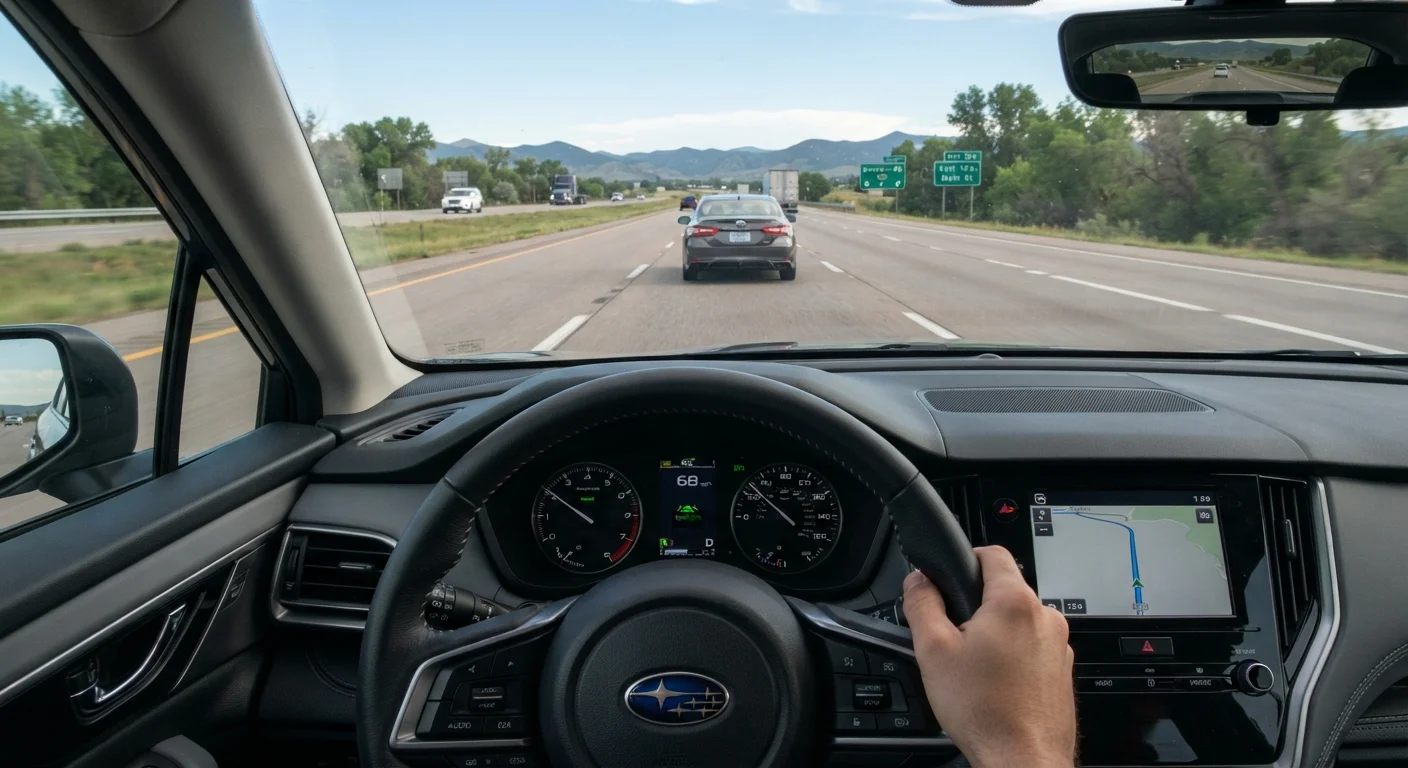
Why Following Distance Matters More Than Most Drivers Think
Rear-end collisions are among the most frequently reported crash types on U.S. roads. A significant contributing factor in many of them is following distance - or the lack of it. Despite this, research consistently shows that most drivers operate far closer to the vehicle ahead than safety guidelines recommend.
The two-second rule exists because of a simple physical reality: your vehicle does not stop the instant you decide to brake. There is a reaction gap - the time between perceiving a hazard and applying the brakes - followed by the actual braking distance. At 60 mph, even a one-second reaction time means your car has already traveled 88 feet before braking begins.
Following distance is a core element of defensive driving - the practice of managing space to give yourself time to respond to what other drivers do unexpectedly.
~29%
Of all crashes involve rear-end collisions
According to the National Highway Traffic Safety Administration (NHTSA), rear-end crashes are one of the most common crash configurations on U.S. roads.
1.5 sec
Typical average following gap observed in studies
Traffic safety research has found that many drivers maintain following gaps well under the recommended two seconds, particularly in urban and highway environments.
50%+
Increase in stopping distance on wet pavement
The Federal Highway Administration notes that wet roads significantly extend stopping distances, underscoring why the two-second minimum must be extended in rain.
How to Apply the Rule in Real Conditions
The measurement is straightforward. As the vehicle ahead passes a fixed landmark - a road sign, a painted line, a utility pole - begin counting seconds. If your front bumper reaches that same point before two full seconds have elapsed, close the gap by lifting off the accelerator.
The rule's practical value is that it scales automatically with speed. At 30 mph, two seconds equals roughly 88 feet. At 60 mph, it doubles to around 176 feet. You do not need to recalculate - the time-based method handles the math for you.
Use a Stationary Landmark, Not the Car Ahead
A common mistake is counting from when the car ahead brakes, rather than from when it passes a fixed point. Always anchor your count to an object that does not move - a sign post, painted marking, or bridge pillar. This gives you an accurate, unbiased measure of your actual following time.
What the rule does not account for are conditions that extend stopping distance beyond normal. Wet pavement can increase stopping distance by 50 percent or more. Snow and ice can multiply it several times over. Worn tires, a heavy load, or an older braking system add further margin that two seconds alone may not cover. In those situations, three or four seconds is a more appropriate buffer.
For a broader look at how speed and judgment interact, see when driving below the speed limit is the right call.
Why Drivers Underuse It - and What to Do Instead
Traffic engineers and safety researchers have identified several reasons drivers close the gap despite knowing they should not. One is social pressure: when traffic is dense, maintaining a two-second gap invites other vehicles to merge into it, which many drivers experience as losing ground. Another is a distorted sense of speed - the faster you travel, the more compressed distances appear, making a dangerously short gap feel acceptable.
Habituation also plays a role. Drivers who commute the same route repeatedly may unconsciously mirror the behavior of surrounding traffic, which trends toward following too closely in congested conditions.
The solution is treating your following gap as non-negotiable rather than situational. When a vehicle moves into your buffer, ease back to re-establish it. Use the visual habit of scanning well ahead - not just at the bumper in front of you - to anticipate slowdowns before they become emergencies. Visual scanning habits that look 12 to 15 seconds ahead give you time to react long before a gap becomes critical.
Following distance also intersects with right-of-way awareness at intersections. Understanding right-of-way rules that confuse experienced drivers reduces the chance of sudden stops that catch a following driver off guard.
Frequently Asked Questions
When the car ahead passes a fixed object - a sign, a shadow line, a bridge overpass - begin counting 'one one-thousand, two one-thousand.' If your front bumper reaches that same object before you finish counting, you are following too closely and need to ease back.
Yes, and it becomes even more critical at highway speeds because stopping distances increase dramatically with speed. At 70 mph, your vehicle travels over 100 feet per second, making even a brief lapse in reaction time dangerous. Many safety experts recommend three or more seconds at freeway speeds.
Yes. All U.S. states have statutes against following too closely, sometimes referred to as tailgating laws. Violations can result in fines and points on a driver's record, and in crashes, following too closely is frequently cited as a contributing factor in fault determinations.
Extend to three or four seconds in rain, snow, ice, fog, or construction zones. Also increase your gap when towing a trailer, driving a heavy vehicle, following a motorcycle, or when you feel fatigued. Reaction time suffers under all of these conditions.
Ease off the accelerator gently to re-establish the gap rather than braking sharply. Resist the urge to reclaim the space by moving closer to the vehicle that cut in - your buffer exists for your safety, not as a territorial claim on road space.
The content on this site is for informational purposes only and is not a substitute for professional advice. Always consult a qualified professional for guidance specific to your situation.