

Why Right-of-Way Keeps Tripping Drivers Up
Right-of-way is one of the most fundamental concepts in US traffic law, yet it generates confusion at intersections nationwide - even among drivers with decades of experience. Part of the problem is that right-of-way rules aren't uniform across every state, and part is that many drivers learned them once during driver's ed and never revisited them.
Understanding who legally has the right to proceed - and when - reduces the risk of collisions and removes the guesswork from common scenarios. This reference breaks down the most misunderstood right-of-way situations clearly and accurately.
| Governing body for traffic laws | Each US state individually; MUTCD provides national guidance for signs and markings (Federal Highway Administration, Manual on Uniform Traffic Control Devices) |
| Most common right-of-way rule | Yield to the right when vehicles arrive simultaneously |
| Roundabout entry rule | Yield to all vehicles already circulating inside the roundabout |
| Pedestrian priority | Pedestrians have right of way at marked and most unmarked crosswalks (Varies by state; verify local statutes) |
| Emergency vehicle rule | Pull to the right and stop - do not enter an intersection to clear the way |
| Left-turn rule | Left-turning vehicles must yield to oncoming straight-moving traffic |
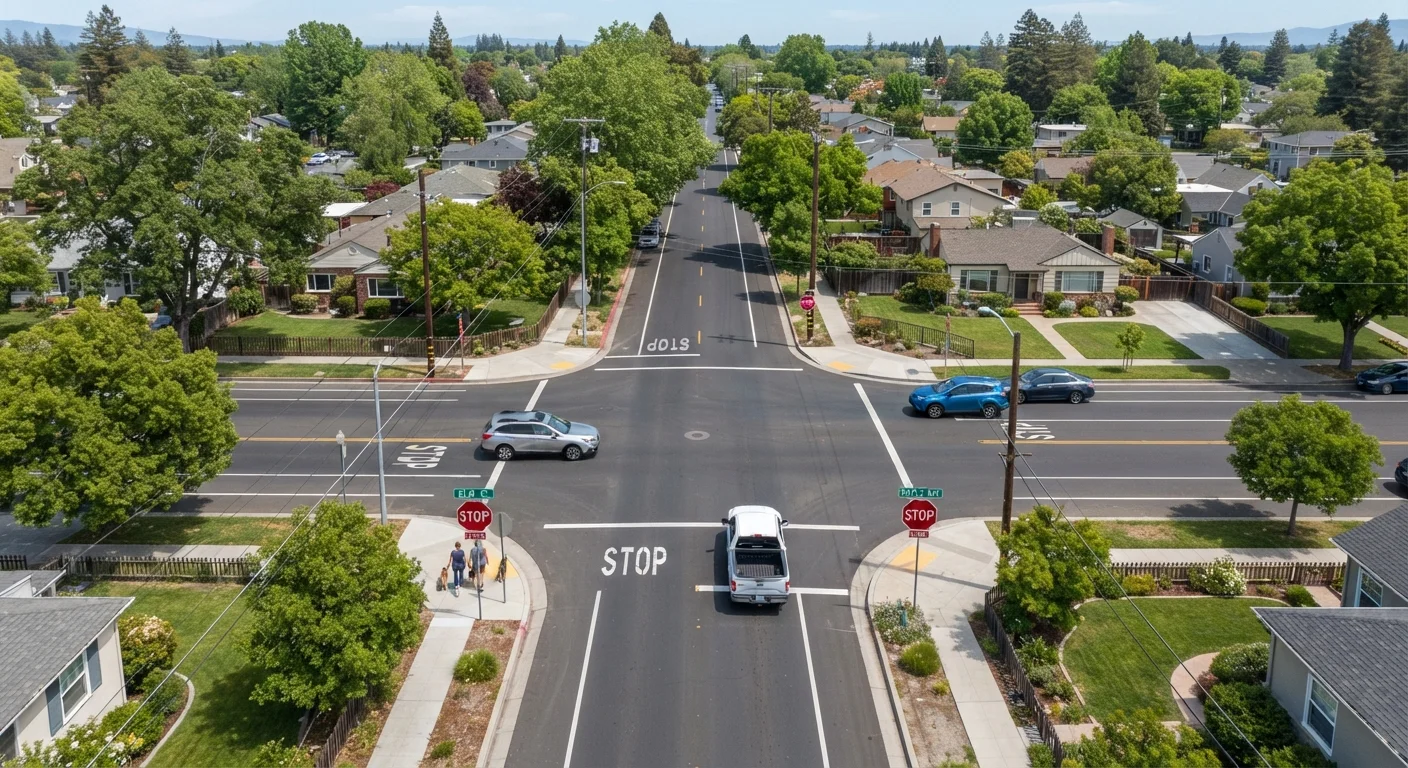
Four-Way Stops: The Rules Behind the Confusion
Four-way stops are a source of frequent hesitation and occasional conflict. The general rules, consistent across most US states, are:
- First to stop, first to go. The driver who stopped first has the right of way.
- Simultaneous arrival - yield to the right. If two vehicles arrive at the same time, the driver on the left yields to the driver on the right.
- Opposite directions, going straight. Both may proceed simultaneously if neither is turning left across the other's path.
- Left turns yield. A vehicle turning left must yield to oncoming straight-moving or right-turning traffic, regardless of stop order.
The confusion peaks when three or four vehicles arrive nearly simultaneously. In that case, drivers should make eye contact, communicate with hand signals if needed, and proceed one at a time. There is no nationally standardized rule for a three-vehicle tie - exercise caution and courtesy.
Right of way
The legal right of a vehicle, pedestrian, or cyclist to proceed through a road space before another. It is granted by traffic laws, not assumed - other parties are required to yield.
Uncontrolled intersection
An intersection with no traffic signals, stop signs, or yield signs. Drivers must rely on arrival order and the yield-to-the-right rule to determine who proceeds first.
Yield
To slow down or stop to allow another road user to proceed first. Yielding is a legal requirement in specific situations, not merely a courtesy.
T-intersection
A junction where one road ends and meets a perpendicular through road, forming a T shape. Traffic on the terminating road must yield to through traffic.
Roundabout
A circular intersection where traffic flows in one direction around a central island. Vehicles entering must yield to those already circulating inside the roundabout.
Uncontrolled Intersections and T-Intersections
An uncontrolled intersection has no stop signs, yield signs, or traffic signals. These appear more often in rural areas and older residential neighborhoods. The rule: the driver who arrives first has the right of way. If two vehicles arrive simultaneously, the driver on the left yields to the driver on the right - the same tie-breaking rule used at four-way stops.
At a T-intersection (where a road ends and meets a through road), vehicles on the terminating road must always yield to traffic on the through road, whether or not a stop sign is present. Many drivers mistakenly assume the T-stop rule only applies when a sign is posted.
For a broader look at how road markings signal priority, see what the yellow lines on US roads actually mean.
Right of Way Cannot Be 'Taken' - Only Given
A critical legal point: right-of-way rules define who must yield, not who may force their way through. Even if you technically have the right of way, you are still required to exercise reasonable care to avoid a collision. Proceeding recklessly when another driver has failed to yield does not eliminate your own liability.
Roundabouts, Pedestrians, and Emergency Vehicles
Roundabouts follow a single consistent rule: vehicles already inside the roundabout have the right of way. Drivers entering must yield to circulating traffic before merging. Despite this simplicity, roundabouts remain unfamiliar to many US drivers. For a full comparison of roundabout and signalized intersection behavior, see how roundabouts compare to traditional intersections.
Pedestrians have the right of way in marked crosswalks and, in most states, at unmarked crosswalks at intersections. Drivers making turns at signalized intersections must yield to pedestrians crossing with the signal - a step that's commonly skipped.
Emergency vehicles with lights and sirens activated always have the right of way. Drivers must pull to the right edge of the road and stop until the vehicle passes. Moving into an intersection to clear the way - a common instinct - can be illegal and dangerous.
New drivers often encounter additional right-of-way gaps tied to broader ownership knowledge. The guide on ownership mistakes that catch new drivers off guard covers several related blind spots worth reviewing.
~40%
Of US traffic fatalities occur at or near intersections
According to the Federal Highway Administration, intersection-related crashes account for a significant share of annual road deaths.
3,000+
Roundabouts operating in the US
The number of US roundabouts has grown substantially over recent decades as research shows they reduce fatal crashes compared to traditional stop-controlled intersections.
The content on this site is for informational purposes only and is not a substitute for professional advice. Always consult a qualified professional for guidance specific to your situation.