

Our Verdict
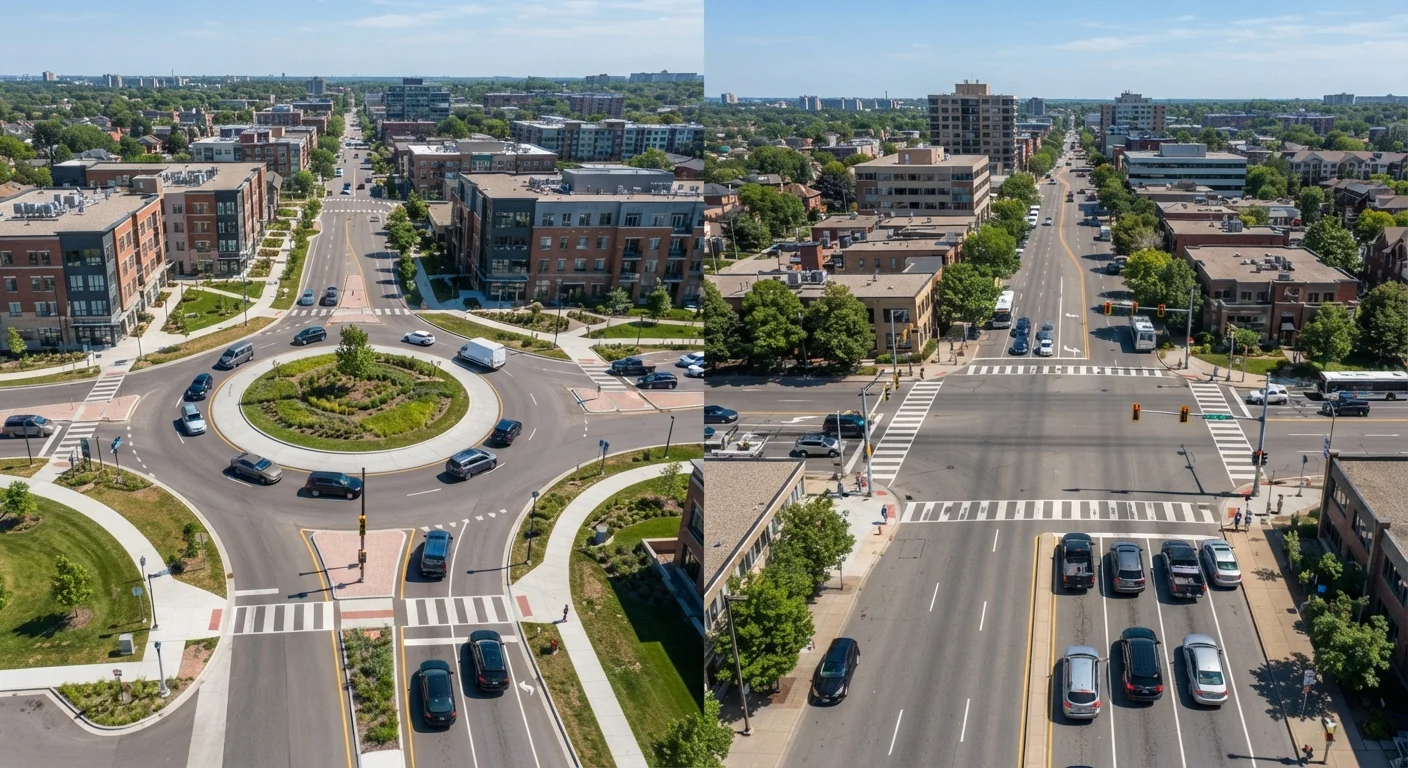
Roundabouts and traditional signalized intersections each manage traffic differently, with distinct safety profiles and driver demands. Roundabouts reduce severe crash types by eliminating high-speed right-angle and head-on conflicts, but require confident yield-based navigation. Signalized intersections offer familiar, structured control that suits high-volume or complex multi-lane scenarios well.
| Best for | Recommended |
|---|---|
| Drivers prioritizing reduced severe crash risk at lower-volume intersections | Roundabout |
| High-traffic urban corridors needing coordinated signal timing | Signalized Intersection |
| Drivers new to yield-based navigation or unfamiliar road layouts | Signalized Intersection |
| Locations where continuous traffic flow without full stops is preferred | Roundabout |
How Each Intersection Type Works
A signalized intersection uses traffic lights to assign right-of-way in timed cycles. Drivers stop on red, proceed on green, and follow dedicated turn signals. The rules are explicit and enforced by a fixed sequence most US drivers have known since they first sat behind the wheel.
A roundabout replaces traffic signals with a circular, one-way travel lane. Entering drivers must yield to vehicles already circulating inside the ring - there are no signals telling you when to go. You merge when a safe gap appears, navigate to your exit, and leave the circle. Speed through a roundabout is kept low by design, typically 15-25 mph.
Understanding the foundational difference - signal-controlled stops versus yield-based merging - is the starting point for navigating either correctly. For a broader look at who has the right of way in various road scenarios, see right-of-way rules that confuse even experienced drivers.
Safety Profiles: Where the Data Points
The Federal Highway Administration (FHWA) has studied roundabout safety extensively. Compared with conventional signalized intersections, roundabouts are associated with substantial reductions in fatal and injury crashes. The key reason is geometry: roundabouts eliminate the high-speed right-angle (T-bone) and head-on conflicts that produce the most serious outcomes at traditional intersections.
Crashes that do occur in roundabouts tend to be lower-speed sideswipe or rear-end events - survivable by design. Signalized intersections, by contrast, carry the risk of red-light running, which remains a leading contributor to intersection fatalities in the US.
~40%
Reduction in injury crashes
The Federal Highway Administration estimates roundabouts reduce injury crashes by approximately 40% compared with conventional intersections.
~75%
Reduction in fatal crashes
FHWA research indicates roundabouts are associated with roughly 75% fewer fatal crashes than signalized or stop-controlled intersections.
That said, signalized intersections are not inherently unsafe. Well-timed signals, protected left-turn phases, and advanced pedestrian signals all contribute to safety in high-volume, multi-lane environments where roundabout geometry would be impractical.
Navigating a Roundabout Correctly
Many US drivers feel uncertain at roundabouts, especially multi-lane versions. A clear, step-by-step mental model helps:
- Slow down and read the signs before reaching the yield line. Advance signage shows which lane leads to which exit.
- Yield to circulating traffic - vehicles already inside the roundabout have the right of way.
- Enter when a safe gap appears. Do not stop inside the roundabout unless traffic ahead forces it.
- Stay in your lane in multi-lane roundabouts. Do not change lanes while circulating.
- Signal your exit as you approach it to alert pedestrians and other drivers.
Choose Your Lane Before You Enter
At multi-lane roundabouts, lane selection must happen before the yield line - not inside the circle. Advance signs and road markings indicate which lane corresponds to each exit. Taking an extra moment to read the approach signage prevents the most common multi-lane roundabout error: drifting lanes mid-circle.
Pedestrians cross at marked crosswalks located just outside the yield line - not at the circle itself. Exiting drivers must yield to pedestrians in these crosswalks.
Practicing active road scanning habits is especially useful in roundabouts, where hazards can approach from multiple angles simultaneously.
Navigating a Signalized Intersection Correctly
Signalized intersections are familiar but still generate common errors. Key practices:
- Obey the full signal cycle. A yellow light means prepare to stop if it is safe to do so - not accelerate.
- Check cross-traffic before entering on green. Red-light runners are a real hazard; a brief scan before proceeding adds a meaningful safety buffer.
- Follow dedicated turn arrows. A green ball signal does not automatically permit a left turn through oncoming traffic.
- Yield to pedestrians in crosswalks on any turning movement, even when you have a green signal.
| Roundabout | Signalized Intersection | |
|---|---|---|
| Right-of-way method | Yield to circulating traffic | Signal-controlled phases |
| Typical operating speed | 15-25 mph | Varies; full stops required |
| Fatal crash risk | Significantly lower | Higher, esp. from red-light running |
| Traffic flow efficiency | Continuous; no full stop cycles | Interrupted by signal cycles |
| Driver familiarity (US) | Lower; yield-based unfamiliar to many | High; standard since early driving |
| Pedestrian crossings | Crosswalks outside yield line | Dedicated signal phases available |
| Best suited for | Moderate-volume, lower-speed roads | High-volume, complex urban junctions |
Applying defensive driving principles at signalized intersections - anticipating others' movements rather than assuming compliance - reduces exposure to the most common crash scenarios.
Which Design Suits Which Situation?
Neither intersection type is universally superior. Transportation engineers select designs based on traffic volume, road geometry, pedestrian density, and crash history at a specific location.
Roundabouts tend to perform well at moderate-volume intersections where reducing severe crashes is the priority and space allows for the circular footprint. They also improve traffic flow by eliminating full stop cycles - vehicles slow rather than stop completely.
Signalized intersections remain the standard for dense urban corridors, intersections with heavy pedestrian or cyclist activity requiring structured crossing phases, and complex multi-road junctions. Coordinated signal timing across multiple intersections (a green wave) is only possible with signal control.
As a driver, awareness of both formats - and confidence navigating each - is part of well-rounded road competency. New drivers especially may encounter unfamiliar intersection formats; a broader review of common mistakes that catch new drivers off guard can help build that foundational awareness.
The content on this site is for informational purposes only and is not a substitute for professional advice. Always consult a qualified professional for guidance specific to your situation.