

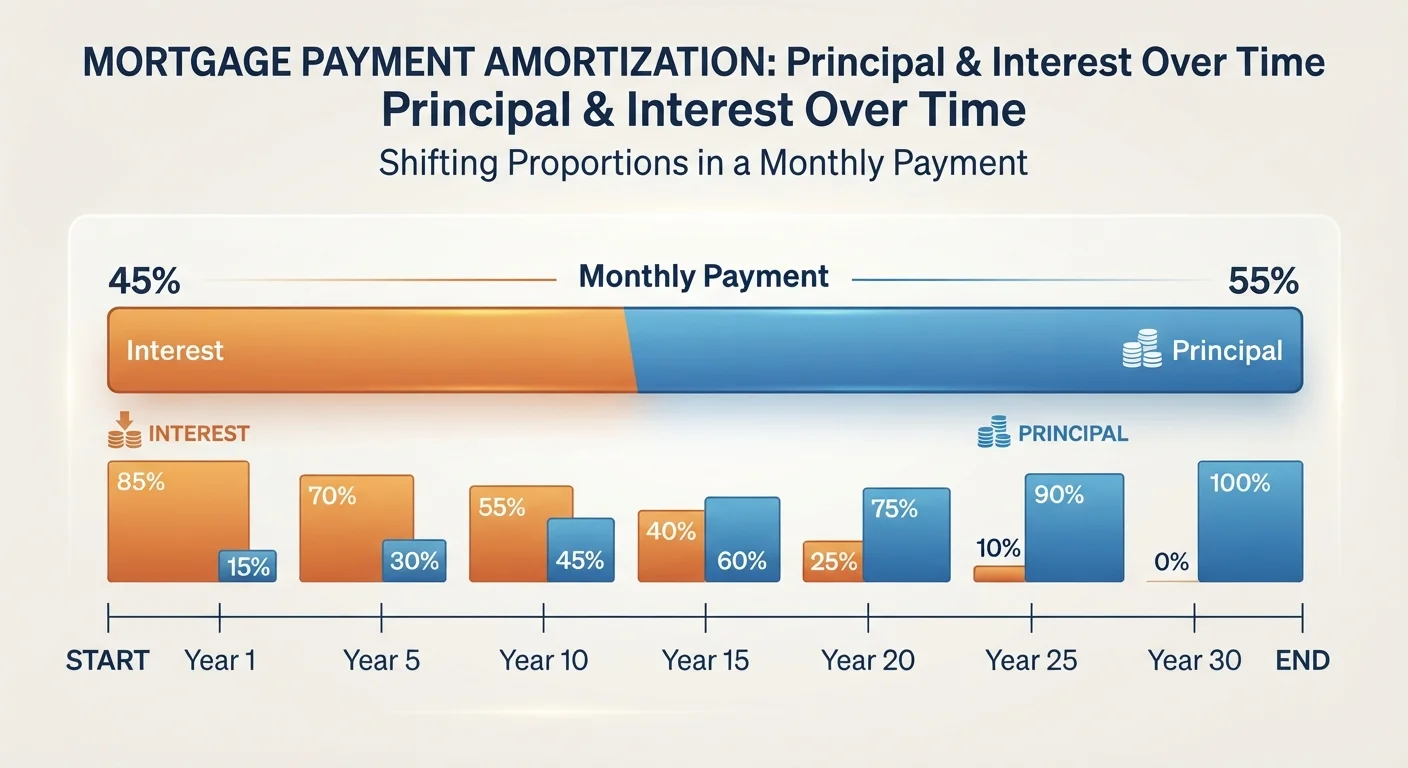
The Myth of the Even Split
Most borrowers assume their monthly payment divides neatly - half to interest, half to principal. In reality, the split is far from even, especially in the early months. On a 30-year mortgage, for example, the majority of your first payment may go entirely toward interest, with only a small fraction reducing what you actually owe. This isn't a trick - it's the natural result of how amortized loans are structured.
If you've ever looked at your loan statement and wondered why your balance barely budged after a year of payments, amortization is the explanation. Understanding it puts you in a much stronger position as a borrower. For a broader look at how loans work from the ground up, see our introduction to how loans work.
~89%
Interest share of first mortgage payment
On a typical 30-year mortgage at around 7%, approximately 89 cents of every dollar in the first payment covers interest rather than principal, illustrating how amortization front-loads interest costs.
30 years
Standard U.S. mortgage term
The 30-year fixed mortgage is the most common home loan in the United States, making amortization literacy especially important for the majority of homebuyers.
Thousands
In potential interest savings from extra payments
Financial educators broadly note that making even one additional principal payment per year on a 30-year mortgage can save borrowers thousands of dollars in total interest and shorten the loan term noticeably.
How the Math Actually Works
Each month, your lender applies your interest rate to the current outstanding balance. That interest charge is subtracted from your payment first. Whatever remains reduces your principal. Because the interest charge is based on the balance - and the balance is highest at the beginning - the interest portion of your payment starts large and gradually shrinks.
Here's a simplified illustration: Suppose you borrow $20,000 at a 6% annual interest rate over 5 years. Your monthly payment would be approximately $387. In month one, roughly $100 of that goes to interest (6% ÷ 12 months × $20,000). About $287 reduces principal. By month 48, your balance is much lower, so the interest portion might be under $20 - and $367 or more goes toward principal.
This is why the language in your loan documents matters: terms like "outstanding balance" and "periodic interest rate" directly affect what you owe each month.
Check Your Loan's Prepayment Policy
Before making extra payments, confirm with your lender that they allow it without penalty and that extra funds are applied directly to principal - not to future scheduled payments. Some loan servicers require you to specify this in writing or through a special payment portal.
The Amortization Schedule: Your Loan's Roadmap
An amortization schedule is a full table of every payment in your loan term, showing exactly how much goes to interest, how much reduces principal, and what your remaining balance will be after each payment. It's one of the most useful documents a borrower can review - yet many people never look at one.
Your lender is generally required to provide this information, and free calculators online can generate one if you have your loan amount, interest rate, and term. Looking at the schedule for a mortgage makes the interest-heavy early years very concrete: on a $300,000, 30-year loan at 7%, you might pay more than $20,000 in interest during the first year while reducing your principal by only a few thousand dollars. For more on how fixed and adjustable rate loans affect these numbers differently, see fixed-rate vs. adjustable-rate mortgages explained.
Not All Loans Use Standard Amortization
Interest-only loans and balloon loans don't follow the standard declining-balance model. With an interest-only loan, your payment may not reduce the principal at all during the interest-only period. Always review your loan type and terms carefully before assuming a standard amortization structure applies.
Making Amortization Work in Your Favor
Because interest is calculated on the remaining balance, reducing that balance faster is the most direct way to save money over the life of a loan. Even one or two extra principal payments per year can shorten your loan term and cut total interest significantly. On a long-term loan like a mortgage, this effect compounds meaningfully.
However, refinancing deserves careful thought. When you refinance, you start a new amortization schedule - meaning your payments shift back toward being interest-heavy. If you're far into a loan, refinancing can reset years of principal-building progress. Always weigh the new interest rate against how far along your current schedule you are.
Auto loans follow the same amortization logic. If you're financing a vehicle purchase, understanding where your payments go is just as important as negotiating the purchase price. Our guide on how auto financing works walks through this in the context of car loans specifically.
For a complete picture of how amortization fits into your overall debt strategy, the debt and loans overview covers repayment mechanics from credit cards to mortgages.
This article is for general informational and educational purposes only and does not constitute personalized financial or legal advice. Consult a qualified financial professional for guidance specific to your situation.
Frequently Asked Questions
Interest is calculated on your remaining balance. At the start, you owe the most, so the interest charge is highest. As you pay down the balance, interest shrinks and more of each payment goes to principal.
An amortization schedule is a table showing every payment in your loan term, broken down by how much goes to interest and how much reduces your principal. Most lenders provide one, and many financial calculators can generate one for you.
Yes. Extra payments applied to principal reduce your outstanding balance faster, which lowers future interest charges and can shorten your loan term. Always confirm with your lender that extra payments are applied directly to principal.
Most installment loans - mortgages, auto loans, personal loans - use standard amortization. Some loans, like interest-only loans or balloon loans, work differently and do not follow the same declining-balance pattern.
Refinancing replaces your current loan with a new one, restarting the amortization clock. This means your early payments on the new loan will again be weighted heavily toward interest, even if you've already paid years on the original loan.
Yes. Many free online amortization calculators let you enter your loan amount, interest rate, and term to see a full payment breakdown. Your loan servicer is also required to provide this information upon request.
The content on this site is for informational purposes only and is not a substitute for professional advice. Always consult a qualified professional for guidance specific to your situation.