

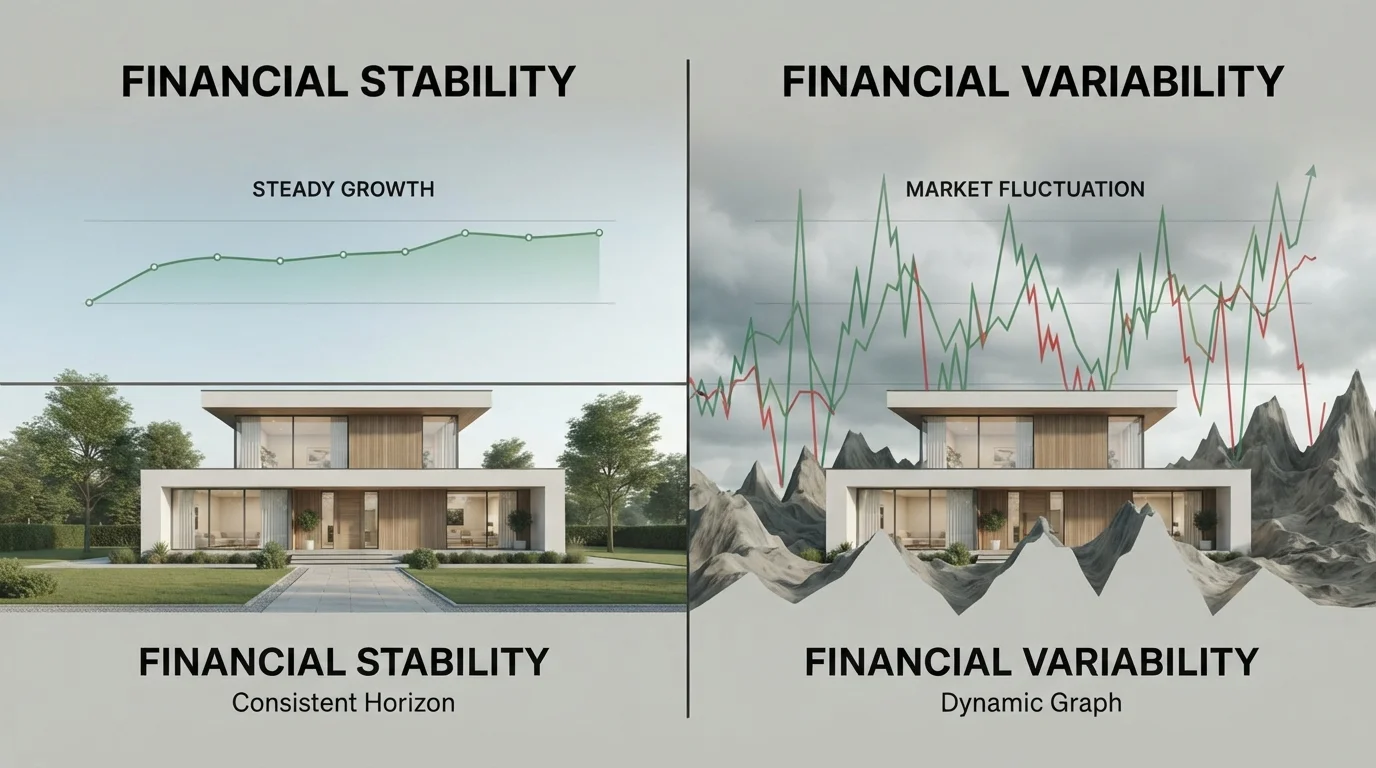
Option A
Fixed-Rate Mortgage
The predictable, long-term stability choice.
Best for: Buyers who plan to stay in their home long-term and want a consistent monthly payment regardless of market conditions.
Option B
Adjustable-Rate Mortgage (ARM)
The flexible, lower-entry-rate alternative.
Best for: Buyers who expect to sell or refinance within a few years and want to take advantage of a lower initial interest rate.
How Each Mortgage Structure Works
A fixed-rate mortgage sets your interest rate at closing and keeps it there for the full loan term - commonly 15 or 30 years. Your principal-and-interest payment stays identical every month, even if market interest rates swing dramatically. Note that your total monthly payment can still change if property taxes or homeowners insurance costs shift - learn more in our guide on how property taxes are calculated.
An adjustable-rate mortgage (ARM) works differently. It begins with a fixed introductory rate - often for 5, 7, or 10 years - and then adjusts periodically based on a benchmark interest rate index, such as the Secured Overnight Financing Rate (SOFR). After the fixed period, the rate recalculates at set intervals (commonly once per year), meaning your monthly payment can go up or down.
ARMs are typically expressed as two numbers: a 5/1 ARM, for instance, has a fixed rate for five years, then adjusts annually. A 7/6 ARM is fixed for seven years and adjusts every six months thereafter.
| Criterion | Fixed-Rate Mortgage | Adjustable-Rate Mortgage (ARM) |
|---|---|---|
| Interest Rate | Locked for entire loan term | Fixed initially, then adjusts periodically |
| Initial Rate | Typically higher than ARM intro rate | Usually lower than fixed-rate equivalent |
| Payment Predictability | Principal & interest never changes | Payment can rise or fall after fixed period |
| Risk Level | Lower - no rate uncertainty | Higher - depends on market rate movement |
| Common Loan Terms | 15-year or 30-year fixed | 5/1, 7/1, 7/6, 10/1 ARM structures |
| Best Time Horizon | Long-term (10+ years in home) | Short-to-medium (under 7-10 years) |
| Rate Caps | Not applicable | Initial, periodic, and lifetime caps apply |
Rate Caps: The Safety Net on Adjustable Loans
One of the most important - and frequently overlooked - features of any ARM is its rate cap structure. Caps limit how much your interest rate can increase, providing some protection against extreme payment shock.
There are typically three types of caps on an ARM:
- Initial cap: The maximum the rate can rise at the first adjustment (commonly 2%).
- Periodic cap: The maximum increase allowed at each subsequent adjustment (often 2%).
- Lifetime cap: The maximum the rate can ever rise above the starting rate over the life of the loan (commonly 5-6%).
For example, on a 5/1 ARM starting at 5.5% with a 2/2/5 cap structure, the rate could never exceed 10.5% - but even that ceiling represents a significant jump in monthly cost. Understanding caps is critical before signing. The same logic applies whenever you compare fixed versus variable rate structures, whether in household budgeting or auto financing.
What Happens When an ARM Adjusts?
At each adjustment date, your lender recalculates your rate by adding a set margin (a fixed percentage determined at origination) to the current benchmark index value. If the index has risen, your rate rises; if it has fallen, your rate may drop. Your lender is required to notify you before any adjustment takes effect, and the new payment amount will be reflected in your next billing statement. Keeping documentation of your cap structure and adjustment schedule from your original loan paperwork is a practical habit for ARM borrowers.
Choosing the Right Structure for Your Situation
There's no universally correct answer - the right mortgage type depends on your financial situation, your risk tolerance, and how long you expect to stay in the home.
Fixed-rate loans are generally a stronger fit if you value long-term stability, are risk-averse, or are purchasing in a low-rate environment where locking in makes financial sense. They also simplify budgeting considerably - similar to how predictable fixed expenses anchor a household spending plan.
ARMs can make practical sense for buyers who have a clear, short-to-medium time horizon - for example, those relocating for a defined work contract or those who realistically expect to refinance within the initial fixed window. The lower introductory rate translates to lower early payments and potentially less interest paid if the loan is closed out before adjustments begin.
Whichever structure you lean toward, consulting with a licensed mortgage professional is strongly advisable before committing. Your lender is required to provide a Loan Estimate disclosing the full cost and terms of any mortgage you apply for - review it carefully and compare multiple offers.
This article is for general informational purposes only and does not constitute personalized financial or mortgage advice. Consult a licensed mortgage professional or financial adviser regarding decisions specific to your situation.
The content on this site is for informational purposes only and is not a substitute for professional advice. Always consult a qualified professional for guidance specific to your situation.