

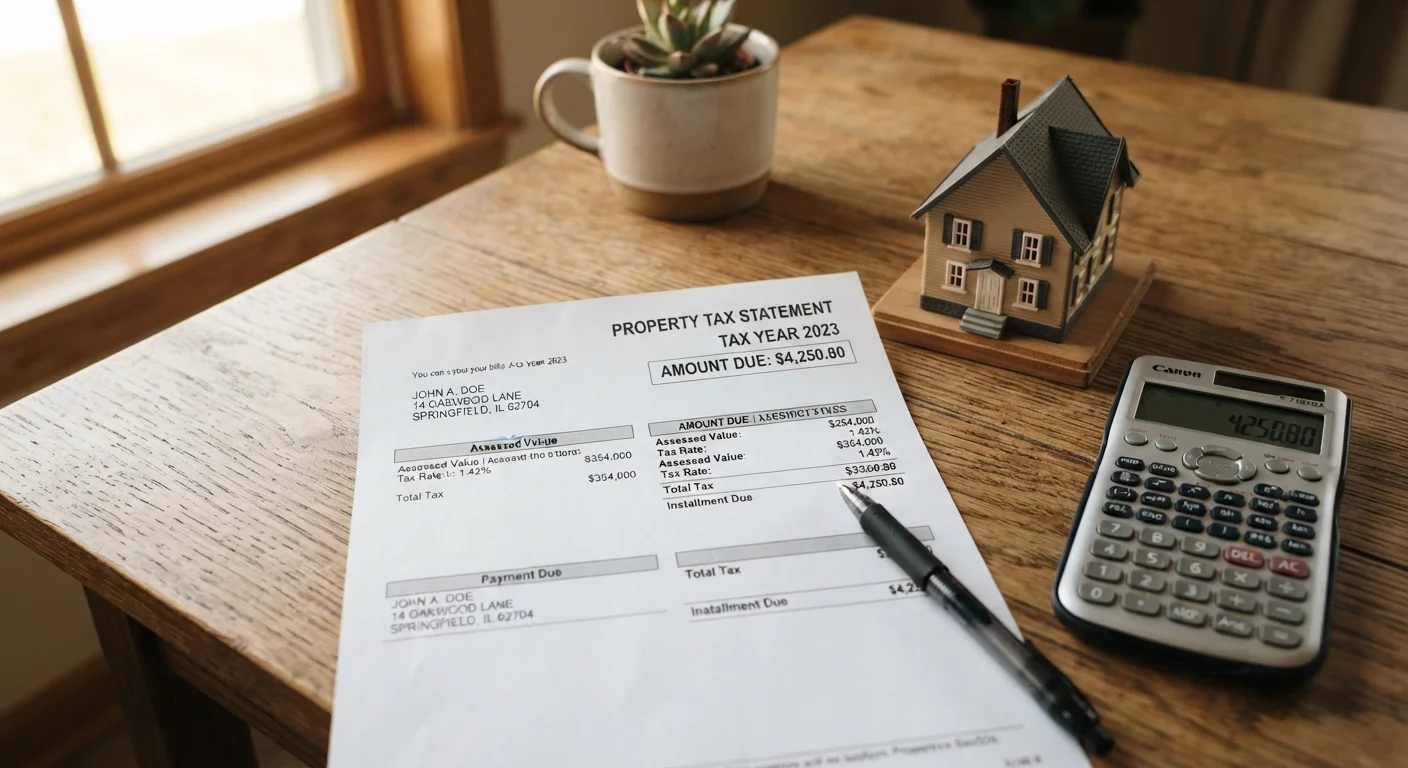
How Property Taxes Are Calculated
Property taxes begin with an assessment - an official estimate of your property's value conducted by a local government assessor. This figure, called the assessed value, is then multiplied by the jurisdiction's mill rate (or tax rate) to produce your annual tax bill.
It's important to understand that assessed value is not the same as market value. Many counties assess property at a set percentage of market value - commonly 80% to 100% - so your assessment may lag behind what your home would actually sell for on the open market. A home with a $400,000 market value assessed at 80% would carry a $320,000 assessed value for tax purposes.
Your total tax bill often reflects multiple overlapping taxing bodies - your county, your municipality, your local school district, and sometimes special districts for services like water or fire protection. Each entity sets its own rate, and those rates are combined into a single bill.
$3,057
Median annual US property tax payment
According to the US Census Bureau's American Community Survey, the median annual real estate tax paid by owner-occupied housing units is approximately $3,057.
Top 1%
States with highest effective property tax rates
New Jersey, Illinois, and Connecticut consistently rank among the states with the highest effective property tax rates in the country, according to data compiled by the Tax Foundation.
~30-60 days
Typical appeal filing window
Most county and municipal assessment review boards require appeals to be filed within 30 to 90 days of the assessment notice date; deadlines vary significantly by jurisdiction.
What Can Change Your Property Tax Bill
Several factors can push your property tax bill higher or lower from one year to the next:
- Reassessment cycles: Many jurisdictions reassess properties periodically - annually, every few years, or upon sale. A rising local housing market can trigger a significant increase in assessed values across the board.
- Local budget decisions: School boards, city councils, and county commissions vote on budgets that determine tax rates. A community approving a new school bond, for example, will likely see a corresponding rate increase.
- Home improvements: Adding a bedroom, finishing a basement, or building a garage can raise your assessed value - and your bill. Permits often trigger reassessment of affected structures.
- Expiring exemptions: If you previously benefited from a tax freeze or temporary exemption that has lapsed, your bill may jump noticeably.
Understanding these drivers helps homeowners anticipate changes rather than be caught off guard. Your mortgage lender adjusts escrow account contributions accordingly - for more on how mortgages and monthly costs interact, see our guide to fixed-rate vs. adjustable-rate mortgages.
Check Your Assessment Card Every Year
Your property record card - available through most county assessor websites - lists the details used to calculate your assessed value, including square footage, bedroom count, and structural features. Reviewing it annually costs nothing and can reveal errors that inflate your bill. If the card lists a finished basement you never built or an extra bathroom that doesn't exist, you have solid grounds for a correction.
Exemptions That Can Lower Your Bill
Most states and localities offer exemptions that reduce the taxable portion of your home's assessed value. The most widely available include:
- Homestead Exemption
- Available in most states for a property that serves as your primary residence. It reduces the assessed value subject to taxation, often by a fixed dollar amount or a percentage.
- Senior Citizen Exemption
- Many jurisdictions offer property tax freezes or reductions for homeowners above a certain age, often with income limitations.
- Veteran and Disability Exemptions
- Service-connected disability ratings or veteran status can qualify homeowners for meaningful reductions, with some states offering full exemptions to qualifying disabled veterans.
Exemptions are not applied automatically in most cases - you typically must apply through your county assessor's office. Deadlines vary, so check with your local office as early as possible. Homeowners carrying other ownership costs such as HOA dues can find it especially valuable to reduce the tax burden where eligible - our HOA fees and rights primer covers the full picture of recurring homeownership costs.
Appealing an Assessment You Believe Is Wrong
If you believe your assessed value is higher than it should be, you have the right to appeal. The general process works as follows:
- Review your assessment notice carefully when it arrives. Check the property details - square footage, bedroom count, lot size - for factual errors. Mistakes in the assessor's records are more common than many homeowners realize.
- Research comparable sales in your neighborhood. If similar homes sold recently for less than your implied market value, that's evidence supporting a lower assessment.
- File a formal appeal within your jurisdiction's deadline, which is often 30 to 90 days from the assessment notice date. Late filings are typically not accepted.
- Present your case to the local review board with documentation: an independent appraisal, photos of property condition issues, or a list of comparable sales.
Many successful appeals are resolved at the informal review stage - simply contacting the assessor's office with evidence may prompt a correction without a formal hearing. If your appeal is denied, most jurisdictions allow further appeal to a state-level board or tax court.
Escrow Accounts and Tax Payments
If you have a mortgage, your lender likely manages an escrow account that collects a portion of your estimated annual property taxes each month. When your taxes change, your lender will adjust your monthly escrow payment - which is why mortgage payments can shift even when your interest rate stays the same. Review your annual escrow analysis statement to understand how any tax changes are affecting your total housing cost.
This article is for general informational purposes only and does not constitute tax, legal, or financial advice. Consult a qualified tax professional or licensed attorney for guidance specific to your situation and jurisdiction.
Frequently Asked Questions
Your bill is calculated by multiplying your property's assessed value by the local tax rate (mill rate). If your home is assessed at $300,000 and your mill rate is 20 mills, you owe $6,000 annually. Some jurisdictions assess at a percentage of market value, so the assessed figure may be lower than what you'd sell for.
Bills can rise due to a higher property assessment, a local government increasing its tax rate, or the expiration of an exemption you previously qualified for. Rising neighborhood home values and local budget increases are the most common drivers.
Yes. Every US jurisdiction provides a formal appeal process, typically through a local review board. You'll need evidence that your assessed value is incorrect, such as a recent independent appraisal or comparable sales data from your area.
Common exemptions include the homestead exemption (for primary residences), senior citizen exemptions, veteran exemptions, and disability-related relief. Eligibility requirements and savings amounts vary widely by state and locality - contact your local assessor's office to find out what applies to you.
Most jurisdictions bill annually or semi-annually, but homeowners with mortgages often pay monthly into an escrow account managed by their lender, which then remits the tax payment on their behalf.
Under current federal law, homeowners who itemize deductions may deduct up to $10,000 in combined state and local taxes (SALT), which includes property taxes. Consult a qualified tax professional for guidance specific to your situation.
The content on this site is for informational purposes only and is not a substitute for professional advice. Always consult a qualified professional for guidance specific to your situation.