

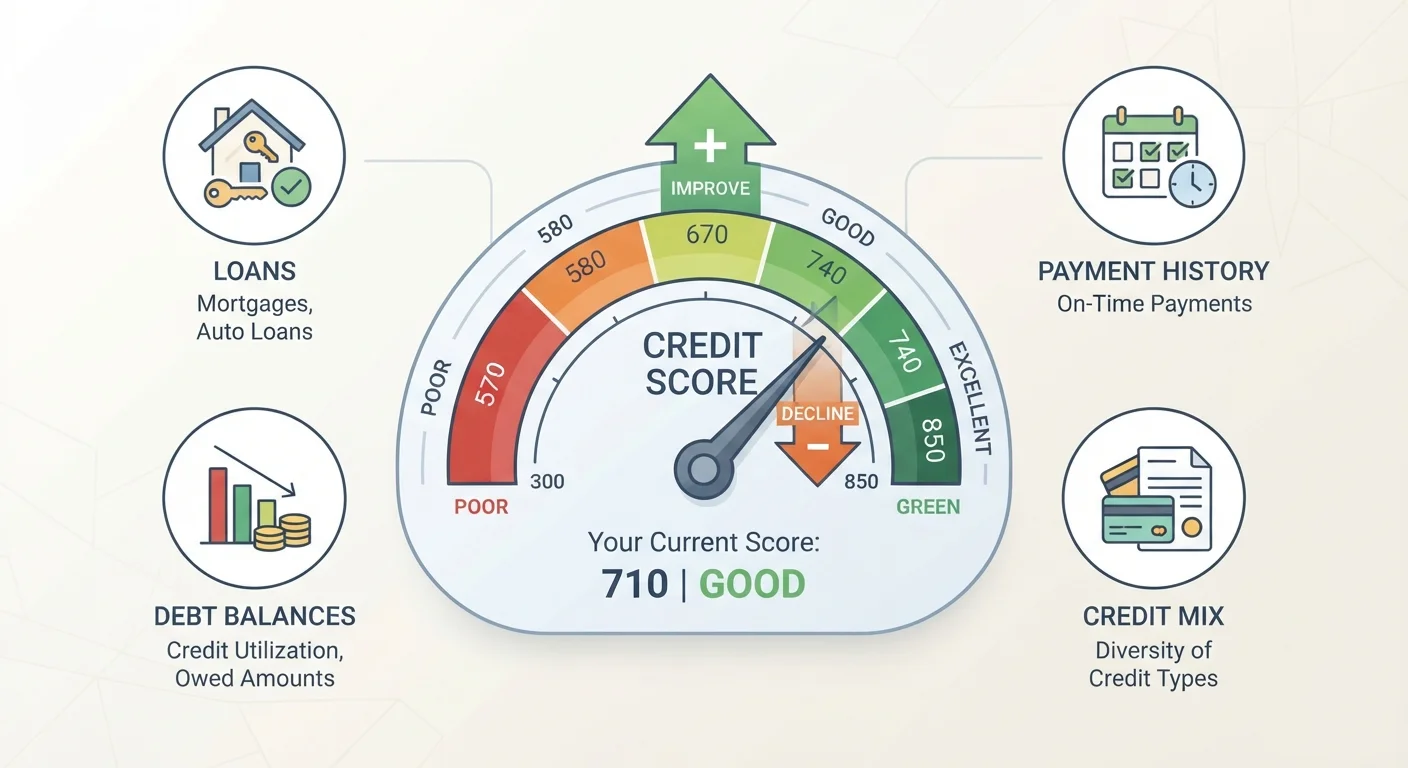
The Moment You Apply: Hard Inquiries
Before a lender approves your loan, they pull your credit report - generating what's called a hard inquiry. This is the first and most immediate credit score movement borrowers notice. A single hard inquiry typically reduces your FICO score by a small number of points, often fewer than five, and the effect generally fades within a few months.
What matters more is how many inquiries accumulate. If you're rate-shopping for a mortgage or auto loan, most scoring models treat multiple inquiries of the same type within a short window (often 14-45 days) as a single event. This lets you compare lenders without compounding the impact. For a deeper look at how loan shopping connects to your score, see how credit scores affect car loan rates.
Rate-Shop Within a Short Window
If you're comparing loan offers from multiple lenders, try to submit all applications within a 14-45 day period. Most major scoring models consolidate inquiries of the same loan type within that window into a single event, limiting the score impact. Spreading applications over several months does not receive this protection.
What Changes on Your Credit Report Right Away
Once a loan is funded, two things happen almost immediately on your credit report:
- A new account appears, which lowers the average age of your credit accounts. Credit history length makes up roughly 15% of your FICO score, so a brand-new account can produce a small, temporary score dip.
- Your total debt balance rises. The "amounts owed" factor - which accounts for 30% of your score - includes the outstanding balance on all your accounts. A large new loan increases this figure, which can lower your score until you've paid it down meaningfully.
If you had only revolving credit (like credit cards) before, adding an installment loan improves your credit mix, a factor worth about 10% of your score. This modest benefit can partially offset the short-term negatives. Learn more about how a related factor works in our guide to credit utilization.
Installment Loans vs. Revolving Credit
Installment loans (personal loans, auto loans, mortgages) have fixed repayment schedules and balances that decrease over time. Revolving credit (credit cards, lines of credit) has flexible balances that can fluctuate month to month. Scoring models treat these differently, which is why adding an installment loan to a credit-card-only profile can improve your credit mix score. For more on how collateral and loan structure differ, see our guide on secured vs. unsecured loans.
The Long Game: Payment History and Score Recovery
Payment history is the single largest factor in your credit score at 35%. Every on-time payment you make on a new loan is reported to the three major credit bureaus - Equifax, Experian, and TransUnion - and incrementally strengthens your profile. This is where borrowing well separates from borrowing carelessly.
Over six to twelve months of consistent payments, many borrowers see their scores recover and often exceed pre-loan levels. The new loan also diversifies your credit file, signaling to future lenders that you can manage structured repayment obligations. Conversely, a single missed payment can undo several months of positive history quickly - the downside risk is asymmetric.
35%
Weight of payment history in a FICO score
According to FICO's published scoring criteria, payment history is the single largest factor determining your credit score.
30%
Weight of amounts owed in a FICO score
FICO's model weights total debt balances and utilization ratios at 30%, making new loan balances an immediate score influence.
< 5 pts
Typical score drop from a single hard inquiry
FICO research indicates most people see fewer than five points removed from a single hard inquiry, with the effect fading within a few months.
If you're new to borrowing and want to understand the full framework before taking on debt, the first-time borrower's introduction to how loans work is a useful starting point. And for a broader view of the factors that chip away at scores silently, see our article on factors that drag your credit score down.
This article provides general financial education and is not personalized financial advice. Consult a licensed financial professional for guidance specific to your situation.
Frequently Asked Questions
A single hard inquiry typically lowers a FICO score by fewer than five points for most people. The effect is temporary and usually fades within a few months. Multiple applications in a short window for the same loan type - such as mortgage shopping - are often grouped as one inquiry by scoring models.
Not necessarily in the long run. There's often a small initial dip due to the hard inquiry and increased debt load, but consistent on-time payments can lift your score above where it started. The net effect depends on your existing credit profile and how you manage repayment.
Positive payment history starts reporting to credit bureaus within one to two billing cycles. Meaningful score improvement from a new installment loan typically becomes visible over six to twelve months of on-time payments.
Paying off a loan removes that debt from your amounts owed, which is generally positive. However, closing the account can slightly shorten your average account age and reduce your credit mix, which may cause a minor temporary dip for some borrowers.
Yes. Installment loans (auto, personal, mortgage) and revolving credit (credit cards) are tracked separately. Having a mix of both types can be a modest positive signal to scoring models, as it shows you can manage different kinds of debt responsibly.
The content on this site is for informational purposes only and is not a substitute for professional advice. Always consult a qualified professional for guidance specific to your situation.