

Our Verdict
Neither product is universally superior - the right choice hinges on how you plan to use the funds and how comfortable you are with rate variability. HELOCs offer flexibility for borrowers with evolving needs, while home equity loans provide predictability for those who want a set repayment schedule from day one.
| Best for | Recommended |
|---|---|
| Homeowners funding a phased renovation or ongoing expenses | HELOC |
| Borrowers consolidating debt or funding a single large project | Home Equity Loan |
| Those who need payment certainty and rate stability | Home Equity Loan |
| Borrowers who want to draw only what they need and repay flexibly | HELOC |
How Each Product Is Structured
Both a Home Equity Line of Credit (HELOC) and a home equity loan let you borrow against the equity you've built in your home - the difference between what you owe on your mortgage and your property's current market value. Beyond that shared foundation, the two products work quite differently.
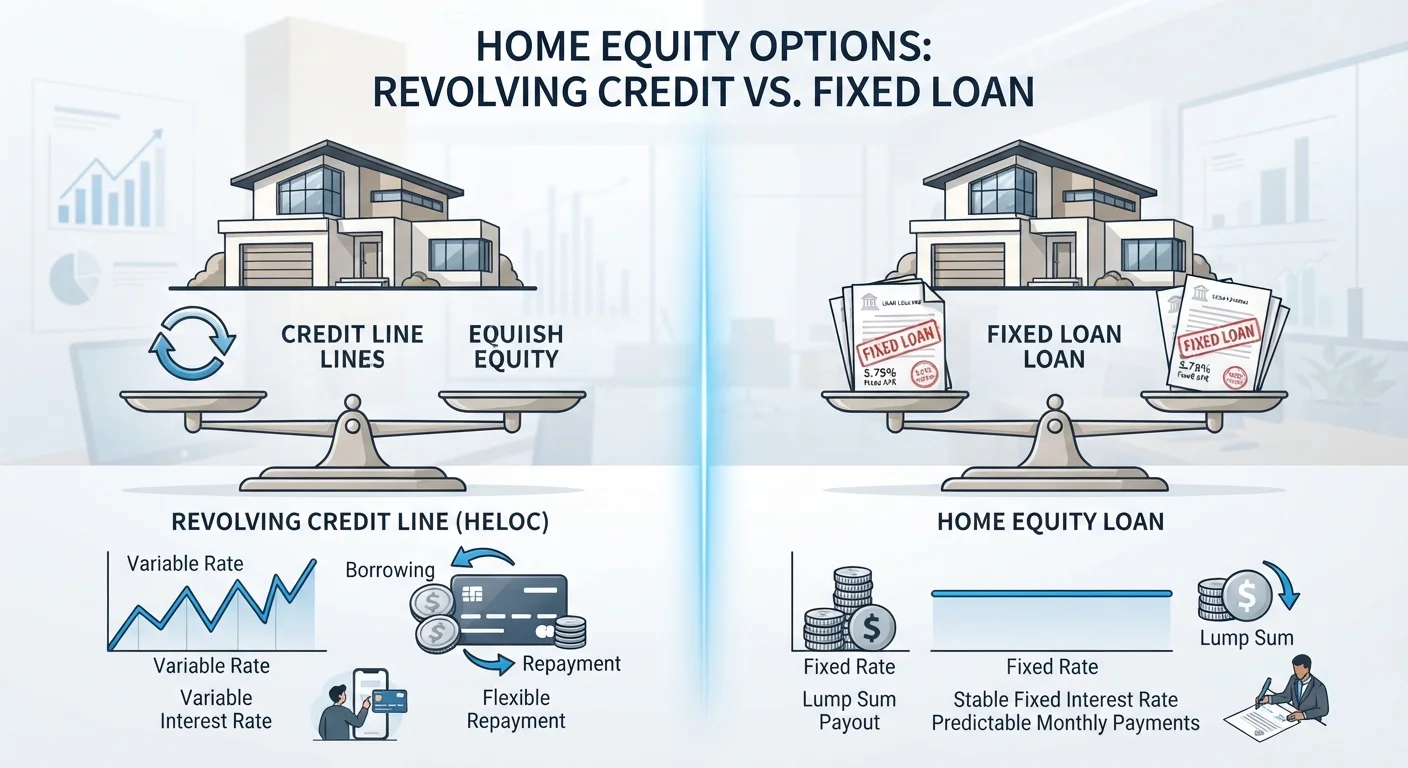
A home equity loan functions like a traditional installment loan. You receive a single lump sum at closing, repay it in fixed monthly payments over a set term (commonly 5-30 years), and the interest rate is fixed for the life of the loan. To understand why the fixed-vs-variable distinction matters so much, see our overview of revolving vs. installment debt structures.
A HELOC, by contrast, is a revolving credit line - similar in mechanics to a credit card. During the draw period (typically 10 years), you can borrow, repay, and borrow again up to your credit limit. After the draw period closes, the repayment period begins, usually lasting 10-20 years. Most HELOCs carry a variable interest rate tied to a benchmark such as the prime rate, which means your monthly payment can change over time.
| HELOC | Home Equity Loan | |
|---|---|---|
| Disbursement | Revolving credit line - draw as needed | Lump sum paid at closing |
| Interest Rate | Typically variable (prime-rate based) | Typically fixed for loan term |
| Monthly Payment | Varies with balance and rate | Fixed and predictable |
| Loan Term Structure | Draw period + repayment period | Single repayment period |
| Best Use Case | Ongoing or phased expenses | One-time defined costs |
| Rate Risk | Higher - payments may rise | Lower - rate locked at closing |
| Collateral | Your home | Your home |
Costs, Rates, and Qualification
Because both products are secured by your home as collateral, lenders typically offer lower interest rates than on unsecured personal loans or credit cards. However, that security cuts both ways - defaulting on either product can ultimately lead to foreclosure. For a broader look at how collateral changes the borrowing equation, see what collateral changes for borrowers.
Both products involve upfront costs: appraisal fees, origination fees, title search charges, and sometimes closing costs of 2-5% of the loan amount. Some lenders waive or reduce HELOC fees in exchange for keeping the line open for a minimum period.
Qualification requirements are broadly similar for both products. Lenders typically look for:
- Combined Loan-to-Value (CLTV) ratio of 85% or below - meaning you retain at least 15% equity after borrowing
- Credit score generally 620 or higher (better terms at 700+)
- Debt-to-income (DTI) ratio typically below 43%
- Verifiable income and a stable payment history
Get Multiple Quotes Before Committing
Interest rates, fee structures, and draw-period terms vary meaningfully between lenders. Requesting loan estimates from at least two or three institutions - including your current mortgage servicer, local credit unions, and banks - gives you a clearer picture of the actual cost of borrowing. Even a small rate difference compounds significantly over a 10- or 20-year repayment term.
Before applying, it's worth revisiting common home equity myths - including the misconception that a HELOC is a low-risk source of free cash.
When Each Option Fits Better
The clearest way to choose is to match the product's structure to how you intend to use the money.
Choose a HELOC if:
- Your project has an uncertain total cost - a multi-stage renovation, for example - and you want to draw only what you need
- You're comfortable with payment variability as interest rates shift
- You want ongoing access to credit rather than a one-time advance
Choose a Home Equity Loan if:
- You have a specific, defined expense: a kitchen remodel with a firm bid, a medical bill, or debt consolidation with a known balance
- You want the certainty of a fixed monthly payment from day one
- Rising interest rates concern you and you prefer to lock in a rate at closing
85%
Typical max CLTV lenders allow
Most lenders require borrowers to retain at least 15% equity in their home after taking out a HELOC or home equity loan.
2-5%
Typical closing cost range
Both HELOCs and home equity loans often carry upfront costs including appraisal, origination, and title fees, though some lenders offer fee reductions.
Neither product is free of risk. Because your home secures the debt, maintaining consistent payments is critical regardless of which option you choose. Consider how each fits within your broader financial picture - and consult a qualified financial adviser if you're unsure which structure makes sense for your circumstances.
This article is for general informational purposes only and does not constitute financial, tax, or legal advice. Consult a licensed financial professional before making borrowing decisions based on your home's equity.
The content on this site is for informational purposes only and is not a substitute for professional advice. Always consult a qualified professional for guidance specific to your situation.