

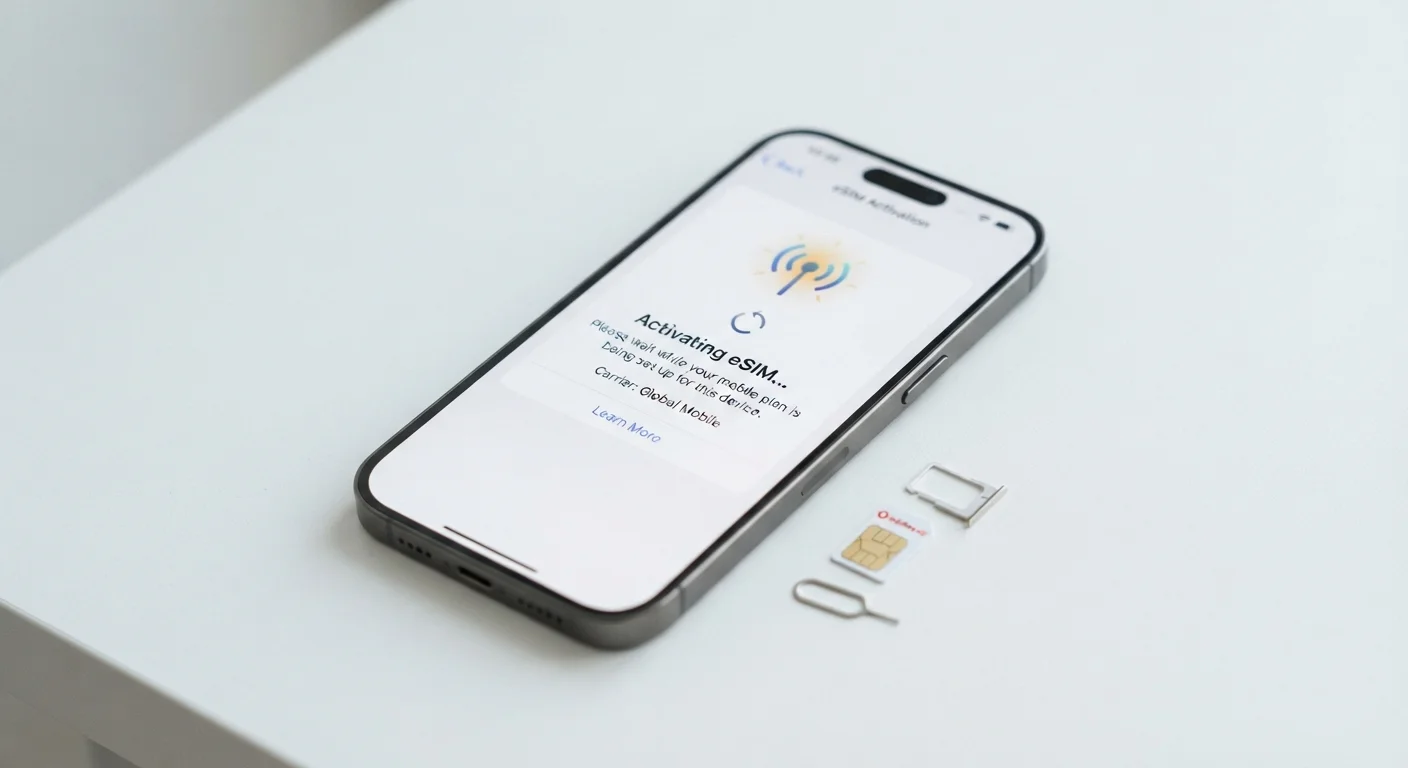
What an eSIM Actually Does
A traditional SIM card is a small plastic chip you slide into a tray on the side of your phone. It stores a unique identifier that tells your carrier's network who you are, which plan you're on, and what your phone number is. Take that card out and the phone loses its connection to the network.
An eSIM does exactly the same thing - but the chip is soldered permanently onto the phone's motherboard. There's no tray, no card to lose, and no physical swap required when you change plans. Instead, your carrier sends you a carrier profile: a bundle of digital credentials that gets downloaded and stored on the eSIM chip. Your phone can hold several of these profiles at once and switch between them in the settings menu.
The underlying radio technology - how your phone communicates with towers - is unchanged. An eSIM doesn't affect call quality, data speeds, or coverage. For a deeper look at what does affect those, see our explainer on 5G vs. LTE and what that means for everyday use.
How eSIM Activation Works in Practice
When you sign up for a plan on a carrier that supports eSIM, the carrier generates a QR code tied to your account. You open your phone's settings, navigate to the cellular or mobile data section, choose to add a plan, and scan the code with your camera. The profile downloads in seconds, and your phone connects to the network almost immediately - no trip to a store, no waiting for a SIM in the mail.
Some carriers skip the QR code entirely and let you activate directly through their app, which is even faster. A few integrate activation into the phone's initial setup flow, so you're connected before you've even reached the home screen.
Keep Your Old Device Nearby During Activation
If you're switching phones and already have an eSIM plan, keep the old device nearby during setup. Some carriers verify your identity by sending a confirmation code to the existing device before authorizing the new one. Having both phones accessible prevents activation from stalling mid-process.
If you're switching phones and already have an eSIM plan, keep the old device nearby during setup. Some carriers verify your identity by sending a confirmation code to the existing device before authorizing the new one.
For everything else you'll want to do when moving to a new phone, our step-by-step phone transfer guide walks through moving contacts, photos, and apps safely.
Why eSIM Matters for Travelers
International travelers are among the people who benefit most from eSIM. Historically, using your phone abroad meant either paying steep roaming fees or hunting down a local SIM card at the airport - which required a working knowledge of the local language, the right adapter size, and physically swapping cards each time you crossed a border.
With eSIM, you can purchase a local data plan before you even board the plane. Several services sell country- or region-specific eSIM profiles that activate the moment you land. Your home number stays active on a separate profile, so you don't miss calls while using local data at local rates.
Travel eSIM Plans Are Often Data-Only
Not every eSIM travel data plan includes voice calls - many are data-only. If you need to receive calls on your home number while abroad, confirm whether your home carrier offers international voice over eSIM, or whether you'll rely on VoIP apps like WhatsApp or FaceTime instead. Reading the plan details before purchase avoids surprises on arrival.
Not every eSIM travel data plan includes voice calls - many are data-only. If you need to receive calls on your home number while abroad, confirm whether your home carrier offers international voice over eSIM, or whether you'll rely on VoIP apps like WhatsApp or FaceTime instead.
For a full breakdown of the tradeoffs between roaming, local SIMs, and eSIM services when traveling internationally, see international roaming vs. local SIM cards.
Are Physical SIM Cards Going Away?
Some newer devices released in the US market ship without a physical SIM tray, relying entirely on eSIM. This approach has advantages for manufacturers - removing the tray creates more internal space and improves water resistance. But it's not yet the global norm.
In many regions, eSIM infrastructure is still maturing. Carriers in developing markets often lack the systems to provision eSIM profiles remotely, and physical SIMs remain the only practical option. Even in the US, not every prepaid or regional carrier supports eSIM.
~50%
Global smartphone shipments with eSIM support
Industry analyst estimates suggest roughly half of all smartphones shipped globally were eSIM-capable by the mid-2020s, a figure rising steadily each year.
200+
Carriers worldwide supporting eSIM
The GSMA has reported that more than 200 mobile operators globally have launched consumer eSIM services across various device types.
Physical SIM cards are unlikely to vanish entirely within the next few years, but the direction of travel is clear. Consumers buying flagship phones today should expect eSIM support to be a given - and in some cases, a requirement. The practical advice: before purchasing any device you plan to use with a specific carrier, verify that carrier's eSIM support for that exact model.
Frequently Asked Questions
Switching is straightforward once your phone is unlocked and the new carrier supports eSIM. You typically scan a QR code the carrier provides, and the new profile downloads in minutes. The main friction point is carrier lock - a locked phone can only use one carrier's eSIM profiles.
Most major US carriers - including AT&T, T-Mobile, and Verizon - support eSIM on compatible devices. Smaller regional and prepaid carriers are catching up, but support isn't universal. Always confirm eSIM availability with your specific carrier before purchasing a device expecting eSIM-only use.
eSIM profiles don't transfer automatically like files do. You'll generally need to contact your carrier to deactivate the profile on the old device and activate a new one on the replacement. Some carriers make this easy through their app; others require a phone call.
Yes - many phones sold globally support what's called a Dual SIM, Dual Standby (DSDS) configuration, with one physical nano-SIM tray and one eSIM. This lets you run two numbers simultaneously, which is useful for separating work and personal lines.
Not immediately, but the trend is clear. Some newer flagship devices ship without a physical SIM tray in certain markets. Physical SIMs remain dominant globally, especially in markets where digital infrastructure for eSIM provisioning is still developing.
eSIMs are generally considered harder to physically steal or clone because there's no card to remove. However, SIM-swapping fraud - where a bad actor convinces a carrier to transfer your number - is a risk with both SIM types and is a carrier security issue, not a hardware one.
The content on this site is for informational purposes only and is not a substitute for professional advice. Always consult a qualified professional for guidance specific to your situation.