

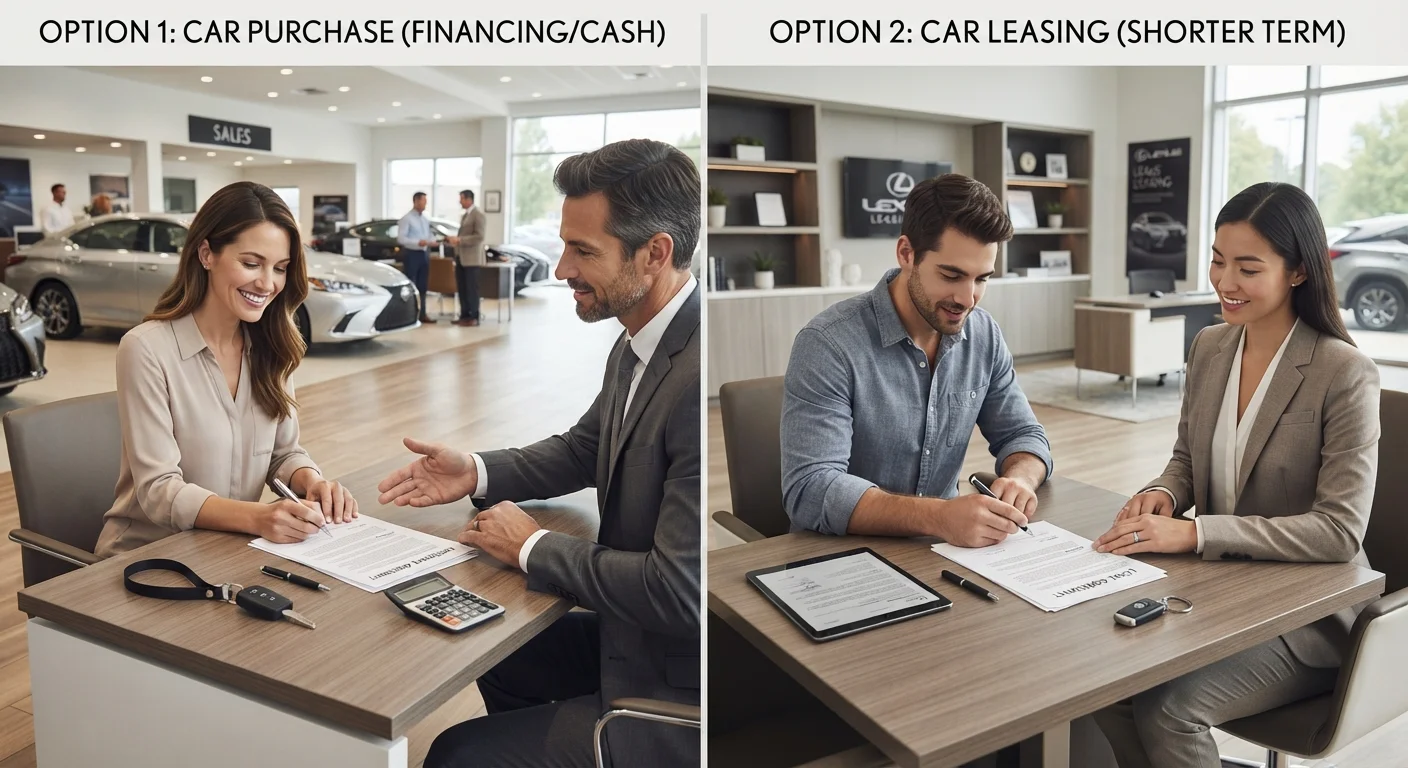
Option A
Leasing a Car
The lower-commitment, lower-monthly-payment option.
Best for: Drivers who want a newer vehicle every few years with predictable monthly costs and no long-term ownership responsibility.
Option B
Buying a Car
The long-term, equity-building ownership path.
Best for: Drivers who want full ownership flexibility, plan to keep the vehicle long-term, and drive high annual mileage.
How Each Path Works
When you lease a vehicle, you are essentially paying to use it for a set period - typically 24 to 39 months. The monthly payment is calculated based on the car's expected depreciation during that term, plus interest (called the money factor) and fees. At the end of the lease, you return the vehicle or, in some cases, have the option to purchase it at a predetermined residual value.
When you buy a vehicle - whether with cash or through an auto loan - you take legal ownership. If you finance, monthly payments cover principal plus interest until the loan is paid off, at which point you own the car outright. The full range of ownership responsibilities and costs that come with that are worth understanding; see our breakdown of real car ownership costs for a detailed look at what drivers typically pay annually beyond the sticker price.
| Criterion | Leasing | Buying |
|---|---|---|
| Monthly Payment | Generally lower | Generally higher |
| Ownership at End of Term | None (return or purchase option) | Full ownership |
| Mileage Limits | Yes - penalties for overages | No limits |
| Customisation | Very limited | Unrestricted |
| Long-Term Cost | Higher if leasing continuously | Lower once loan is paid off |
| Warranty Coverage | Usually covers full lease term | Expires; repairs become owner's cost |
| Early Exit Flexibility | Costly - steep termination fees | More flexible - sell or trade in |
| Wear and Tear Risk | Fees for excess wear at return | No penalty; affects resale value only |
The Financial Trade-Offs in Plain Terms
Monthly lease payments are generally lower than loan payments for an equivalent vehicle because you are financing only a portion of the car's value, not the whole thing. That can free up cash flow in the short term. However, over many years, continually leasing means you are always paying - there is no payoff date and no owned asset at the end.
Buying costs more month-to-month initially, but once the loan is retired, your transportation cost drops dramatically. Drivers who hold onto a paid-off car for several years after the loan ends typically come out ahead financially compared to perpetual lessees - assuming reasonable maintenance costs.
~55%
Share of new vehicles financed via loans
According to Experian's State of the Automotive Finance Market report, the majority of new vehicle transactions involve traditional financing rather than leasing.
$0.15-$0.25
Typical per-mile overage fee in a lease
Industry-standard lease contracts commonly charge between 15 and 25 cents for every mile driven beyond the annual cap, per Edmunds research.
3-4 years
Average US auto loan term at origination
While longer 60- to 84-month loans are common, the Consumer Financial Protection Bureau notes that extended terms significantly increase total interest paid.
There are also tax considerations for business owners who use their vehicle professionally, but those rules are nuanced and vary by situation. A qualified tax professional can clarify what applies to your circumstances.
Restrictions, Flexibility, and Day-to-Day Ownership
Leases come with a set of built-in restrictions that buyers never encounter. The most common are mileage caps - usually 10,000 to 15,000 miles per year. Exceeding the cap triggers per-mile fees (often $0.15-$0.25 per mile) that can add up to a significant bill at lease return. Lessees are also responsible for keeping the vehicle in good condition; anything deemed excess wear and tear - dents, stained upholstery, bald tires - can generate additional charges.
Buyers face none of those restrictions. You can drive as many miles as you wish, skip a detail job, and install aftermarket accessories without penalty. That freedom also means you carry more responsibility: when something breaks after the warranty expires, the repair bill is entirely yours.
Lease-End Purchase Option Explained
Most lease agreements include a buyout clause that lets you purchase the vehicle at a set residual value when the lease expires. This can be advantageous if the car's market value is higher than the residual price, or if you simply want to keep a car you have come to rely on. However, you are under no obligation to buy - returning the vehicle and walking away is the default outcome. Review any buyout terms carefully before signing a lease agreement.
Early termination is another key difference. Exiting a lease before it ends typically involves steep fees - sometimes equal to several remaining payments. Selling or trading in an owned vehicle, while not always straightforward, is generally more flexible.
Which Path Fits Your Situation?
Neither leasing nor buying is universally superior - the right answer depends on how you use a vehicle and what you value most. Consider these factors:
- Annual mileage: Consistent high mileage favors buying. Low or predictable mileage fits leasing well.
- Length of commitment: If your living situation or lifestyle may change, a three-year lease is a shorter obligation than a five- or six-year loan - though early exit from either can be costly.
- Desire for the latest features: Leasing lets you cycle into newer technology and safety features more regularly.
- Long-term financial goals: Ownership builds equity; leasing does not. If eliminating a car payment eventually matters to you, buying is the logical path.
Drivers weighing these decisions are essentially navigating a rent-vs.-own question similar to what homeowners face - for a broader perspective on that dynamic, the article Renting vs. Buying: Weighing the Real Trade-Offs explores parallel financial and lifestyle considerations.
This article is for general informational purposes only and does not constitute financial or legal advice. Consult a qualified professional regarding your specific financial situation before making a vehicle financing decision.
The content on this site is for informational purposes only and is not a substitute for professional advice. Always consult a qualified professional for guidance specific to your situation.