

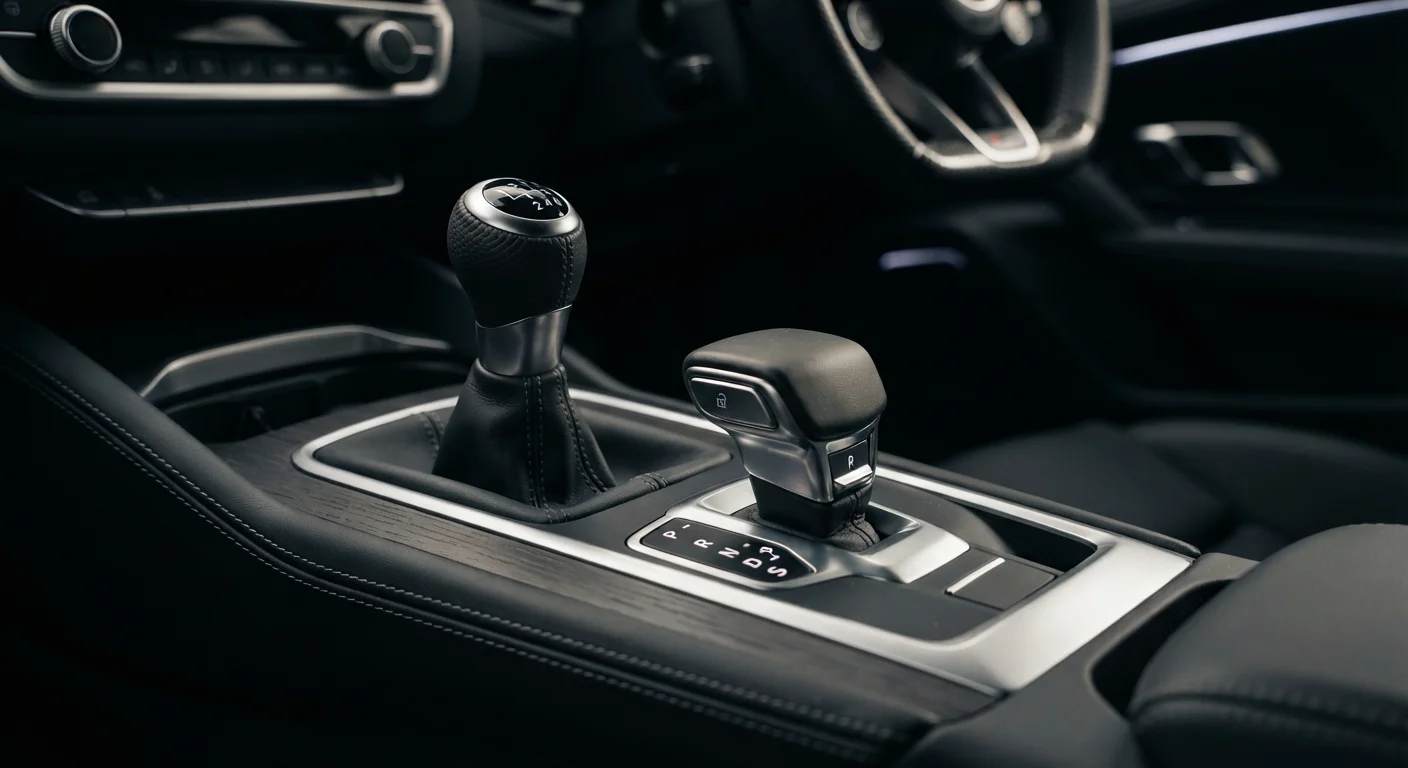
Option A
Manual Transmission
The driver-controlled, hands-on gearbox.
Best for: Drivers who want direct control over gear selection, engine braking, and vehicle behavior on varied terrain.
Option B
Automatic Transmission
The self-shifting, convenience-focused gearbox.
Best for: Drivers who prioritize ease of use, heavy traffic commuting, and a lower physical workload behind the wheel.
How Each Transmission Works
A manual transmission - sometimes called a standard or stick shift - requires the driver to press a clutch pedal to disengage the engine from the drivetrain, select a gear using the gearstick, and then release the clutch to re-engage power. This process happens dozens or even hundreds of times during a typical drive.
An automatic transmission performs this gear-selection process on its own, using hydraulic systems, sensors, and software to determine when to shift based on vehicle speed and engine load. The driver uses only the accelerator and brake pedals. Modern automatics include continuously variable transmissions (CVTs) and dual-clutch automatics, which shift faster than most human inputs can.
Understanding these mechanical differences is the foundation for understanding how each transmission affects control, safety, and driving behavior.
| Criterion | Manual Transmission | Automatic Transmission |
|---|---|---|
| Driver input required | Clutch + gear selection | Accelerator and brake only |
| Engine braking control | Direct, driver-selected | Limited; some modes available |
| Stop-and-go traffic ease | Physically demanding | Low effort |
| Hill-start difficulty | Requires learned technique | Assisted by hill-hold systems |
| US market availability | Increasingly limited | Dominant across most segments |
| Skill threshold | Higher learning curve | Accessible to most drivers |
| Driver engagement | High - active involvement | Low - passive operation |
Control, Hill Starts, and Slippery Conditions
One of the most practical distinctions between transmission types shows up on hills and in low-traction situations. With a manual, an experienced driver can use engine braking - downshifting to a lower gear to slow the vehicle using engine resistance rather than relying solely on the brakes. This is particularly useful on long descents, where repeated brake use can cause brake fade (a loss of braking effectiveness due to heat buildup).
Manual transmissions also allow deliberate control of wheel torque on ice or loose surfaces. A skilled driver can select a higher gear at low speed to reduce torque and minimize wheelspin. However, this requires experience - an improperly managed manual in slippery conditions can cause stalling or loss of control just as easily as it can help.
Automatics have narrowed this gap considerably. Many modern automatic vehicles include hill-start assist (a system that briefly holds brake pressure during a hill start to prevent rolling) and traction control systems that automatically manage wheelspin. For most everyday drivers, these electronic aids deliver effective control without requiring manual gear selection.
~98%
US new car sales with automatic transmissions
Industry sales data consistently shows that nearly all new passenger vehicles sold in the United States are equipped with automatic transmissions.
3-5 sec
Typical hill-start window without assist
Drivers on steep grades without hill-start assist have a narrow window to engage the clutch or throttle before a vehicle rolls - a challenge that disproportionately affects less experienced manual drivers.
Traffic, Fatigue, and Everyday Driving Demands
In urban stop-and-go traffic, the manual transmission's demands become significant. Repeatedly pressing and releasing the clutch - sometimes hundreds of times in a single commute - contributes to left-leg fatigue and divided attention. Drivers must simultaneously monitor traffic, manage clutch engagement, and select appropriate gears. For drivers still building comfort with the skill, this splits focus away from hazard awareness.
Automatic transmissions reduce this workload substantially. With no clutch pedal to manage, drivers can concentrate more fully on mirrors, signaling, pedestrian activity, and spacing. This cognitive advantage is especially relevant in high-density driving environments.
That said, some research in driver behavior suggests that greater engagement - as required by a manual - can reduce passive inattention for experienced drivers. The key word is experienced: for those still developing clutch coordination, the added demand is a distraction, not a benefit.
For a broader look at how driving decisions interact with financial planning around vehicle ownership, see our overview of auto loan structures - understanding your financing is just as important as knowing your transmission.
Availability, Licensing, and Practical Considerations
In the US, automatic transmissions dominate new vehicle sales, making manual-equipped vehicles increasingly rare outside of performance-oriented or specialty segments. A driver trained exclusively on an automatic may find their options limited if they ever need to operate a manual vehicle - whether a rental abroad, a work vehicle, or a borrowed car in an emergency.
Some states and countries require separate licensing endorsements or tests for manual vehicles. While this is not uniformly enforced across US states, it underscores the distinct skill set a manual requires.
From a maintenance standpoint, manual clutches wear over time and require eventual replacement - a cost that varies considerably by vehicle type and driving habits. Automatic transmissions carry their own service requirements, including fluid changes at manufacturer-recommended intervals. Neither type is inherently more or less expensive to maintain across the board; total cost depends on the specific vehicle and usage patterns.
Navigating road conditions confidently - whether managing a hill start or merging into fast-moving traffic - connects to broader driving awareness skills. Our comparison of roundabouts versus traditional intersections explores how infrastructure design similarly demands adaptable driver responses.
CVTs and Dual-Clutch Automatics
Not all automatics behave identically. A continuously variable transmission (CVT) uses a belt-and-pulley system to provide seamless acceleration without distinct gear steps, which some drivers find unfamiliar. A dual-clutch automatic (DCT) uses two separate clutch packs for odd and even gears, enabling faster shifts than a traditional automatic. If you are evaluating a specific vehicle, it is worth confirming which automatic variant it uses, as driving feel and maintenance needs can differ.
The content on this site is for informational purposes only and is not a substitute for professional advice. Always consult a qualified professional for guidance specific to your situation.