

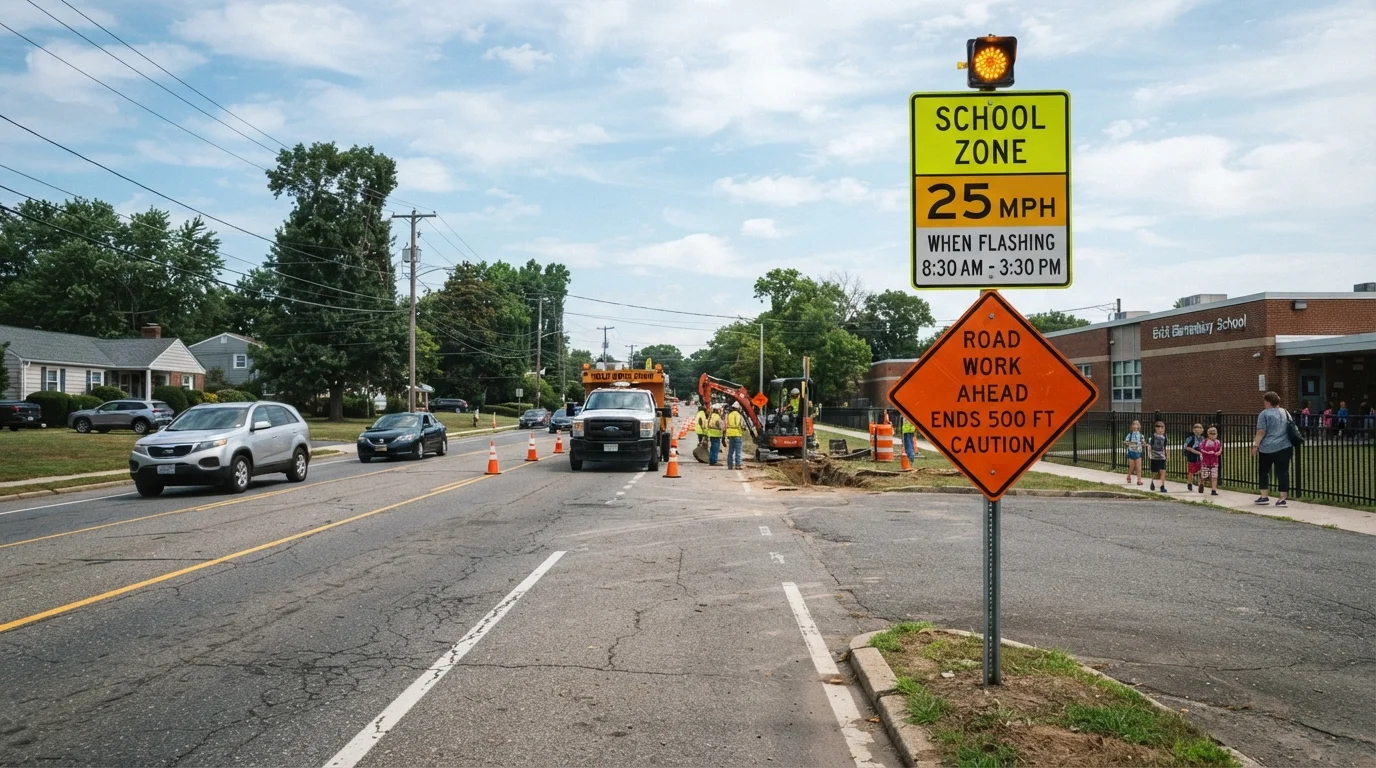
Why These Zones Have Their Own Rules
Standard posted speed limits reflect conditions on a typical road during typical traffic. School zones and work zones are anything but typical - they introduce pedestrians, children, construction workers, equipment, and unpredictable hazards that standard limits aren't designed to address.
As a result, every state in the US establishes separate speed requirements for these areas, backed by enhanced penalties. The details vary significantly from state to state, which is why understanding the general framework - and knowing to look for your specific state's rules - is essential for any driver.
For broader context on when the posted limit isn't always the safe speed, see our article on situational speed awareness.
| Typical school zone speed | 15-25 mph (Varies by state) |
| Common fine multiplier in school zones | 2x-3x standard fine (Varies by state) |
| Work zone speed sign color | Orange (Federal Highway Administration standard) |
| States with work zone camera enforcement | Several, including IL, MD, AZ (State DOT programs) |
| When work zone limit begins | At the first posted warning sign (General standard across most states) |
School Zone Speed Laws: What Changes and When
Most states set school zone speeds between 15 and 25 mph, but the triggering conditions matter just as much as the number itself. Speed restrictions in school zones typically apply during the following windows:
- When children are present: Some states use this broad standard, meaning the limit applies any time a child is visible near the roadway - regardless of the time of day.
- During school hours: Other states specify fixed time windows (often 7-8 a.m. and 2:30-4 p.m.) during school days.
- When lights are flashing: Many jurisdictions use flashing beacons to signal when a reduced-speed zone is active. If the lights are not flashing, the standard limit may apply.
Penalties for school zone violations are steep. Most states impose fines that are double or triple the standard amount, and some add mandatory court appearances or points on a license. In several states, a second offense within a set period carries automatic license suspension.
School Zone
A designated area surrounding a school where reduced speed limits apply to protect children. The exact boundaries and active hours vary by state and municipality.
Work Zone
A temporary section of roadway where construction, maintenance, or utility work is underway. Reduced speed limits and enhanced penalties typically begin at the first posted warning sign.
Enhanced Penalty
A fine or consequence that is multiplied - often doubled or tripled - when a traffic violation occurs in a designated safety zone such as a school or work zone.
Automated Speed Enforcement
Camera-based systems that record vehicle speed and issue citations without a law enforcement officer present. Used in some states specifically in school or work zones.
When Children Are Present Standard
A legal trigger used in some states that activates school zone speed limits any time a child is visible near the roadway, rather than during fixed time windows.
One critical consistency: school zones are typically enforceable year-round in some states, not only during the academic year. Always verify whether the zone applies on holidays and summer breaks in your state.
Work Zone Speed Laws: Active vs. Posted
Work zones introduce a separate layer of complexity. Unlike school zones, which are fixed locations, work zones are temporary and can move. Their boundaries are marked by orange signs, and the reduced-speed requirement begins at the first warning sign - not at the construction equipment itself.
Most states distinguish between two situations in a work zone:
- Workers present: When construction workers are actively in or near the roadway, fines are typically doubled and, in some states, tripled. A minimum mandatory fine applies regardless of the standard penalty schedule.
- Workers not present: Some states enforce the reduced posted speed even when no workers are in the zone. Others revert to standard enforcement. Drivers should not assume an empty work zone means normal rules apply.
~700
Work zone fatalities annually in the US
According to the Federal Highway Administration, approximately 700 people are killed in US work zones each year.
2x
Minimum fine multiplier in most states' work zones
The majority of US states double fines for speeding in active work zones when workers are present.
25 mph
Most common school zone speed limit
25 mph is the most frequently set school zone speed across US states, though many localities use 15 or 20 mph.
Many states have also adopted automated speed enforcement - cameras - specifically in work zones. These systems can issue citations based on recorded speed alone, often without a law enforcement officer present. Arizona, Illinois, Maryland, and several other states have established or expanded such programs.
Repeat offenders in work zones face escalating consequences. Some states require drivers who accumulate multiple work zone violations to attend driving safety courses or face mandatory license suspension.
Key Differences Across States
Because traffic law is primarily governed at the state level, there is no single national rule for these zones beyond broad federal guidelines tied to highway funding. Here are categories where states diverge most:
- Default speed: School zone speeds range from 15 mph (common in many states) to 25 mph (common in others). Work zone reductions vary from fixed limits to percentage reductions off the normal posted speed.
- Enforcement windows: Some states have time-of-day restrictions; others use a "when active" or "when children are present" standard.
- Fine structure: Minimum fines, multipliers, and surcharges differ widely. A violation that costs $150 in one state may cost $500 or more in another.
- Automated enforcement: Camera-based ticketing is legal in some states and explicitly banned in others.
Drivers who frequently cross state lines - including commercial drivers - are responsible for knowing the rules of each state they travel through. Ignorance of local law is not a valid defense in traffic court.
Understanding reduced-speed zones is one piece of the larger picture of road safety rules. For a clear breakdown of who has the right of way at intersections and other common confusion points, see our guide on right-of-way rules that confuse even experienced drivers.
This article provides general information about traffic laws for educational purposes only. Speed laws vary by state and locality. Always consult your state's Department of Motor Vehicles or official transportation agency for the specific rules that apply where you drive.
The content on this site is for informational purposes only and is not a substitute for professional advice. Always consult a qualified professional for guidance specific to your situation.