

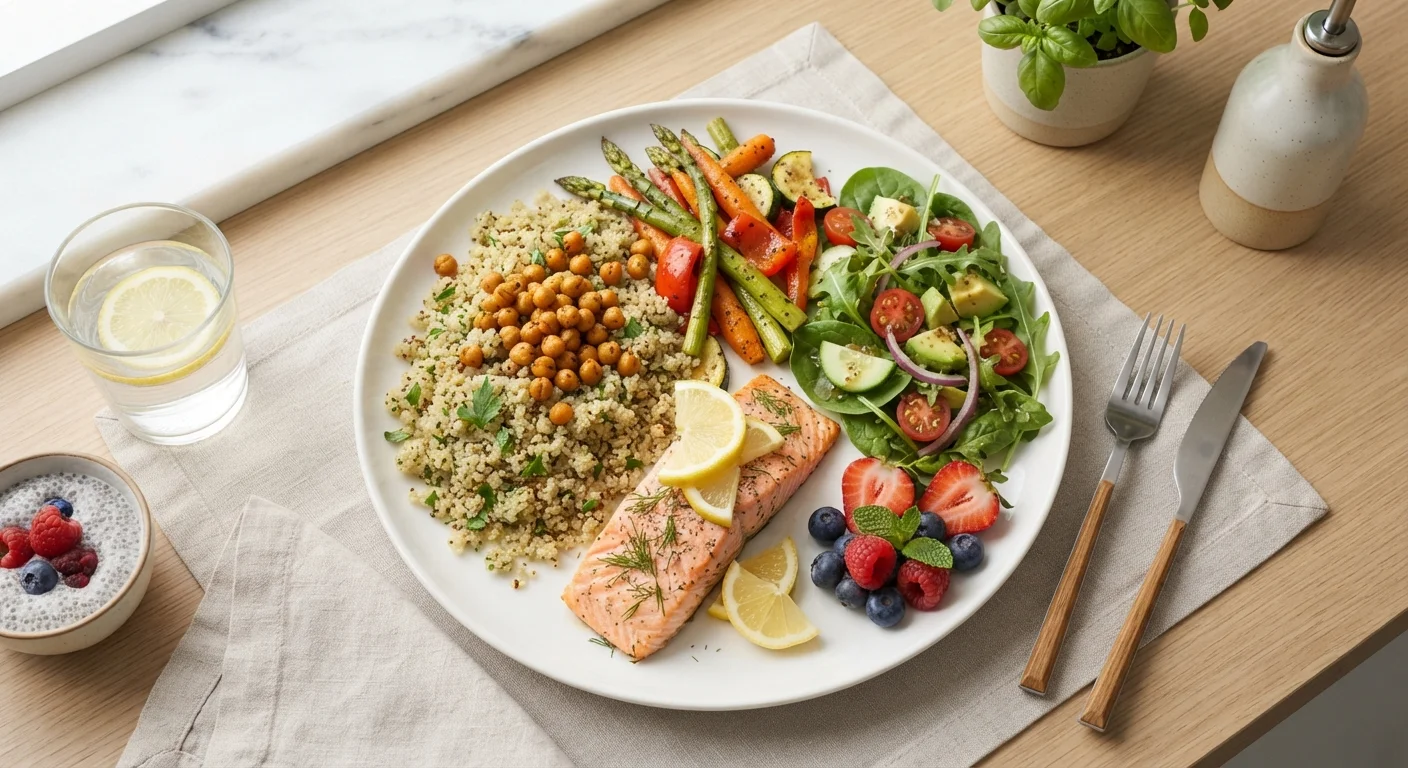
What Does a Balanced Plate Actually Mean?
The phrase "balanced plate" gets used so often it risks losing meaning. At its core, it refers to eating meals that include a meaningful variety of nutrient-providing foods in reasonable proportions - rather than defaulting to a single food type or excluding entire categories without a medical reason.
The USDA's MyPlate framework, developed to reflect current Dietary Guidelines for Americans, offers one widely used reference model: roughly half the plate occupied by fruits and vegetables, about a quarter by grains (with an emphasis on whole grains), and the remaining quarter by protein foods, accompanied by a serving of dairy or a fortified alternative. This isn't a rigid prescription - it's a visual tool designed to shift proportions in a more health-supporting direction.
It's worth noting that "balance" looks different across cultures, health conditions, and life stages. A general framework gives you a starting point, but individual needs vary. For guidance specific to your health situation, a registered dietitian is the most qualified resource.
Start With What's Already on Your Plate
Before making any changes, spend a few days noticing what you currently eat without judgment. Awareness of existing patterns is more useful than immediately adopting a new framework. Small, targeted adjustments to an existing routine tend to stick better than wholesale replacements.
The Major Food Groups and Why Each Matters
Understanding what each food group contributes helps you make more intentional choices rather than following rules you don't understand.
- Vegetables and fruits supply fiber, vitamins, minerals, and antioxidants. Variety within this group matters - different colors generally signal different phytonutrients. See our plain-language vitamins and minerals reference for a breakdown of what specific nutrients do and where to find them.
- Whole grains (such as oats, brown rice, and whole wheat) provide sustained energy from complex carbohydrates, along with B vitamins and fiber. Refined grains have had much of this stripped away during processing.
- Protein foods - including legumes, nuts, seeds, eggs, seafood, poultry, and meat - support muscle maintenance, immune function, and countless enzymatic processes. Plant and animal sources each have distinct nutritional profiles; our article on plant-based vs. omnivorous eating explores those trade-offs in depth.
- Dairy and fortified alternatives are primary sources of calcium and vitamin D for many Americans, though these nutrients can also be obtained through other foods.
- Healthy fats - from sources like avocados, olive oil, and fatty fish - support brain function and fat-soluble vitamin absorption. Fats are not a food group to eliminate.
1 in 10
Americans meet vegetable intake recommendations
According to CDC data, only about 10% of U.S. adults consume the recommended amount of vegetables daily.
~57%
of U.S. calories come from ultra-processed foods
A study published in the journal BMJ Open estimated that ultra-processed foods account for more than half of daily caloric intake for the average American.
3x
Higher fiber intake linked to gut microbiome diversity
Research in Nature Reviews Gastroenterology & Hepatology links high dietary fiber variety to significantly greater gut microbiome diversity compared to low-fiber diets.
Portion Awareness Without Calorie Obsession
Obsessively counting every calorie is, for most people, neither practical nor psychologically sustainable. Portion awareness - developing a general sense of how much of each food type you're eating relative to others - is a more manageable approach for everyday life.
A few practical reference points that don't require a scale:
- A serving of protein (cooked) is roughly the size of your palm.
- A serving of grains or starchy vegetables is approximately the size of your closed fist.
- A tablespoon of oils or nut butters is roughly the size of your thumb tip.
These are approximations, not clinical targets. The goal is pattern awareness - noticing if protein has been crowded off the plate, or if vegetables have gone missing for several days in a row.
Portion Guidance Is Not a Personal Prescription
The portion reference points in this article are general educational tools, not individualized targets. Caloric and macronutrient needs vary significantly based on age, body size, activity level, health status, and other factors. Do not use general guidelines to set strict personal targets without input from a qualified healthcare professional or registered dietitian.
Building Variety Into Your Everyday Meals
Eating the same five foods every week - even healthy ones - limits the range of micronutrients your diet delivers. Variety is one of the most evidence-supported principles in nutrition: broader dietary diversity correlates with better gut microbiome health and more complete micronutrient intake in population studies.
Practical strategies for increasing variety without overhauling your entire routine:
- Rotate your grain base - alternate between rice, quinoa, farro, and whole wheat pasta rather than defaulting to one.
- Try one new vegetable per grocery trip. Unfamiliar produce is often inexpensive and easy to prepare simply.
- Vary your protein sources across the week - including at least some plant-based options like lentils or chickpeas, regardless of your broader dietary pattern.
- Experiment with different herbs and spices rather than sauces high in sodium or added sugar. Spices also contribute bioactive compounds worth including.
If budget is a concern, variety doesn't have to mean expensive. See our guide on eating well on a budget for practical, cost-conscious approaches.
When building a meal, try filling your plate with vegetables first before adding grains and protein. This simple sequence naturally adjusts proportions without any measuring.
Visual sequencing is a behavioral strategy used by registered dietitians to help clients shift meal composition without relying on rigid rules or calorie tracking.
Frozen vegetables are nutritionally comparable to fresh and are often more affordable and longer-lasting - don't overlook them as a practical everyday staple.
Freezing vegetables shortly after harvest preserves most heat-sensitive vitamins, making frozen produce a legitimate whole-food option supported by food science research.
Common Eating Habits That Undermine Balance
Many eating patterns that fall short of balance aren't the result of bad choices - they're the result of convenience, habit, or misinformation. Our companion article on popular nutrition myths covers some of the most widespread misconceptions in detail, but a few patterns frequently appear in practice:
- Skewing heavily toward one macronutrient - such as very high protein with minimal carbohydrates, or low fat diets that inadvertently cut out beneficial fats - often reflects a diet trend rather than a nutritional need.
- Eating the same few meals repeatedly reduces dietary diversity even when each individual meal is reasonably healthy.
- Relying heavily on ultra-processed foods - those with long ingredient lists of additives, stabilizers, and refined components - tends to displace whole foods and reduce overall nutrient density.
- Skipping meals can disrupt hunger regulation for some people, making it harder to make considered food choices later in the day.
Avoid Eliminating Entire Food Groups Without Guidance
Cutting out whole food groups - carbohydrates, fats, dairy - without a specific medical reason or professional supervision can lead to nutritional gaps over time. Some nutrients have limited alternative sources, and deficiencies may develop gradually before symptoms appear. If you're considering a significantly restrictive dietary pattern, work with a registered dietitian to ensure you're meeting your needs.
Making Sustainable Changes Over Time
The most nutritionally sophisticated diet is the one you can actually maintain. Abrupt, sweeping dietary overhauls have a poor track record for long-term adherence. Incremental shifts - adding a vegetable serving, swapping a refined grain for a whole grain, reducing sugary beverages - tend to compound into meaningful changes over months and years.
Physical activity and nutrition also work in tandem. Explore the Fitness & Exercise hub for guidance on building a complementary active routine. Similarly, the relationship between food, mood, and mental well-being is increasingly well-documented; our article on building a personal mental wellness routine addresses this connection.
No single article - including this one - replaces individualized guidance. If you have a chronic condition, are pregnant, managing a digestive disorder, or have specific nutritional goals, a registered dietitian can assess your actual dietary intake and make tailored recommendations. General principles are a useful starting point; professional guidance is how you apply them to your life.
This article is for general informational and educational purposes only and does not constitute medical or nutritional advice. Consult a qualified healthcare provider or registered dietitian before making significant changes to your diet, especially if you have an existing health condition.
“There is no such thing as a perfect diet. What matters most is the overall pattern of eating over time - consistent variety, adequate vegetables, and minimally processed foods - not perfection at any single meal.”
— Walter Willett, Professor of Epidemiology and Nutrition, Harvard T.H. Chan School of Public Health
The content on this site is for informational purposes only and is not a substitute for professional advice. Always consult a qualified professional for guidance specific to your situation.