

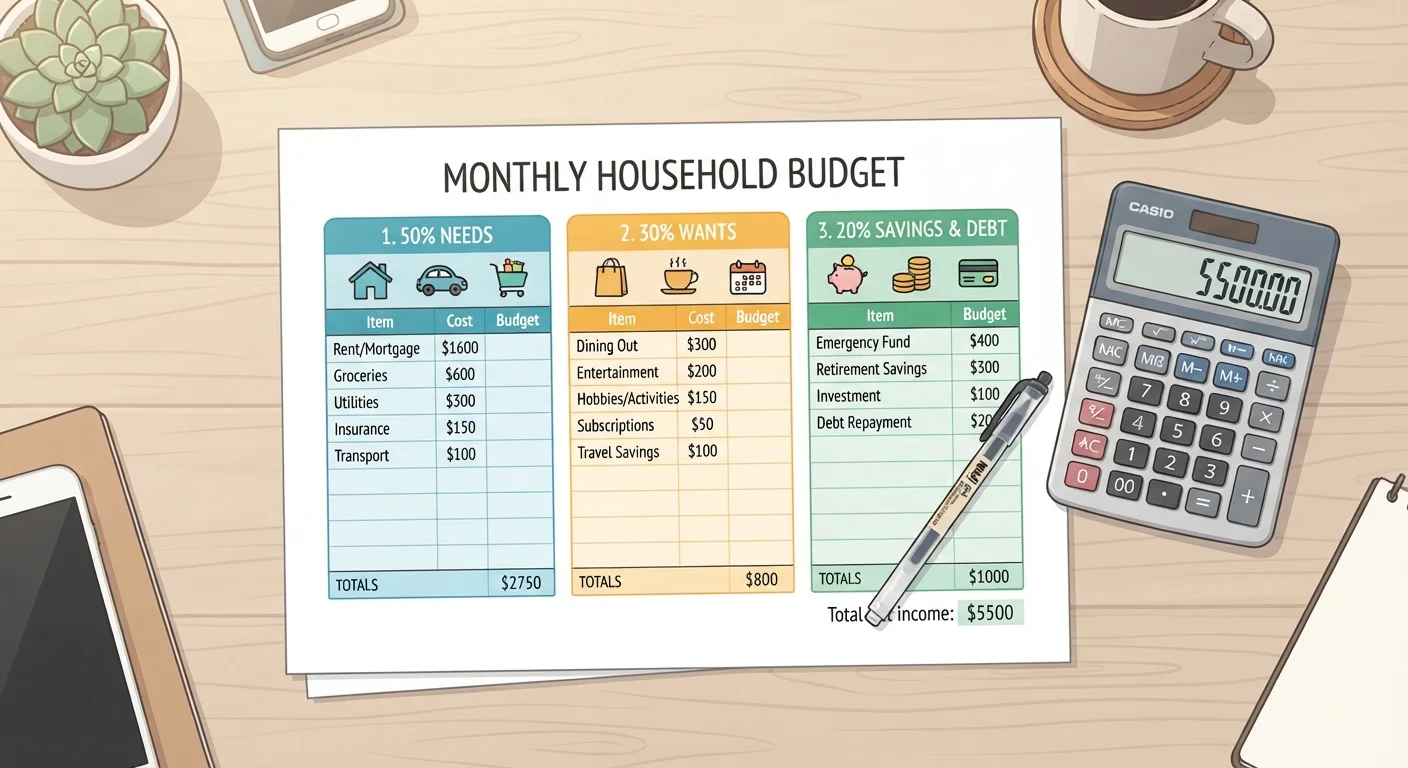
How the Three Buckets Work
The 50/30/20 rule divides your monthly after-tax income across three broad categories. Understanding what belongs in each bucket is more important than memorizing the percentages themselves.
50% - Needs
Needs are expenses you must pay to maintain a basic standard of living and meet financial obligations. This includes rent or mortgage payments, utilities, groceries, health insurance premiums, minimum loan or credit card payments, and essential transportation costs. If skipping an expense would put your housing, health, or employment at risk, it's a need.
30% - Wants
Wants are the discretionary spending that makes life more comfortable or enjoyable but isn't strictly necessary. Dining at restaurants, streaming services, vacations, hobby gear, and clothing beyond the basics all fall here. A car payment can straddle both categories: basic transportation is a need, but a luxury upgrade is a want.
20% - Savings and Debt Repayment
This bucket funds your financial future. It covers emergency fund contributions, retirement account deposits (such as a 401(k) or IRA), and extra payments toward debt beyond the required minimum. Think of this 20% as paying your future self before optional spending erodes what's left. For more on how these buckets fit into a complete financial picture, see The Anatomy of a Household Budget.
50%
Maximum after-tax income for needs
The 50/30/20 framework recommends keeping essential living expenses at or below half of monthly take-home pay.
20%
Minimum directed toward savings and debt
Financial educators generally regard saving or paying down debt with at least 20% of take-home income as a meaningful benchmark for long-term stability.
~30%
Share of Americans with no emergency savings
Surveys conducted by the Federal Reserve and Bankrate have consistently found that a significant share of U.S. households lack sufficient emergency savings, underscoring the importance of the 20% savings target.
Putting the Rule Into Practice
Applying the 50/30/20 rule starts with knowing your actual take-home pay. If your income varies month to month, use a conservative estimate - perhaps the average of your three lowest-earning months in the past year.
From there, calculate each target dollar amount:
- Needs ceiling: Take-home pay × 0.50
- Wants ceiling: Take-home pay × 0.30
- Savings/debt floor: Take-home pay × 0.20
Then track one month of real spending across those categories. Many people discover their needs already exceed 50%, or that wants are quietly consuming money they assumed was going to savings. That honest baseline is where adjustment begins.
Start With One Month of Real Data
Before adjusting your targets, track every dollar you actually spend for a full month and sort each transaction into needs, wants, or savings. Most people are surprised by how much sits in the 'wants' column. One honest month of data is more useful than any estimate you make in advance.
When you're ready to track and manage these categories consistently, it helps to choose a format that suits how you think. Comparing spreadsheets and budgeting apps can help you find the right fit.
When the Rule Needs Adjusting
The 50/30/20 framework is a starting point, not a universal prescription. Several real-world situations make the standard split difficult or inappropriate.
The Rule Works on After-Tax Income Only
Always apply the 50/30/20 percentages to your take-home pay, not your gross salary. If your employer withholds taxes before your paycheck is deposited, your take-home figure is already net of those deductions. Using gross income would make your spending targets look larger than the money you actually have available.
High Housing Costs
In expensive metro areas, rent or mortgage alone can consume 35-45% of take-home pay. In those cases, some households compress the wants category to 15-20% to keep savings intact, rather than letting the 30% wants budget crowd out savings entirely.
Low Income
When income is modest, essential costs may naturally consume 60-70% of take-home pay. The framework still provides direction - spend less than you earn, save what you can - but rigid adherence to the 50% ceiling isn't realistic for everyone.
Aggressive Debt Payoff Goals
If you're working to eliminate high-interest debt quickly, temporarily boosting the 20% bucket to 30% or more by cutting wants is a common and sensible adjustment. The 50/30/20 rule doesn't prohibit this - it simply sets a baseline.
For a side-by-side look at how this framework compares to other approaches like envelope budgeting and zero-based budgeting, see Budgeting Methods Compared.
This article is for general informational and educational purposes only and does not constitute personalized financial advice. Consult a qualified financial professional for guidance specific to your situation.
Frequently Asked Questions
It uses after-tax income - the amount that actually lands in your bank account each pay period. Using gross income would inflate your budgeting baseline and make the percentages inaccurate.
Needs are expenses you genuinely cannot avoid: rent or mortgage, utilities, groceries, minimum debt payments, and basic transportation. Wants are discretionary upgrades or lifestyle choices - dining out, streaming subscriptions, gym memberships, or a newer car than you strictly require.
Yes, but you may want to shift more than 20% toward debt repayment temporarily. The minimum required payments belong in the 'needs' bucket; any extra payments you choose to make go in the 20% savings and debt category. Paying down high-interest debt faster is a common reason households adjust the baseline percentages.
It can work as a directional framework, but the fixed percentages may be harder to hit. People with lower incomes often find that needs consume more than 50% of take-home pay. In that case, focus on the intent - spend less than you earn and save something consistently - rather than hitting exact targets.
Minimum required payments are categorized as needs. Any additional voluntary payments above the minimum belong in the 20% savings and debt bucket alongside retirement savings and emergency fund contributions.
The content on this site is for informational purposes only and is not a substitute for professional advice. Always consult a qualified professional for guidance specific to your situation.