

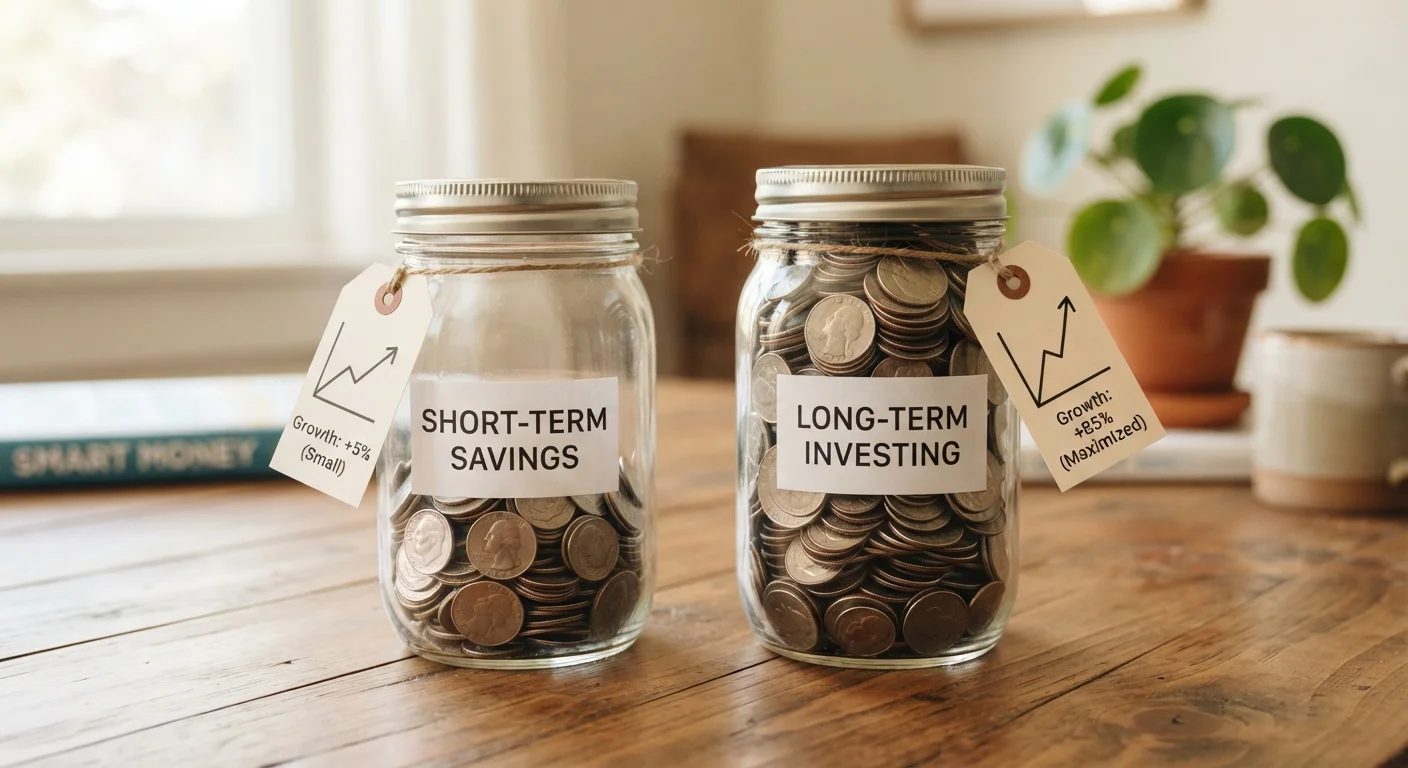
Option A
High-Yield Savings Account
The higher-interest option for dedicated savers.
Best for: Consumers who want to maximize interest earnings on an emergency fund or medium-term savings goal.
Option B
Traditional Savings Account
The familiar, low-barrier account at your local bank.
Best for: Consumers who value branch access, simplicity, and keeping savings alongside their existing checking account.
How Interest Rates Actually Differ
The most significant difference between these two account types is the annual percentage yield (APY) - the rate at which your balance earns interest over a year, including the effect of compounding. For a plain-language breakdown of terms like APY and compound interest, see our Personal Finance Glossary.
Traditional savings accounts at large national banks have historically offered APYs well below 1%, sometimes as low as 0.01%. High-yield savings accounts - most commonly offered by online banks and some credit unions - have frequently offered APYs many times higher, though rates fluctuate with the federal funds rate set by the Federal Reserve.
To put that in practical terms: on a $10,000 balance, a 0.01% APY earns roughly $1 in a year. A 4.50% APY on the same balance earns approximately $450. That gap is meaningful for anyone building an emergency fund or saving toward a specific goal.
0.01%
Typical APY at large national banks
The FDIC publishes average national savings account rates, which have historically hovered near or below 0.10% at many major institutions.
$250,000
FDIC insurance limit per depositor
Both high-yield and traditional savings accounts at FDIC-member banks are insured up to this amount per depositor, per institution.
1-3 days
Typical ACH transfer time to online bank
Cross-institution electronic transfers generally take one to three business days, which can affect access to savings in a pinch.
Side-by-Side Comparison
Beyond interest rates, these accounts differ in a few other practical ways that matter depending on how you manage money day to day.
| Criterion | High-Yield Savings | Traditional Savings |
|---|---|---|
| Typical APY | Often significantly higher (varies with rates) | Often near 0.01%-0.50% |
| Where offered | Primarily online banks, some credit unions | Brick-and-mortar and online banks |
| FDIC/NCUA insured | Yes, up to $250,000 | Yes, up to $250,000 |
| Transfer speed | 1-3 business days (ACH) | Often instant (same institution) |
| Minimum balance | Often $0-$1 to open | Varies; some require $25-$300+ |
| In-person access | Usually none | Widely available |
| Best suited for | Long-term savings, emergency funds | Convenient, all-in-one banking |
One area worth noting: both account types are typically insured by the FDIC (for banks) or the NCUA (for credit unions) up to $250,000 per depositor, per institution. Neither account type carries more deposit risk than the other from an insurance standpoint.
Access, Transfers, and Everyday Use
Traditional savings accounts generally sit within the same institution as your checking account, making internal transfers instant. High-yield savings accounts at online banks often require an ACH transfer (an electronic transfer between financial institutions), which can take one to three business days. That lag matters if you need emergency funds quickly.
Some online banks have addressed this with faster transfer options or partnerships that allow ATM access, but it's worth confirming before opening an account. If you're weighing where your emergency fund should live, our article Emergency Fund vs. Savings Account offers useful framing on how account type intersects with purpose.
Many consumers find a practical middle ground: keeping a small buffer in a traditional savings account for immediate access and routing the bulk of longer-term savings into a high-yield account where it compounds faster.
Watch for Fees That Offset Earnings
Some savings accounts - including high-yield options - charge monthly maintenance fees if your balance drops below a threshold. A monthly fee can quickly cancel out the interest earned, especially on smaller balances. Always review the fee schedule before opening any savings account, and look for accounts that waive fees with a minimum balance or automatic transfer.
Choosing What Fits Your Situation
The better account isn't universal - it depends on your savings behavior and goals. If you tend to dip into savings frequently, the slight friction of a cross-bank transfer can actually work in your favor by reducing impulse withdrawals. Research cited by behavioral economists suggests that mild barriers to accessing money can support savings habits that stick.
If your savings are automated - regular transfers from your paycheck or checking account - a high-yield account is relatively effortless to maintain. Our guide on automating your savings covers how to set that up and what to watch for.
Either way, the most important variable isn't the account type - it's actually saving consistently. As we explore in The Savings Rate Trap, earning more doesn't automatically translate into saving more. A disciplined savings habit in any account outperforms a high-yield account you rarely contribute to.
This article is for general informational purposes only and does not constitute personalized financial advice. Consult a licensed financial professional for guidance tailored to your specific situation.
The content on this site is for informational purposes only and is not a substitute for professional advice. Always consult a qualified professional for guidance specific to your situation.