

Our Verdict
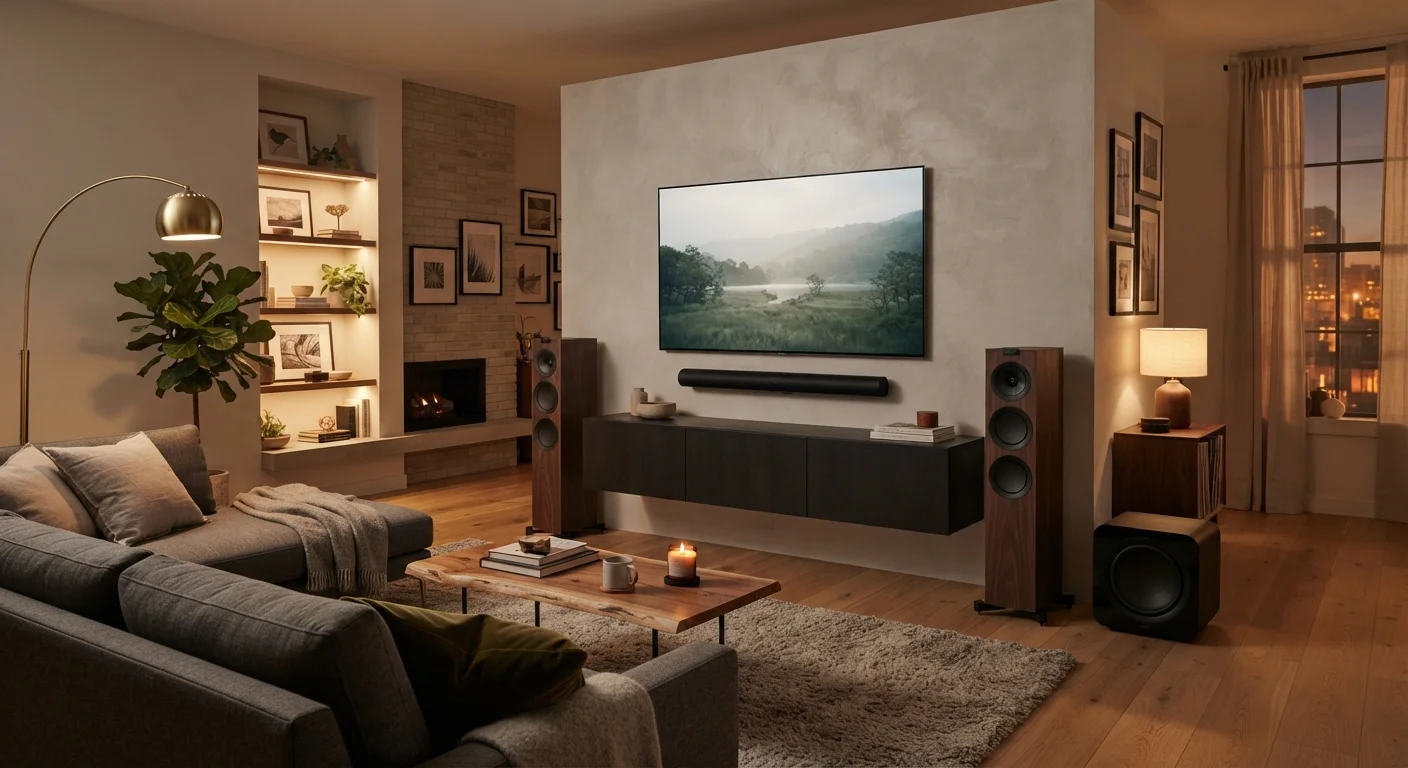
Soundbars win on convenience, aesthetics, and ease of setup - making them the practical choice for most everyday households. Dedicated surround sound systems, however, remain the standard for serious home theater enthusiasts who want genuinely immersive audio and have the space and patience to set one up properly. Neither is a wrong choice; they serve different needs.
| Best for | Recommended |
|---|---|
| Renters, smaller rooms, or those wanting a simple upgrade from TV speakers | Soundbar |
| Dedicated home theater rooms or listeners who prioritize audio immersion | Surround Sound System |
| Households with limited time or technical comfort for complex setup | Soundbar |
| Movie enthusiasts wanting discrete, positional sound from multiple directions | Surround Sound System |
What Each Setup Actually Is
A soundbar is a single, elongated speaker enclosure that typically sits below your TV. It houses multiple drivers - the internal components that produce sound - arranged to simulate directional audio without requiring multiple separate speakers. Many soundbars include a separate wireless subwoofer for low-frequency bass.
A surround sound system - often called a home theater system - uses multiple discrete speakers placed around the room. A typical 5.1 configuration includes front-left, center, and front-right speakers, two rear surround speakers, and a subwoofer. More advanced setups (like 7.1 or Dolby Atmos-enabled 5.1.2 systems) add overhead or height channels. These speakers connect to an AV receiver, which acts as the system's brain. If you're new to these terms, our home theater jargon glossary breaks them all down in plain English.
How They Compare Across Key Factors
The decision between these two approaches touches on several practical dimensions - not just sound quality. Here's how they stack up across the criteria that matter most to everyday consumers.
| Soundbar | Surround Sound System | |
|---|---|---|
| Setup complexity | Low - typically one cable | High - multiple speakers, wiring, receiver |
| Space required | Minimal - sits below TV | Significant - speakers placed around room |
| Audio immersion | Simulated surround via psychoacoustics | True discrete directional channels |
| Dolby Atmos support | Many models support it | Full support with compatible receiver |
| Upgrade flexibility | Limited - mostly replace the unit | High - swap individual components |
| Aesthetic impact | Clean, minimal, low-profile | Multiple units visible throughout room |
| Ideal room size | Small to medium | Medium to large |
For a deeper foundation on what speakers, receivers, and wiring actually involve before committing to a full system, the home audio introduction guide is a useful starting point.
Room Size and Placement Reality
Room dimensions significantly shape which system performs well. Soundbars are engineered to work in a wide range of room sizes without precise speaker positioning. They're particularly effective in open-plan layouts, bedrooms, or living rooms where running speaker wire or placing rear speakers simply isn't practical.
Surround sound systems shine when you can actually position speakers at the correct angles relative to your primary listening spot. In a small room, rear speakers placed too close together can sound cluttered rather than immersive. In a large room, a soundbar may not fill the space convincingly. If your room is on the compact side, our article on setting up a home theater in a small room covers what actually works when square footage is limited.
Measure Before You Commit
Before choosing either setup, sketch your room layout and note where your primary seating is relative to your TV. For surround sound, rear speakers should ideally sit at approximately ear height when seated, roughly 90-110 degrees to the side. If that placement isn't physically achievable, a soundbar may actually deliver a more consistent result in your specific space.
Audio Quality: What the Trade-offs Really Mean
Soundbars have improved considerably - many now support Dolby Atmos and DTS:X, the leading object-based surround formats that create the sense of sound moving in three dimensions. However, the spatial effect in a soundbar is produced through psychoacoustics - engineering that tricks the brain into perceiving directional sound from a single source. The effect is convincing for casual viewing but doesn't replicate true discrete surround channels.
A well-configured surround sound system with properly placed speakers produces genuinely directional audio. When sound is mixed to come from a rear channel, it physically comes from a speaker behind you. This is a meaningful difference for film enthusiasts, gamers, or anyone watching content with active surround-sound mixing. That said, a poorly placed or mismatched speaker system can underperform a good soundbar, so setup matters enormously.
5.1
Standard surround sound channel configuration
A 5.1 system uses five speakers and one subwoofer - the baseline configuration for most home theater setups and the standard against which soundbars are compared.
~30 min
Typical soundbar setup time
Most soundbars connect via a single HDMI ARC or optical cable, making the full setup process significantly faster than a multi-speaker surround system.
Setup, Wiring, and Long-Term Flexibility
Soundbars are among the most straightforward audio upgrades available. Most connect to a TV via a single HDMI ARC or optical cable. Setup typically takes under 30 minutes. Because they're self-contained, they're also easy to move if you relocate.
Surround sound systems involve considerably more planning: running speaker wire (or managing wireless rear speaker kits), positioning each speaker correctly, calibrating the AV receiver to your room's acoustics, and managing the visual clutter of multiple components. Many receivers include automatic calibration tools that help, but the process is still meaningfully more involved. The payoff is greater flexibility over time - you can upgrade individual speakers, add components, or expand the system as your needs evolve. For context on how audio fits into a broader home electronics setup, see the complete home electronics overview.
The content on this site is for informational purposes only and is not a substitute for professional advice. Always consult a qualified professional for guidance specific to your situation.