

Separating Evidence from Garden Folklore
Companion planting has been practiced for centuries, and that long history is both its strength and its complication. Some pairings have been validated through agricultural research; many others persist simply because they've been repeated so often they feel like fact. If you're just getting started in the garden, it helps to know which advice is grounded and which deserves healthy skepticism.
The core challenge is that gardens are complex systems. A pairing that reduces aphids in one region may show no effect in another, because pest populations, soil biology, climate, and plant varieties all interact. That doesn't mean companion planting is useless - it means evaluating it with the same critical eye you'd apply to any gardening claim. Our article on garden myths experienced growers have stopped believing covers similar ground on separating plant folklore from practice.
Why Garden Research Is Hard to Generalize
Many companion planting studies are conducted under controlled conditions that differ significantly from typical home gardens. Soil biology, regional pest species, climate, and plant cultivars all affect outcomes. A pairing with positive results in one trial may not translate directly to your backyard. Use published findings as a useful starting point, not a guarantee.
Pairings With Meaningful Support
The Three Sisters (corn, beans, squash): This is among the best-documented companion systems. Used for generations by Indigenous peoples of North America, it works on multiple levels: pole beans climb corn stalks, fix atmospheric nitrogen into the soil, and squash leaves provide dense ground cover that suppresses weeds and slows moisture loss. Agricultural researchers have studied this system and generally confirm its productivity advantages over monoculture planting.
Legumes as nitrogen fixers: This is not folklore - it's well-established plant science. Legumes (beans, peas, clover) form a symbiotic relationship with Rhizobium bacteria in the soil, converting atmospheric nitrogen into a form nearby plants can eventually access. Pairing legumes thoughtfully in your rotation or garden layout is a practical, evidence-backed way to reduce the need for supplemental nitrogen fertilizer. Healthy soil management underpins this benefit; see soil amendment approaches that make a real difference for related guidance.
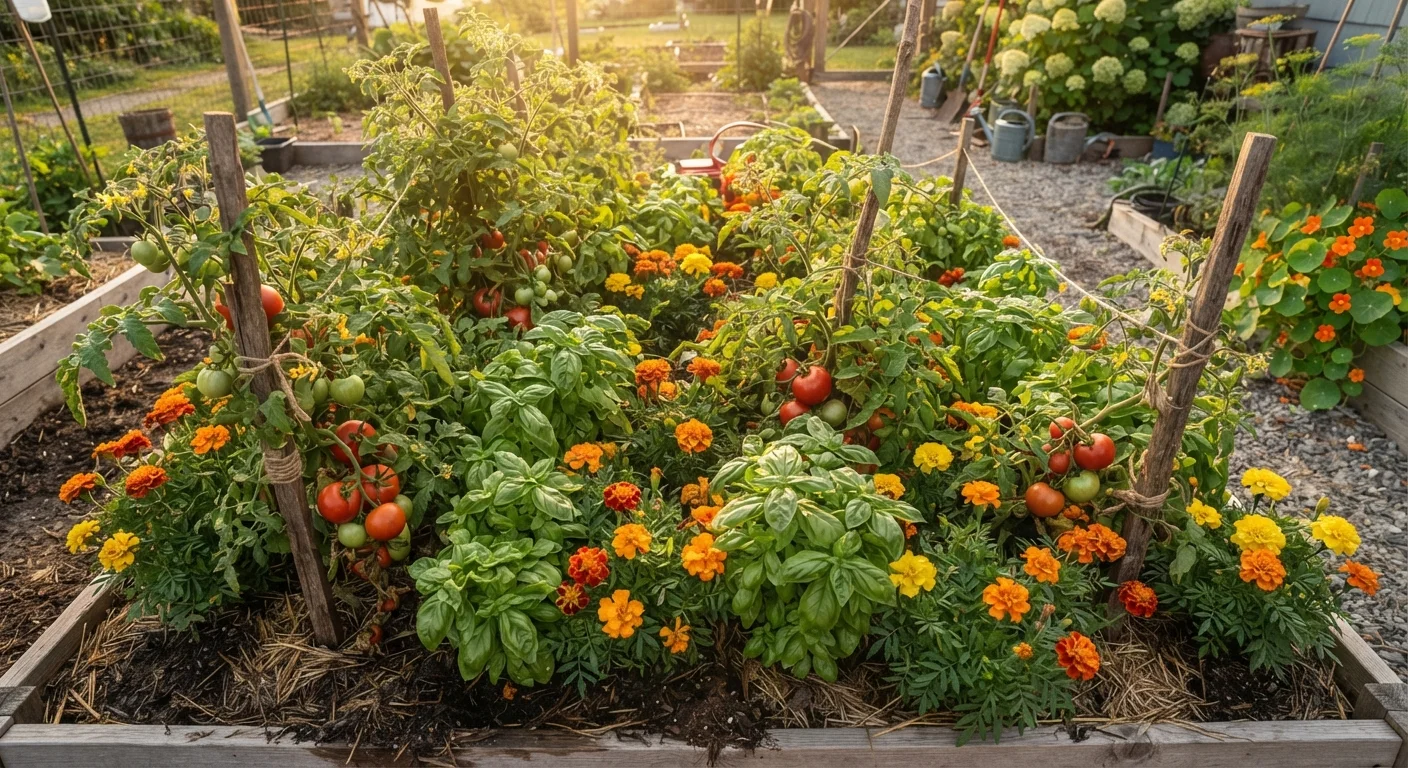
French marigolds near susceptible crops: Research - particularly studies on Tagetes patula - shows that dense plantings can suppress root-knot nematodes in the soil. This works best when marigolds are planted thickly and left in place long enough to affect the soil environment. Scattered, sparse marigolds are unlikely to produce the same results.
Get the Density Right With Marigolds
For marigolds to have a meaningful effect on soil nematodes, they need to be planted thickly - not just as occasional border accents. Aim to plant them as a solid mass in affected beds and leave them in the ground through the end of the season. A few scattered plants are unlikely to produce the same benefit seen in research settings.
Popular Pairings With Limited Evidence
Basil and tomatoes: This is perhaps the most famous companion pairing in home gardening. The claim is that basil repels tomato hornworms and whiteflies. Controlled research has not consistently shown significant pest deterrence. That said, basil grows well in the same conditions as tomatoes, uses space efficiently, and poses no competitive harm - so it remains a sensible spatial choice even if the pest-control benefits are overstated.
Nasturtiums as trap crops: Nasturtiums are often recommended as aphid decoys - the idea being that aphids prefer them and leave other plants alone. Some gardeners find this useful; studies are mixed on whether it reliably protects neighboring crops or simply adds more aphids to the garden. If you try it, monitor closely rather than assuming protection.
Garlic deterring pests: Garlic's strong scent is widely claimed to repel a range of insects. Evidence from controlled trials is inconsistent. Garlic does contain compounds that have pesticidal properties in laboratory settings, but field results in home gardens are variable and context-dependent.
~80%
Nitrogen from biological fixation in legumes
Research in agroecology consistently shows legumes can meet the majority of their own nitrogen needs through symbiosis with Rhizobium bacteria, reducing reliance on synthetic inputs.
2-3 seasons
Time for dense marigolds to suppress nematodes
Studies on French marigold (Tagetes patula) suggest sustained, dense plantings across multiple growing seasons are needed for meaningful nematode reduction in garden soil.
Plants That Can Harm Their Neighbors
Companion planting isn't just about beneficial pairings - knowing what to keep apart matters equally. Fennel is one of the most notable garden antagonists. It releases compounds that can inhibit the growth of tomatoes, peppers, eggplant, and many other vegetables. Most experienced gardeners plant fennel in an isolated spot or a separate container.
Black walnut trees produce a compound called juglone, which is toxic to a wide range of plants including tomatoes, peppers, apples, and blueberries. If your yard includes a black walnut, the root zone and areas where leaves and husks fall require careful plant selection.
Brassicas (cabbage, broccoli, kale) and strawberries are also commonly cited as poor companions, with some evidence suggesting mutual growth inhibition. Whether you're working with raised beds or in-ground planting, planning around these antagonists is worthwhile.
How to Apply This in Your Garden
The most practical approach to companion planting is treating it as a low-cost experiment rather than a guaranteed system. Start with a few well-supported pairings - legumes near heavy feeders, marigolds planted densely in nematode-prone beds - and observe results over a season or two. Keep simple notes on what you planted where and what outcomes you noticed.
Avoid reorganizing your entire garden around companion planting claims you haven't tested. Fundamentals like healthy soil, appropriate watering, and good plant spacing will always matter more than any single pairing. Native flowering plants can also support beneficial insects in ways that complement companion strategies - see the case for native plants in a home garden for that perspective.
Companion planting is a useful part of the gardener's toolkit. Approached with realistic expectations, it can contribute to a more resilient, diverse garden - especially when paired with everything else you know about how your specific soil, climate, and local pest population behaves.
“The challenge with companion planting research is that positive results in one setting are often difficult to replicate in another. The garden system is too variable for simple rules, but some combinations do hold up - and those are worth knowing.”
— Extension Horticulture Specialist, University cooperative extension program, vegetable production research
Frequently Asked Questions
Some pairings have solid evidence - like legumes fixing nitrogen or marigolds suppressing soil nematodes. Others are largely anecdotal. Companion planting can be a useful tool, but it's best treated as one layer of good garden practice, not a guaranteed solution.
The Three Sisters is a traditional Indigenous growing system pairing corn, beans, and squash together. Corn provides a climbing structure for beans, beans fix nitrogen into the soil, and squash leaves shade the ground to suppress weeds and retain moisture. Research generally supports its productivity benefits.
French marigolds (Tagetes patula) have shown measurable ability to suppress root-knot nematodes in soil when planted densely. Their effect on above-ground insect pests is less consistent, and results depend heavily on planting density, species, and local pest populations.
This is one of the most popular pairings, but scientific evidence is limited. Some gardeners report benefits; controlled studies have not consistently demonstrated significant pest reduction. Basil is still a worthwhile neighbor - it uses space efficiently and won't harm tomatoes.
Companion planting alone is unlikely to eliminate pest problems. It can reduce pressure from certain pests and support beneficial insects, but works best as part of a broader approach that includes healthy soil, crop rotation, and physical barriers where needed.
Some plants compete or inhibit each other. Fennel is notably allelopathic and can suppress tomatoes, peppers, and beans planted nearby. Black walnut trees release juglone, which is toxic to many plants. It's worth researching known antagonists before placing plants.
The content on this site is for informational purposes only and is not a substitute for professional advice. Always consult a qualified professional for guidance specific to your situation.