

Our Verdict
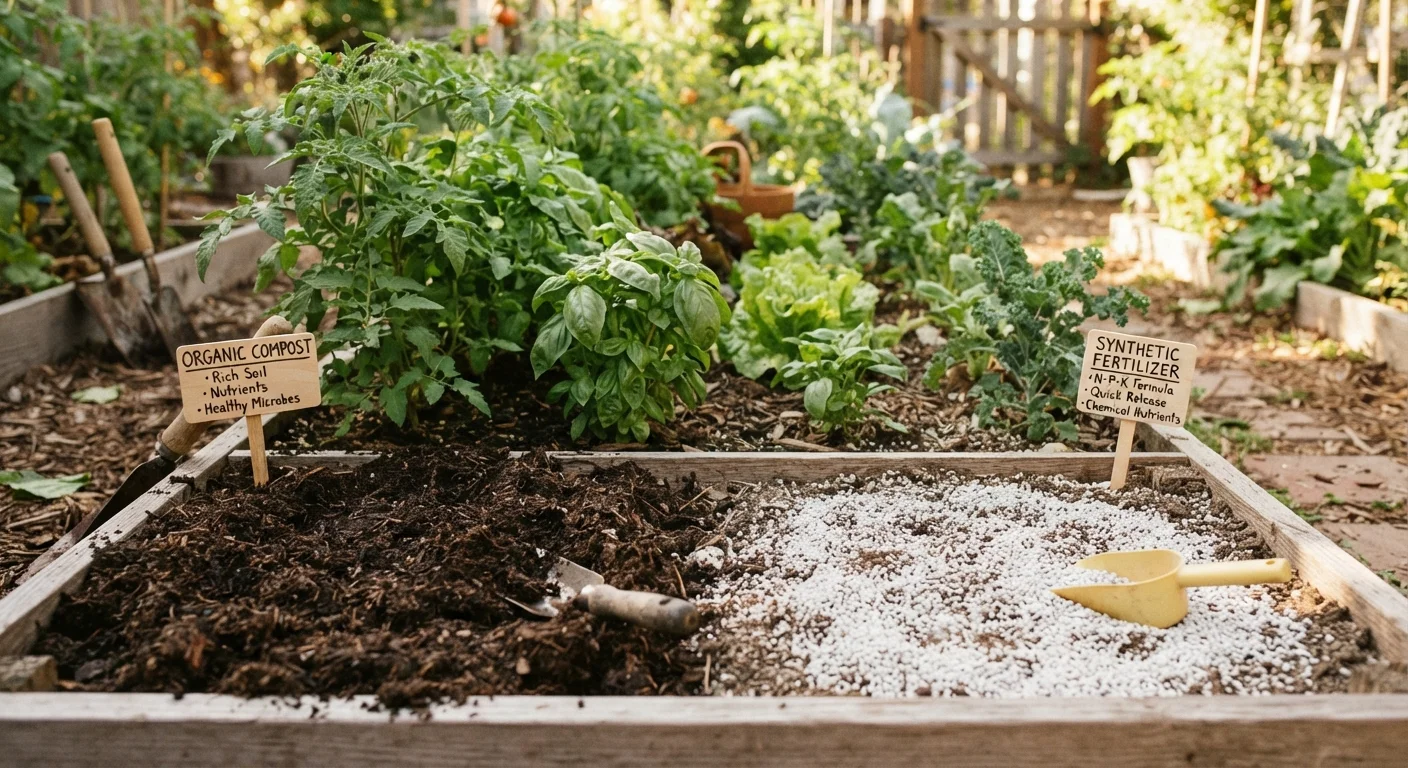
Organic fertilizers build healthier soil over seasons, making them a strong long-term choice for most home gardens. Synthetic fertilizers offer speed and precision that's hard to match when plants need a quick nutrient boost. Understanding how each one works helps you use them intentionally rather than relying on habit or marketing.
| Best for | Recommended |
|---|---|
| Long-term soil health and sustainability | Organic fertilizers |
| Fast correction of specific nutrient deficiencies | Synthetic fertilizers |
| New or depleted garden beds needing a foundation | Organic fertilizers |
| Established gardens balancing speed and biology | A combination approach |
How Each Type Actually Works
The core difference between organic and synthetic fertilizers isn't just ingredients - it's the mechanism of delivery. Understanding this helps you apply whichever you choose at the right time, in the right way.
Organic fertilizers - such as compost, bone meal, blood meal, kelp, and worm castings - are derived from plant or animal materials. They don't feed plants directly. Instead, soil microorganisms break down organic matter into forms plants can absorb. This biological process takes time, which means nutrients are released gradually over weeks or even months.
Synthetic fertilizers are manufactured to deliver specific ratios of nitrogen (N), phosphorus (P), and potassium (K) - the three macronutrients shown on every fertilizer label. Because these nutrients are already in a water-soluble form, plant roots can absorb them almost immediately after application.
Your soil type plays a big role in how either fertilizer performs. Sandy soils drain quickly, which increases the risk of synthetic nutrients leaching away before plants can use them. Clay soils hold nutrients longer but can also become compacted over time - an area where organic matter genuinely helps.
| Organic Fertilizers | Synthetic Fertilizers | |
|---|---|---|
| Nutrient release speed | Slow - weeks to months | Fast - hours to days |
| Soil biology impact | Feeds and builds microbial life | Minimal direct benefit to microbes |
| Risk of plant burn | Low with proper composting | Higher if overapplied |
| Nutrient precision | Variable, harder to control | Highly precise ratios |
| Runoff and leaching risk | Generally lower | Higher, especially pre-rain |
| Long-term soil structure | Improves over time | Does not improve structure |
| Cost per application | Often higher upfront | Generally lower upfront |
The Long-Term Soil Health Picture
One of the most important distinctions between these two approaches shows up not in a single season but over years of gardening.
Organic fertilizers do more than supply nutrients - they feed the living ecosystem in your soil. Beneficial bacteria, fungi, earthworms, and other organisms thrive when organic matter is regularly added. These organisms improve soil structure, water retention, and the natural cycling of nutrients. Over time, consistent organic inputs can transform thin or depleted soil into something genuinely productive.
Synthetic fertilizers, by contrast, are nutrient-delivery tools, not soil builders. Used alone over many seasons, they don't replenish organic matter, support microbial populations, or improve texture. Some research suggests that heavy reliance on high-nitrogen synthetics can gradually reduce microbial diversity in soil, though results vary by product, rate, and soil type.
Combine Both for Seasonal Balance
A practical approach many gardeners use: apply organic fertilizers or compost in early spring to feed soil biology as temperatures rise, then use a targeted synthetic product mid-season if plants show signs of a specific deficiency. This hybrid method captures the long-term benefits of organics while keeping the fast-response option available when needed.
This doesn't make synthetic fertilizers harmful by default. Applied at appropriate rates and timed correctly, they're a legitimate horticultural tool. The concern arises mainly from overuse or sole reliance without any organic inputs alongside them.
For gardeners working to improve their soil foundation, our guide on soil amendment approaches covers how organic matter works alongside fertilization as part of a broader strategy.
Speed, Precision, and Practical Trade-Offs
Speed is synthetic fertilizers' biggest practical advantage. If a nitrogen deficiency is causing yellowing leaves mid-season, a water-soluble synthetic product can deliver results within days. Organic options simply can't match that timeline - the microbial breakdown process isn't something you can rush.
Precision is another strength. Synthetic fertilizers come in formulas tailored to specific plants, growth stages, or nutrient needs. You can choose a high-phosphorus blend for root development or a balanced formula for general feeding with a level of specificity that organic products rarely offer.
More Is Not Better With Synthetics
Applying synthetic fertilizer above recommended rates doesn't speed up plant growth - it raises salt concentration in the soil, which draws water out of roots through osmosis. This causes fertilizer burn: brown leaf tips, wilting, and in severe cases, plant death. Always follow label instructions and err on the side of less when uncertain.
On the organic side, the trade-off for slower release is more forgiving application. It's difficult to burn plants with well-composted organic fertilizer, whereas synthetic products - especially high-nitrogen formulas applied too heavily - can cause fertilizer burn, damaging roots and foliage. Precision cuts both ways.
Synthetic fertilizers also carry a higher risk of nutrient runoff into waterways when overapplied or applied before heavy rain. This is a genuine environmental consideration, particularly in regions near streams or with heavy rainfall patterns.
Good fertilizer practice pairs well with smart watering habits. Our article on watering deeply vs. watering often explains how irrigation patterns affect how nutrients move through your soil.
Choosing an Approach for Your Garden
Most gardeners benefit from thinking of organic and synthetic fertilizers as complementary tools rather than competing philosophies. Here's a practical framework:
- New or depleted beds: Prioritize organic inputs - compost, aged manure, or organic slow-release fertilizers - to build microbial life and structure before anything else.
- Established vegetable gardens: A base of organic matter plus targeted synthetic feeding during heavy-producing periods (like fruiting or heading) can deliver both long-term health and peak-season performance.
- Lawns: Slow-release synthetic fertilizers are widely used and generally effective, but supplementing with organic top-dressing annually supports the soil beneath the turf.
- Container plants: Synthetics work well here because containers lack the microbial ecosystem that makes organics shine; organic liquid fertilizers are a middle-ground option.
Whatever approach you choose, a soil test is the most useful starting point. It tells you what your soil actually contains - not what you assume it needs - and helps you avoid over-fertilizing, which wastes money and can harm plants. For gardeners deciding how to set up their growing space in the first place, raised beds vs. in-ground planting is worth reading alongside fertilizer strategy.
The content on this site is for informational purposes only and is not a substitute for professional advice. Always consult a qualified professional for guidance specific to your situation.